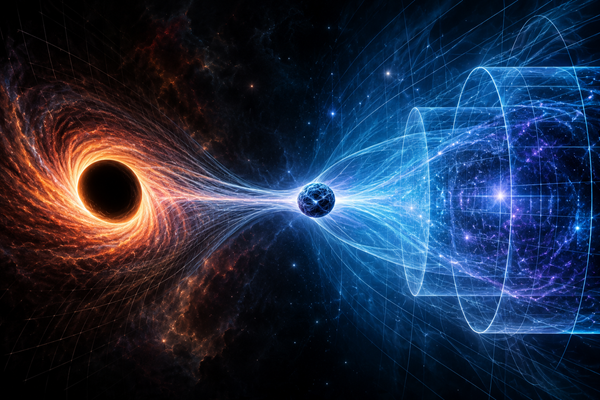
The Black Hole Information Paradox May Finally Have an Answer—And It Leads Beyond Four Dimensions
For decades, one of the deepest mysteries in modern physics has challenged some of the greatest scientific minds. What really happens to information when a black hole evaporates? Does information disappear forever, violating the fundamental laws of quantum mechanics? Or could nature be hiding a deeper layer of reality that physicists have not yet fully understood?
A new theoretical study may offer one of the most intriguing answers proposed in recent years. By combining higher-dimensional geometry, spacetime torsion, black hole physics, and the origin of particle mass, researchers have developed a framework that could reshape our understanding of the universe itself.
More importantly, the theory suggests something remarkable: black holes may never completely disappear.
If true, this idea could solve the famous Black Hole Information Paradox while simultaneously shedding light on one of particle physics’ most puzzling questions—the origin of mass.
But could the solution to two of science’s greatest mysteries really emerge from a hidden seven-dimensional structure of reality?
Black Hole Information Paradox: Why Does Information Loss Terrify Physicists?
Black holes have fascinated scientists and the public alike for decades. They represent regions of spacetime where gravity becomes so powerful that nothing—not even light—can escape once it crosses the event horizon.
For many years, physicists believed black holes simply swallowed matter and energy forever. However, that assumption changed dramatically during the nineteen seventies when physicist Stephen Hawking demonstrated that black holes are not entirely black.
Through groundbreaking calculations that combined quantum theory and general relativity, Hawking discovered that black holes emit a faint form of radiation now known as Hawking Radiation.
This revelation transformed our understanding of black holes.
Yet it also created a profound problem.
As Hawking Radiation carries energy away, a black hole slowly loses mass. Eventually, according to the standard model, the black hole should evaporate completely.
But here is the dilemma.
Everything that falls into a black hole contains information. Quantum mechanics states that information cannot be destroyed. The principle of unitarity requires that information must always remain preserved in some form.
If a black hole evaporates entirely, where does that information go?
Does it vanish?
Does it somehow escape?
Or does our understanding of physics break down at the edge of a black hole?
This contradiction became known as the Black Hole Information Paradox, and it remains one of the most important unresolved questions in theoretical physics.
Seven-Dimensional Geometry and Black Hole Physics: A Radical New Approach
A recently published study in General Relativity and Gravitation, led by Richard Pinčák and collaborators, introduces an unconventional but mathematically sophisticated solution.
Rather than modifying quantum mechanics, the researchers explore the possibility that spacetime possesses hidden dimensions beyond the familiar three dimensions of space and one dimension of time.
Their model employs Einstein-Cartan Theory, an extension of Einstein’s General Relativity.
Unlike conventional spacetime, Einstein-Cartan Theory allows spacetime not only to curve but also to twist.
Physicists refer to this twisting property as torsion.
To investigate the consequences of torsion, the team constructed a seven-dimensional geometric framework based on a mathematical object known as a G-two manifold.
Although these concepts may sound highly abstract, they lead to surprisingly concrete predictions.
At extremely high densities near the Planck scale, spacetime torsion generates a repulsive effect that counteracts gravitational collapse.
Consequently, the final stages of black hole evaporation change dramatically.
Instead of shrinking into nothingness, the black hole reaches a stable endpoint.
This stable object remains as a permanent remnant.
Could this remnant hold the key to preserving information?
How Spacetime Torsion Could Prevent Complete Black Hole Evaporation
Under traditional Hawking evaporation scenarios, black holes eventually disappear.
However, the new model predicts a different outcome.
As the black hole becomes increasingly small, torsion effects strengthen dramatically. Eventually, these effects oppose further collapse and prevent total evaporation.
As a result, the black hole stabilizes into an ultra-small remnant with a predicted mass of approximately nine times ten to the power of negative forty-one kilograms.
While incredibly tiny, this object would not vanish.
Instead, it could survive indefinitely.
This prediction changes the entire discussion surrounding black hole information.
After all, if the black hole never completely disappears, perhaps the information never disappears either.
Could the paradox simply arise because physicists assumed black holes evaporate all the way to nothing?
The new theory suggests exactly that.
Black Hole Remnants as Quantum Information Storage Systems
The most fascinating aspect of the study involves information preservation.
According to the researchers, the stable remnant functions as a form of quantum memory archive.
Information does not escape through Hawking Radiation in a conventional way. Instead, it becomes encoded within persistent oscillations of the torsion field.
Physicists describe these oscillations as quasi-normal modes.
These modes can be thought of as long-lasting vibrational patterns that carry information about everything that previously entered the black hole.
In essence, the remnant becomes a cosmic storage device.
The team’s calculations suggest that a remnant formed from a black hole with approximately the mass of the Sun could preserve roughly one point five one five times ten to the power of seventy-seven qubits of information.
That number is staggering.
It represents an amount of information far beyond anything humanity could currently store or process.
If these calculations prove correct, the black hole information paradox may not require a radical revision of quantum mechanics at all.
Instead, information may simply remain hidden within structures that physicists have not yet observed.
Seven-Dimensional Space and the Origin of Particle Mass
Perhaps even more surprising is the theory’s connection to particle physics.
The same geometric framework that prevents complete black hole evaporation also appears capable of explaining the electroweak scale.
This scale plays a crucial role in the Standard Model of particle physics because it is directly associated with the Higgs field.
The Higgs field gives elementary particles their mass.
Yet physicists still do not fully understand why the electroweak scale possesses its observed value.
This puzzle is known as the mass hierarchy problem.
Remarkably, the researchers found that reducing their seven-dimensional geometry to the familiar four-dimensional universe naturally produces an energy scale close to two hundred forty-six gigaelectronvolts.
This value closely matches the electroweak scale observed in nature.
In the model, the vacuum expectation value of the torsion field becomes dynamically linked to the Higgs mechanism.
Could mass itself emerge from the geometry of hidden dimensions?
If so, one elegant mathematical framework may simultaneously explain both black hole information preservation and the origin of particle masses.
Why Have Scientists Never Observed These Extra Dimensions?
Naturally, a critical question arises.
If additional dimensions exist, why has nobody detected them?
The researchers argue that the answer lies in energy.
The particles associated with these hidden dimensions, called Kaluza-Klein excitations, are predicted to possess masses around eight point six times ten to the power of fifteen gigaelectronvolts.
This energy scale exceeds the capabilities of the Large Hadron Collider by roughly seven orders of magnitude.
Current particle accelerators simply cannot reach such extreme energies.
However, lack of direct detection does not necessarily invalidate the theory.
Many accepted physical models predict phenomena that remain beyond current technological capabilities.
The real question is whether indirect evidence can be found.
Fortunately, the theory offers several opportunities for observational testing.
Dark Matter, Primordial Gravitational Waves, and Observable Predictions
Unlike many speculative theories, this framework produces specific predictions.
One possibility involves dark matter.
Astronomers know that most matter in the universe remains invisible. Yet they still do not know what dark matter actually consists of.
The proposed black hole remnants could contribute to this missing mass.
If future observations detect gravitational signatures consistent with Planck-scale relics, support for the theory would grow considerably.
The theory also predicts possible traces within the early universe.
Because the relevant energy scales existed shortly after the Big Bang, signatures of seven-dimensional geometry may be preserved in the Cosmic Microwave Background.
Likewise, primordial gravitational waves could contain clues about the universe’s hidden geometric structure.
Future generations of detectors may reveal whether such fingerprints truly exist.
Could the earliest moments of cosmic history already contain evidence of extra dimensions?
The answer remains unknown—but the possibility is profoundly exciting.
Could a Seven-Dimensional Universe Solve Multiple Physics Mysteries at Once?
Scientific breakthroughs often emerge when seemingly unrelated puzzles reveal a common origin.
This new framework attempts exactly that.
Rather than treating black hole evaporation, quantum information, particle masses, dark matter, and higher-dimensional geometry as separate problems, it links them within a single mathematical structure.
The implications are extraordinary.
If the theory survives future scrutiny, black holes may no longer represent places where information disappears. Instead, they could become cosmic archives that preserve information indefinitely.
Furthermore, the same geometric mechanisms responsible for preserving information may also help explain why particles possess mass at all.
Of course, much work remains.
The model must undergo extensive mathematical analysis, independent verification, and observational testing. As with every major theoretical proposal, skepticism remains essential.
Nevertheless, the study offers a fascinating possibility.
What if the universe is not fundamentally four-dimensional?
What if hidden dimensions quietly shape everything from black holes to elementary particles?
And what if the solution to one of physics’ greatest paradoxes has been embedded within the geometry of spacetime all along?
For now, those questions remain unanswered.
Yet they may point toward a deeper understanding of reality—one that stretches beyond the dimensions we currently perceive and into a far richer cosmic architecture waiting to be discovered.
Source: The Black Hole Information Paradox May Finally Have an Answer—And It Leads Beyond Four Dimensions
Mars Was Never Supposed to Do This… So Why Is Its Atmosphere Acting Like a Giant Shield?
Mars Was Never Supposed to Do This… So Why Is Its Atmosphere Acting Like a Giant Shield?
Sources
Pinčák, Richard et al., General Relativity and Gravitation (Seven-Dimensional Einstein-Cartan Framework and Black Hole Remnants).
Stephen Hawking, foundational work on Hawking Radiation and Black Hole Evaporation.
Einstein-Cartan Theory literature on spacetime torsion and gravitational physics.
Research on G-two manifolds and higher-dimensional geometry in theoretical physics.
Standard Model and Higgs Field studies concerning the electroweak scale and mass hierarchy problem.