The smallest particle accelerator just fired up, and it opens up a world of possibilities
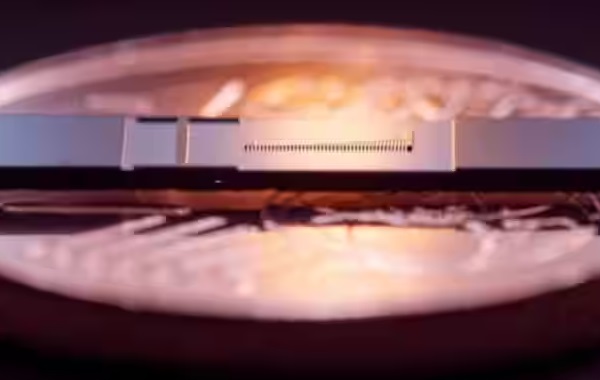
Scientists recently fired up the world’s smallest particle accelerator, Nanophotonic electron accelerator (NEA). This tiny technological win could open the possibilities of a wide range of applications.
The main acceleration tube of the NEA is approximately 0.02 inches long, which is 54 million times shorter than the 16.8-mile-long (27 kilometres) ring that makes up CERN’s Large Hadron Collider (LHC) in Switzerland. This is the world’s largest and most powerful particle accelerator.
The main goal of creating these accelerators is to utilise the energy given by the accelerated electrons in targeted medical treatments that can replace more damaging forms of radiotherapy, which is used to kill cancer cells.
A nanophotonic electron accelerator consists of a small microchip that houses an even smaller vacuum tube, which is made up of thousands of individual “pillars.”
The world’s largest and most potent particle accelerator, the Large Hadron Collider (LHC) at CERN in Switzerland, has discovered a range of new particles, including the Higgs Boson (or God particle), ghostly neutrinos, the charm meson and the mysterious X particle.
In a recent study that was published on October 18 in the journal Nature, researchers from the Friedrich-Alexander University of Erlangen-Nuremberg (FAU) in Germany used the tiny device to accelerate electrons from an energy value of 28.4 kiloelectron volts to 40.7 keV, which is an increase of almost 43%.
Since the nanophotonic electron accelerator’s initial proposal in 2015, the researchers have successfully fired a nanophotonic electron accelerator for the first time, they said in a statement. The accomplishment was already repeated by Stanford University researchers using their tiny accelerator, although their findings are still being evaluated.
“For the first time, we really can speak about a particle accelerator on a [micro]chip,” study co-author Roy Shiloh, a physicist at FAU, said in the statement.
How LHC and NEA work
Both LHC and NEA create a magnetic field to accelerate particles. However, LHC uses more than 9,000 magnets to create magnetic fields, that accelerate particles to around 99.9% of the speed of light, and NEA works by firing light beams at the pillars in the vacuum tube. This amplifies the energy in just the right way, although the resulting energy field is much weaker. The electrons accelerated by the NEA only have around a millionth of the energy that particles accelerated by the LHC have.
Researchers believe that they can improve the NEA’s design by using alternative materials or stacking multiple tubes next to one another, which could further accelerate the particles.
“The dream application would be to place a particle accelerator on an endoscope in order to be able to administer radiotherapy directly at the affected area within the body,” study lead author Tomáš Chlouba, a physicist at FAU, wrote in the statement. But this is still a long way off, he added.
Source: wionews
350-Year-Old Theorem Reveals ‘Profound’ Connection Between Properties of Light
350-Year-Old Theorem Reveals ‘Profound’ Connection Between Properties of Light
The smallest particle accelerator just fired up, and it opens up a world of possibilities