The Seven-Million-Year-Old Secret That May Have Changed Human History: Did Upright Walking Begin Much Earlier Than We Thought?
A Seven-Million-Year-Old Hominin Discovery That Could Rewrite Human Evolution
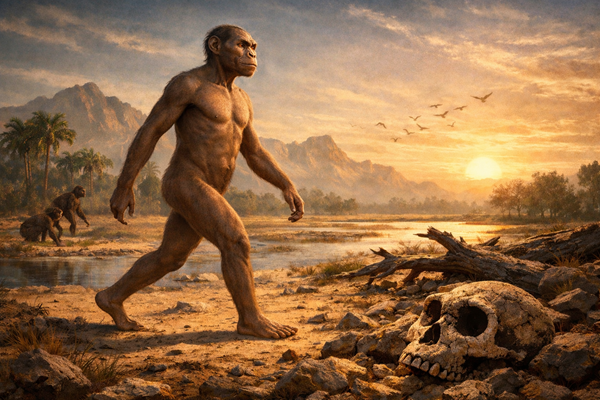
A mysterious seven-million-year-old ape fossil may represent the earliest known hominin to walk on two legs, challenging long-held assumptions about when and how bipedalism emerged. Discovered in the Sahara region decades ago, this ancient species—Sahelanthropus tchadensis—has once again become the focus of scientific debate due to new, compelling evidence.
From the outset, the fossil resisted easy classification. Researchers questioned whether it belonged to the lineage of modern apes like chimpanzees and gorillas or whether it stood closer to humans. Now, modern analytical techniques are offering clearer answers—and raising deeper questions about our origins.
Could upright walking have evolved far earlier than we ever imagined?
Sahelanthropus tchadensis and the Origins of Early Hominin Bipedalism
When anthropologists first uncovered Sahelanthropus tchadensis, they immediately recognized its significance. However, its place on the evolutionary tree remained uncertain. The fossil combined ape-like features with subtle traits that hinted at something more human.
Recent research revisited these bones using advanced three-dimensional imaging and refined comparative anatomy. Scientists compared Sahelanthropus to both modern primates and fossil hominins, including the iconic Lucy (Australopithecus afarensis). This broader comparison revealed patterns that earlier studies could not fully resolve.
As a result, the debate shifted from speculation toward anatomical evidence.
Fossil Femur Evidence Points to Early Upright Walking
The most striking finding emerged from the femur, or thigh bone. Researchers identified a clear femoral tubercle, a bony feature that anchors the iliofemoral ligament. This ligament is the strongest in the human body and plays a crucial role in stabilizing the hips during upright walking.
Such a structure does not appear in quadrupedal apes. Instead, it supports bipedal locomotion, allowing efficient weight-bearing on two legs. According to the research team, this feature alone strongly suggests that Sahelanthropus could walk upright on the ground.
Importantly, this was not an isolated trait but part of a broader anatomical pattern.
A Bipedal Ape With a Chimpanzee-Sized Brain
Despite its walking ability, Sahelanthropus did not resemble modern humans in every way. Its brain remained small, comparable in size to that of a chimpanzee. Limb proportions also reflected an ape-like build, with relatively short legs.
However, the overall proportions aligned more closely with early hominins than with knuckle-walking apes. The fossil also showed evidence of strong gluteal muscles, essential for balance and propulsion during bipedal movement.
According to Scott Williams of New York University, who led the study, this combination tells a compelling story.
Sahelanthropus likely walked upright on the ground while still spending considerable time in trees. It foraged, climbed, and sought safety above ground, yet relied on bipedal posture when moving across open terrain.
Does this dual lifestyle represent the earliest phase of human locomotion?
Conflicting Interpretations and Why This Study Matters
Earlier studies disagreed on how Sahelanthropus moved. Some researchers argued for upright walking, while others suggested it primarily used all fours like modern apes. This new analysis adds substantial weight to the bipedal interpretation by providing direct skeletal evidence, rather than relying on indirect clues.
More importantly, it pushes the origin of bipedalism much deeper into the past. If Sahelanthropus truly walked on two legs, then upright movement emerged before large brains, stone tools, or complex social behaviors.
That realization forces a reconsideration of what it truly means to be human.
Why Sahelanthropus Could Be a Turning Point in Human Evolution
Taken together, the anatomical evidence suggests that bipedalism evolved early in the hominin lineage, possibly from an ancestor that still closely resembled today’s chimpanzees and bonobos. This challenges the traditional view that upright walking evolved after major anatomical changes.
Instead, walking on two legs may have been the foundation upon which all later human traits developed.
If this is true, then Sahelanthropus tchadensis is not just another fossil—it may be a pivotal figure at the very beginning of the human story.
So the question remains: Did humanity’s defining trait emerge from an ape that still lived in the trees, or does this fossil reveal a deeper, more complex origin of who we are?
Source: The Seven-Million-Year-Old Secret That May Have Changed Human History: Did Upright Walking Begin Much Earlier Than We Thought?
A Surprising Migration in Human Evolution: Two Species Emigrated from Africa at the Same Time