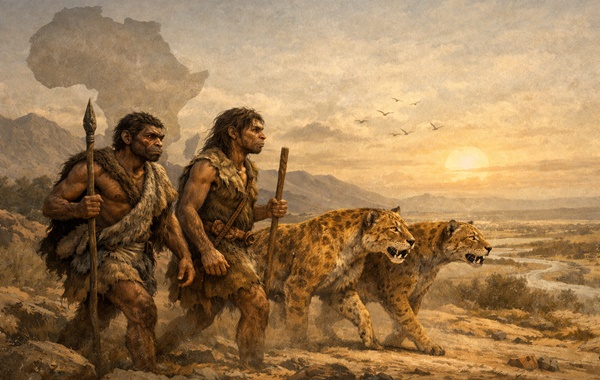
A Surprising Migration in Human Evolution: Two Species Emigrated from Africa at the Same Time
The traditional “Out of Africa” narrative is being challenged once again by a study suggesting the existence of two separate ancient human species that migrated together from Africa approximately 1.8 million years ago.
Focusing on fossils discovered in the Dmanisi region of Georgia, the research proposes that Homo erectus may have moved alongside a more primitive hominin species during humanity’s first major migration from the African continent, fundamentally reshaping our understanding of early human migration patterns.
The textbook version of human evolution has long held that Homo erectus was the pioneering species that crossed the borders of Africa approximately 1.8 million years ago. However, new analysis of five skulls unearthed between 1999 and 2005 in the Dmanisi region of the Republic of Georgia reveals a more complex picture.
According to Phys.org, scientists now believe these fossils may represent two distinct hominin species that coexisted and migrated together .

Skull 5: A Groundbreaking Discovery
At the heart of this debate is a specimen known as Skull 5, discovered at Dmanisi along with its attached jawbone (mandible). This remarkable fossil exhibits features that set it apart from others. Despite having an extremely large jaw and facial structure, Skull 5 houses one of the smallest brain cavity capacities ever found in the Homo genus (approximately 546 cubic centimeters).
These primitive features have led researchers to classify it not with the more advanced Homo erectus specimens found at the same location, but with Australopithecus, more ape-like ancestors that preceded the Homo lineage.
The morphological differences between skull 5 and the other four Dmanisi specimens are striking enough to warrant serious consideration of whether they represent separate evolutionary lineages.
While the other skulls exhibit more pronounced human-like features consistent with Homo erectus, skull 5’s massive jaw, elongated face, and small brain capacity place it in an evolutionary category closer to earlier African hominins.
As reported by Phys.org, this anatomical difference has sparked intense debate within the paleoanthropology community about whether variation within a single species can explain such dramatic differences.

Implications for the Theory of Human Evolution
The implications of this discovery extend far beyond a mere taxonomic debate. If confirmed, the presence of two distinct hominin species at Dmanisi would fundamentally alter our understanding of early human migration patterns and the evolutionary forces that drove our ancestors out of Africa.
This suggests that migration from Africa may have been a more social event than previously imagined, with multiple hominin lineages adapting to new environments simultaneously and even cooperating in some way.
The Dmanisi site in the South Caucasus region has emerged as one of the most important archaeological sites for understanding early human migration outside of Africa. Fossils found here, dating back approximately 1.8 million years, represent some of the oldest hominin remains discovered beyond the African continent.
The site’s significance was already well-known, but this new interpretation adds another layer of complexity to the story of human origins.
The Broader Context of Human Species Diversity
This discovery joins a growing body of evidence suggesting that human evolution is not a linear progression from primitive to modern, but rather a branched lineage in which multiple species coexisted and sometimes interbred.
In recent years, numerous discoveries have challenged this simplified view of human ancestry, from the recognition of interbreeding between Homo sapiens and Neanderthals, to the discovery of entirely new species such as Homo naledi, and the recently identified human populations in China showing evidence of interbreeding with Homo erectus.
The debate surrounding the Dmanisi fossils highlights the inherent difficulties in interpreting ancient remains. With an incomplete fossil record and significant morphological variation even within known species, drawing clear taxonomic boundaries becomes extremely challenging.
Some researchers argue that the variation observed in Dmanisi is within the expected range for a single, highly variable species adapting to new environments. Others claim that the differences are too large to be explained solely by individual variation.
What is undeniable is that the Dmanisi discoveries continue to provide invaluable insights into a crucial moment in human history. Whether representing a single species or two, these ancient hominins successfully navigated a journey from Africa to the alien lands of Eurasia, adapting to new climates, predators, and ecological niches.
Their success laid the groundwork for future waves of human migration that would eventually colonize the entire world. As research continues and new analytical techniques emerge, the Dmanisi fossils will undoubtedly continue to advance our understanding of who we are and where we came from.
Source: A Surprising Migration in Human Evolution: Two Species Emigrated from Africa at the Same Time
What If Lucy Wasn’t Humanity’s Mother—Is 50 Years of Evolutionary Theory About to Collapse?