The Ocean Beneath Pluto: Could Liquid Water Exist on a Frozen World?
An ocean of liquid water beneath Pluto’s icy surface is coming into focus thanks to new calculations by Alex Nguyen, a graduate student in Earth, environmental, and planetary sciences at Washington University in St. Louis.
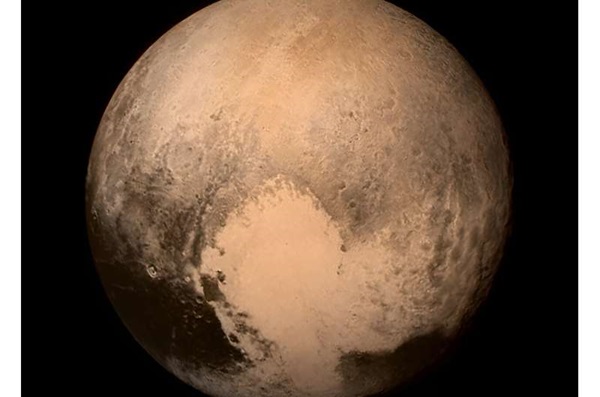
In a paper published in the journal Icarus, Nguyen used mathematical models and images from the New Horizons spacecraft, which passed by Pluto in 2015, to examine the likely ocean beneath a thick shell of nitrogen, methane, and water ice. Patrick McGovern of the Lunar and Planetary Institute in Houston co-authored the paper.
For many decades, planetary scientists assumed that Pluto could not support an ocean due to its surface temperature of about -220°C, where even gases like nitrogen and methane freeze solid. Water shouldn’t have a chance.
“Pluto is a small body,” said Nguyen, who is conducting his Ph.D. research as an Olin Chancellor’s Fellow and a National Science Foundation Graduate Research Fellow. “It should have lost almost all of its heat shortly after it was formed, so basic calculations would suggest that it’s frozen solid to its core.”
In recent years, however, prominent scientists, including William B. McKinnon, a professor of Earth, environmental, and planetary sciences, have gathered evidence suggesting Pluto likely contains an ocean of liquid water beneath the ice. This inference came from several lines of evidence, including Pluto’s cryovolcanoes that spew ice and water vapor. Although there is still some debate, “it’s now generally accepted that Pluto has an ocean,” Nguyen said.
The new study probes the ocean in greater detail, even though it is far too deep below the ice for scientists to see directly. Nguyen and McGovern created mathematical models to explain the cracks and bulges in the ice covering Pluto’s Sputnik Planitia Basin, the site of a meteor collision billions of years ago. Their calculations suggest the ocean in this area exists beneath a shell of water ice 40 to 80 km thick, a blanket of protection that likely keeps the inner ocean from freezing solid.
They also calculated the likely density or salinity of the ocean based on the fractures in the ice above. They estimate Pluto’s ocean is, at most, about 8% denser than seawater on Earth, or roughly the same as Utah’s Great Salt Lake. If you could somehow get to Pluto’s ocean, you could effortlessly float.
As Nguyen explained, that level of density would account for the abundance of fractures seen on the surface. If the ocean were significantly less dense, the ice shell would collapse, creating many more fractures than observed. If the ocean were much denser, there would be fewer fractures. “We estimated a sort of Goldilocks zone where the density and shell thickness are just right,” he said.
Space agencies have no plans to return to Pluto any time soon, so many of its mysteries will remain for future generations of researchers. Whether it’s called a planet, a planetoid, or merely one of many objects in the outer reaches of the solar system, it’s worth studying, Nguyen said. “From my perspective, it’s a planet.”
Source: The Ocean Beneath Pluto: Could Liquid Water Exist on a Frozen World?
Are We Alone? How Plate Tectonics Could Answer the Fermi Paradox
Are We Alone? How Plate Tectonics Could Answer the Fermi Paradox