The Cosmic Stew: Scientists Recreate the Big Bang’s Aftermath and It’s Not What You’d Expect
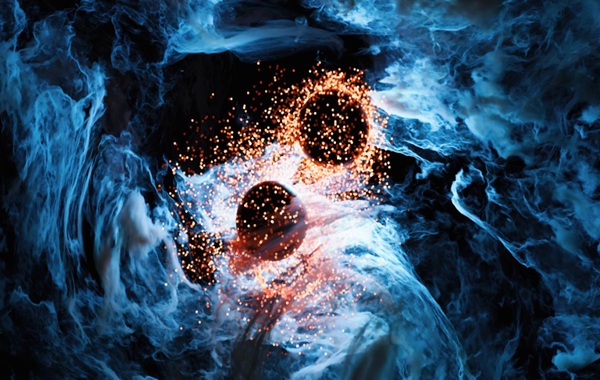
For decades, we’ve imagined the immediate aftermath of the Big Bang as a blinding flash of light and a chaotic explosion of gas. But thanks to groundbreaking simulations and high-energy physics, scientists have discovered a truth that is far more “fluid.” As it turns out, the infant universe wasn’t a cloud of smoke—it was a perfect soup.
From Chaos to Liquid Gold
In the first microseconds of existence, the universe was so unimaginably hot and dense that atoms couldn’t even form. Instead, the building blocks of matter—quarks and gluons—roamed free in a state known as Quark-Gluon Plasma (QGP).
New research simulating these primordial conditions reveals a startling characteristic: this plasma didn’t behave like a gas. Instead, it flowed with almost zero friction, making it a “perfect fluid.” Imagine a liquid so smooth that if you stirred it, it would never stop swirling. This “cosmic soup” is what eventually cooled and clumped together to form the protons and neutrons that make up everything you see today—from the stars above to the device in your hand.
Recreating the Beginning of Time
To reach these conclusions, researchers didn’t just look through telescopes; they used the Large Hadron Collider (LHC) to smash particles together at nearly the speed of light. These “mini Big Bangs” allow scientists to peek behind the curtain of time, reaching temperatures millions of times hotter than the core of the Sun.
The simulations show that the early universe was a masterpiece of fluid dynamics. This discovery challenges our fundamental understanding of how matter evolved. If the “soup” had been just a little bit thicker or thinner, the entire structure of the universe—galaxies, planets, and life itself—might never have emerged.
Why Does This Matter?
Understanding the QGP is like finding the DNA of the cosmos. By studying how this “perfect liquid” expanded and cooled, physicists are solving the ultimate puzzle: How did the universe transition from a hot, messy soup into the organized, complex world we live in today?
We are literally made of the “leftovers” of this ancient broth. The next time you look at the night sky, remember: you aren’t just looking at space; you’re looking at the cooled-down remnants of the most incredible liquid ever to exist.
Source: Science Alert
Shadows in the Starlight: Gaia Uncovers a Ghostly Swarm of Black Holes Roaming Our Galaxy
The Cosmic Stew: Scientists Recreate the Big Bang’s Aftermath and It’s Not What You’d Expect