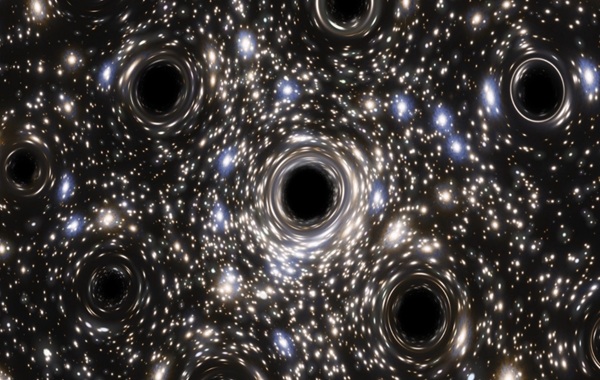
Shadows in the Starlight: Gaia Uncovers a Ghostly Swarm of Black Holes Roaming Our Galaxy
For decades, we viewed the Milky Way as a structured neighborhood of stars, planets, and nebulae. But what if there’s a “phantom population” lurking in the dark, moving silently through the cosmic backyard? Thanks to the latest data from the European Space Agency’s Gaia mission, astronomers have just pulled back the curtain on a chilling reality: an entire swarm of black holes is drifting through our galaxy.
The Invisible Nomads
Unlike the supermassive giant at the center of our galaxy, these are “stellar-mass” black holes—the collapsed remains of massive stars. For eons, they remained invisible, hidden by their own gravity which swallows even light. However, Gaia’s ultra-precise “eye” detected their presence not by seeing them, but by observing how their immense gravity warps the light of distant stars behind them—a phenomenon known as gravitational microlensing.
A Cosmic Minefield?
This discovery suggests that the Milky Way is far more crowded with “dark remnants” than previously thought. These aren’t just isolated anomalies; they are part of a vast, traveling swarm. They act like invisible weights, influencing the movement of everything around them. This revelation changes our entire understanding of galactic evolution, suggesting that we are living in a graveyard of dead stars that still exert a powerful, ghostly influence on the living cosmos.
Why This Matters
This isn’t just about finding more black holes. It’s about mapping the “dark side” of our galaxy. By tracking this swarm, scientists can finally begin to calculate the true mass of the Milky Way and understand the violent history of star death that shaped our celestial home.
The universe just got a lot more mysterious—and a lot more crowded. We are no longer just looking at the stars; we are looking at the shadows they leave behind.
Source: Science Alert
Saturn’s Hidden Past: Did One Impact Give Birth to Both Titan and the Rings?
Shadows in the Starlight: Gaia Uncovers a Ghostly Swarm of Black Holes Roaming Our Galaxy