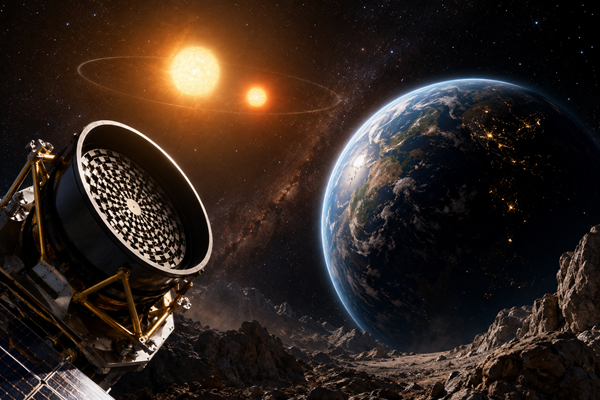
The Best Place to Find Another Earth Might Be a Double Sunset—Why Haven’t We Looked There Until Now?
Half of all sun-like stars are not alone. They orbit with companions. This complicates planet hunting. Astronomers have found thousands of exoplanets. Yet Earth 2.0 remains hidden. Why? Binary systems create complex gravitational dynamics. These dynamics can mask or mimic planetary signals. The search for Earth 2.0 in binary systems requires new approaches.
Current methods struggle. The transit technique needs perfect alignment. Radial velocity measurements lack sensitivity. An Earth-mass planet moves its star by only nine centimeters per second. Our best instruments reach fifty centimeters per second. Stellar activity creates noise. This gap prevents detection of Earth 2.0 around sun-like stars.
But what if we could use binary systems themselves as tools? What if the very complexity they introduce could be exploited? A new mission concept proposes exactly this.
Earth 2.0 Detection Methods: Why Astrometry Offers a New Path
Astrometry measures stellar positions precisely. It tracks wobbles against background stars. For Earth 2.0 at thirty-three light-years, the wobble is zero point three microarcseconds. GAIA achieves one hundred microarcseconds precision. The gap is enormous. However, SHERA proposes a clever workaround.
Instead of faint background stars, SHERA targets bright binary pairs. These stars are gravitationally bound. They move together. Measuring their relative separation cancels background noise. It also eliminates optical distortions. This is a fundamental shift in approach.
The technique is called relative astrometry. It compares two stars in the same field. Both experience the same distortions. Subtracting their positions removes errors. If one star hosts Earth 2.0, the planet causes a periodic shift. SHERA detects this shift. The question is: can we achieve the required precision?
SHERA’s Diffractive Pupil: A Technological Leap for Finding Earth 2.0
The answer lies in a diffractive pupil. This is a complex phase pattern. It is etched onto a twenty-two-centimeter telescope mirror. The process uses electron-beam lithography. This is similar to computer chip manufacturing. The pattern serves three functions.
First, it acts as an optical ruler. It measures how distortions change over time. Thermal expansion is tracked precisely. Second, it spreads starlight across multiple pixels. The spread follows a known pattern. Microscopic detector defects are averaged away. Third, it monitors the star’s spectrum. Sunspots can mimic planetary signals. The pattern corrects for these changes.
This technology achieves sub-microarcsecond precision. It is a stepping stone from the TOLIMAN CubeSat concept. TOLIMAN targeted Alpha Centauri. SHERA scales this up. The result is a mission that can find Earth 2.0 in binary systems.
Imagine a ruler so precise it can measure the width of a human hair from one thousand kilometers away. That is the scale of precision SHERA targets. Can such a tool be built? The authors believe yes.
Seven Binary Systems: Where SHERA Will Hunt for Earth 2.0
The SHERA team selected seven nearby binary systems. All lie within seventeen parsecs. These are ideal targets. They are bright and closely separated. The mission has three science goals.
First, find Earth-mass planets in habitable zones. Second, test whether binary companions suppress planet formation. We already know this happens at some separations. Third, combine astrometric data with radial velocity measurements. Ground-based instruments provide complementary information.
The calculations predict approximately four detections. This is based on standard occurrence rates. However, even fewer detections would be significant. Finding fewer than two planets would indicate something important. It would suggest that Earth 2.0 is rarer around binary stars. This would reshape our understanding of planet formation.
What does this mean for the search for life? If binary systems suppress Earth-like planets, then habitable worlds may be rarer than we think. But if they do not, then half of all sun-like stars could host Earth 2.0. The stakes are enormous.
The Habitable Worlds Observatory Connection: SHERA’s Legacy for Earth 2.0 Search
SHERA’s most important role may be supporting another mission. The Habitable Worlds Observatory (HWO) is a future flagship. It will characterize exoplanet atmospheres. It will search for biosignatures. However, HWO is expensive. Its time is precious.
Thirteen of SHERA’s fourteen target stars are Tier One for HWO. Proving a planet’s existence takes time. SHERA can do this in advance. It can reduce HWO’s characterization time by up to forty percent. This is a massive savings.
SHERA is a NASA Small Explorer mission. It is relatively inexpensive. Private funding is also possible. The mission could launch in the early twenty-thirties. HWO will launch in the early twenty-forties. The timing aligns perfectly.
But will SHERA be funded? No official plans exist yet. The scientific community must advocate for it. The paper on arXiv makes a compelling case. The question remains: will we seize this opportunity?
Questions That Linger: Is Earth 2.0 Waiting in a Binary System?
How common are Earth-like planets in binary systems? Does a companion star help or hinder habitability? Could the nearest Earth 2.0 be orbiting a binary pair? These questions remain unanswered. SHERA could provide the first data.
Consider Alpha Centauri. It is a triple system. The nearest stars to Earth. Could they host habitable worlds? TOLIMAN aimed to find out. SHERA extends this to seven systems. The sample is small but statistically meaningful.
What would a detection mean? It would prove that Earth 2.0 can form in binary systems. It would open a new frontier. It would also test theories of planet formation. Close binaries might suppress planets. Wide binaries might not. SHERA will distinguish between these scenarios.
The search for Earth 2.0 continues. The prize is not just a planet. It is a potential home for life. Binary systems may hold the key. SHERA offers a path forward. Will we take it?
Source: The Best Place to Find Another Earth Might Be a Double Sunset—Why Haven’t We Looked There Until Now?
The Best Place to Find Another Earth Might Be a Double Sunset—Why Haven’t We Looked There Until Now?
Sources:
- arXiv preprint: “Searching for Habitable Exoplanets with Relative Astrometry (SHERA)”
- NASA Exoplanet Exploration Program documentation
- GAIA mission performance reports
- TOLIMAN CubeSat mission concept studies
- Exoplanet occurrence rate literature (Fressin et al., 2013; Bryson et al., 2021)
- Binary star planet formation theory (Kraus et al., 2016; Quintana et al., 2017)