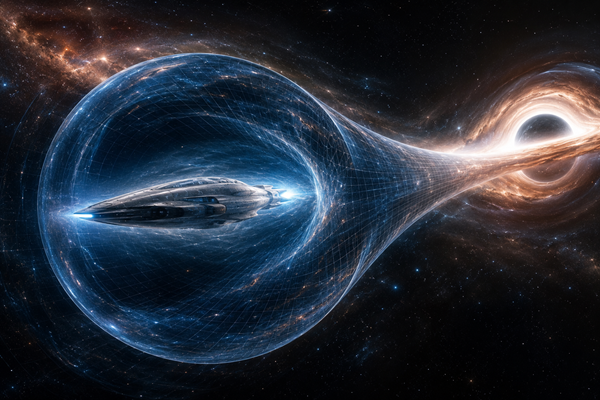
What if the only way to reach the stars is to bend space, tear it open, or ride a black hole’s gravity?
Humanity has dreamed of reaching the stars for centuries. Yet the moment we move beyond imagination and ask how such a journey could actually happen, the Universe becomes far less forgiving.
Welcome back to our series on Interstellar Travel, where we examine the many concepts proposed for sending spacecraft beyond the Solar System. Earlier installments explored how the Space Age emerged alongside advances in nuclear weapons and rocketry, leading scientists to consider nuclear propulsion as a way to cross enormous distances.
We then examined how thermonuclear research inspired concepts for fusion propulsion. Later, the discovery and development of antimatter technologies encouraged proposals for spacecraft powered by positrons and antiprotons. In the previous installment, we turned toward technologies that appear considerably more practical, including solar sails, magnetic sails, and directed-energy propulsion.
Now we enter a very different territory.
What if a spacecraft did not need to cross the space between stars in the conventional sense? What if it could manipulate spacetime itself? Could a tunnel through the Universe shorten an interstellar journey from thousands of years to something a human civilization could actually experience?
These questions bring us to some of the most extraordinary ideas in modern theoretical physics: warp drives, traversable wormholes, and the Halo Drive.
They sound like science fiction.
But unlike many fictional technologies, each concept has been connected to real equations, real physical principles, and serious theoretical research.
The enormous problem is that mathematics can permit a possibility long before engineering can make it reality.
Interstellar Travel and the Problem of Crossing the Stars
The fundamental challenge of Interstellar Travel is not simply reaching another star.
It is reaching another star within a meaningful period of time.
Our galaxy contains hundreds of billions of stars. Astronomers have also confirmed thousands of planets beyond the Solar System, revealing that planetary systems are not unusual cosmic accidents. Instead, they appear to be widespread features of our galaxy.
That discovery creates an extraordinary question:
If planets are everywhere, why is traveling to them so difficult?
The nearest stellar system, Alpha Centauri, lies roughly four and a quarter light-years away. Its red-dwarf member Proxima Centauri hosts Proxima b, a planet that has attracted enormous scientific interest because of its location and its rocky nature.
However, distance alone does not determine whether Proxima b is suitable for life. Its atmosphere, magnetic environment, stellar activity, and surface conditions remain crucial unknowns.
Even so, Proxima b represents something important.
It gives humanity a nearby destination to imagine.
At today’s spacecraft speeds, however, reaching even the nearest stars would require extraordinarily long journeys. Increasing the velocity dramatically requires increasing the energy budget, and relativistic physics makes that problem increasingly severe.
The closer a spacecraft approaches the speed of light, the more difficult further acceleration becomes.
So perhaps the most important question is not:
How can we build a faster rocket?
Perhaps the better question is:
Can we change the way the spacecraft interacts with spacetime?
That is where warp-drive concepts begin.
Interstellar Travel and the Alcubierre Warp Drive: Can Spacetime Move the Ship?
The idea of a warp drive became famous through science fiction. Yet physicist Miguel Alcubierre transformed the concept into something much more interesting in the nineteen nineties.
In his landmark work, Alcubierre examined whether General Relativity could permit a configuration in which spacetime itself expands behind a spacecraft and contracts ahead of it.
The spacecraft would not locally accelerate through space faster than light.
Instead, the geometry surrounding it would change.
This distinction is crucial.
Einstein’s Special Relativity states that an object with mass cannot locally accelerate through space beyond the speed of light. Alcubierre’s proposal attempted to work around that limitation by manipulating the geometry of spacetime rather than simply pushing the spacecraft faster and faster.
The theoretical structure became known as the Alcubierre metric.
Imagine a spacecraft surrounded by an invisible bubble.
Inside the bubble, the spacecraft could remain locally at rest relative to its immediate surroundings. Outside the bubble, however, spacetime itself would contract in front of the vehicle and expand behind it.
The result would resemble motion at superluminal speed from the perspective of distant observers.
But there is a remarkable distinction:
The spacecraft would not necessarily be breaking the local speed limit. The geometry around it would be doing the work.
That is what makes the concept so fascinating.
And that is also where the nightmare begins.
Warp Drive Physics: The Negative-Energy Problem
Alcubierre’s original proposal requires an unusual distribution of energy.
In its original form, the warp bubble depends on regions with negative energy density. Such exotic energy configurations are not something engineers currently know how to manufacture and control on macroscopic scales.
Quantum physics does allow limited situations in which energy densities can behave in ways that differ from ordinary classical expectations. The Casimir effect is one famous example.
However, this does not mean that scientists have discovered a supply of usable negative mass.
That distinction matters.
A microscopic quantum effect is not automatically a technological resource capable of surrounding a spacecraft with a planet-scale gravitational structure.
The original energy requirements of the Alcubierre concept were therefore extraordinarily large.
Nevertheless, researchers have continued to investigate whether the original formulation represents the only possible version of a warp drive.
Some later theoretical studies have explored alternative spacetime configurations that reduce or even eliminate the need for negative energy under particular assumptions. For example, theoretical work has investigated positive-energy warp configurations, although these proposals remain mathematical models rather than demonstrated propulsion systems.
This creates an intriguing scientific divide.
Perhaps the biggest obstacle is not that General Relativity completely forbids warp-like geometries.
Perhaps the real problem is finding a physically realizable source of the required spacetime curvature.
So we must ask:
If the equations permit the geometry, what kind of matter or energy could actually create it?
And even if we found that answer, another question would remain.
Could a spacecraft survive inside the bubble?
Could a Warp Drive Actually Be Safe?
A theoretical warp drive faces problems far beyond its energy requirements.
Researchers must consider how the bubble would form, how it could be controlled, how it would interact with surrounding matter, and what would happen when it reached its destination.
There are also serious questions involving causality.
If a spacecraft could travel effectively faster than light between distant locations, the relationship between cause and effect could become complicated under relativity.
The destination also presents a major problem.
A warp bubble moving through interstellar space would not necessarily behave like a harmless science-fiction vehicle. The interaction between the bubble and particles or radiation encountered along its path could have consequences that are difficult to predict.
Then comes the most basic engineering question:
How do you turn the warp field on, control it, steer it, and turn it off?
A mathematical solution to Einstein’s field equations does not automatically provide an engineering blueprint.
That gap between mathematics and technology is one of the most important themes in advanced propulsion research.
Interstellar Travel Research: From Alcubierre to Modern Warp Concepts
The possibility of manipulating spacetime has nevertheless continued to attract researchers.
In the early twenty-first century, several researchers explored alternative approaches that attempted to reduce the enormous energy requirements associated with the original Alcubierre metric.
Harold White and colleagues became associated with experimental investigations inspired by warp-field concepts. The work generated considerable public interest because it attempted to investigate whether extremely small spacetime distortions could be detected experimentally.
However, no experiment has demonstrated a functioning warp drive.
That point deserves emphasis.
There is currently no experimentally verified warp propulsion system.
The field remains theoretical.
Yet theoretical physics often begins by asking questions that seem impossible.
General Relativity itself once predicted phenomena that sounded extraordinary, including gravitational waves and black holes. Those predictions eventually received observational support.
Warp drives are nowhere near that level of confirmation.
Still, the research raises a fascinating possibility:
Could future physics reveal that our current understanding of spacetime is only part of the story?
Interstellar Travel Through Wormholes: Could the Universe Have Shortcuts?
Warp drives attempt to manipulate spacetime around a spacecraft.
Wormholes take an even more radical approach.
Instead of moving rapidly through ordinary space, a wormhole would theoretically connect two distant regions of spacetime through a shortcut.
Imagine drawing two points on a sheet of paper.
Normally, you would travel from one point to the other across the surface. But if you folded the paper so that the two points touched, the distance between them would suddenly become much smaller.
A wormhole is often visualized in a similar way.
The mathematics is rooted in General Relativity.
The Einstein-Rosen bridge emerged from early work involving black-hole solutions and became one of the foundational ideas associated with wormhole geometry. However, the original Einstein-Rosen structure is not a practical tunnel through which a spacecraft could simply fly.
The crucial issue is stability.
A naturally occurring wormhole could collapse before anything crossed it.
So the question becomes:
What could hold a wormhole open?
Again, exotic energy enters the story.
Traversable Wormholes and the Search for Exotic Physics
A traversable wormhole must remain open long enough for information, matter, or potentially a spacecraft to pass through.
Theoretical research has explored mechanisms involving negative Casimir-like energy and quantum fields.
Juan Maldacena and collaborators have studied traversable wormhole solutions under specific theoretical conditions. One model involves charged, massless fermions producing a negative Casimir-like energy that helps support the wormhole geometry.
Later work by Maldacena and Alexey Milekhin examined whether wormholes could, under certain extensions of known physics, become traversable by humans. Their model used the Randall-Sundrum framework, which introduces extra-dimensional geometry beyond ordinary four-dimensional spacetime.
This sounds astonishing.
But there is a crucial qualification.
These are theoretical constructions.
They do not demonstrate that a civilization can build a wormhole.
They demonstrate that certain mathematical models can produce geometries with interesting traversability properties.
That distinction separates theoretical physics from engineering.
And it leads to an even deeper question:
What if the Universe permits wormholes but gives us no practical way to create them?
Why Wormhole Travel Is Still Far Beyond Human Technology
Even the most promising theoretical wormhole models face immense obstacles.
A human-scale wormhole would require control over gravitational and quantum effects that are far beyond current technology.
The structure would also have to withstand enormous stresses.
Tidal forces could become destructive near compact objects. Radiation could pose another danger. Stability could depend on extremely specific physical conditions.
Furthermore, traversability itself may not mean that every form of matter or information can pass through the wormhole easily.
Recent theoretical work has examined how different probes interact with traversable wormhole geometries. A two thousand twenty-six study found that transmission can depend strongly on the type and frequency of the probe, with some signals becoming strongly suppressed while certain resonant conditions can produce much higher transmission.
This is an important reminder.
Calling something a “traversable wormhole” does not mean it behaves like a perfectly open cosmic doorway.
The physics could be much stranger.
Interstellar Travel and the Halo Drive: Using a Black Hole as a Cosmic Accelerator
Now we arrive at perhaps the most unusual concept in this entire discussion.
What if we did not need to invent a new propulsion engine at all?
What if the Universe already contains the ultimate accelerator?
That is the basic inspiration behind the Halo Drive, proposed by astrophysicist David Kipping.
Instead of carrying enormous quantities of propellant, a spacecraft could theoretically exploit the energy and motion associated with an extreme gravitational environment.
The idea builds upon gravitational-assist concepts.
Spacecraft already use planetary flybys to change their velocity. The spacecraft does not create all of its kinetic energy internally. Instead, it exchanges momentum with the moving planet.
Kipping extended this concept into an extraordinary relativistic scenario involving black holes and photons. His two thousand nineteen proposal describes a method in which light can act as a remotely controlled gravitational intermediary, allowing energy extracted from the motion of a black hole to accelerate a spacecraft.
The concept is called the Halo Drive because of the special photon trajectories involved.
And this is where the idea becomes truly remarkable.
Halo Drive Physics: Can a Black Hole Become a Cosmic Slingshot?
Kipping’s concept draws inspiration from earlier ideas involving gravitational machines and rotating compact objects.
A rapidly moving black hole can act as an extraordinary gravitational source.
Near a rotating black hole, spacetime itself becomes twisted by the black hole’s angular momentum. This phenomenon is associated with frame dragging and the structure of the ergosphere.
The ergosphere is especially interesting because an object cannot remain stationary relative to distant space while inside it.
In principle, energy can be extracted from a rotating black hole.
The famous Penrose process provides one theoretical mechanism for doing so.
The Halo Drive takes this extraordinary gravitational environment and turns it into a propulsion concept.
Instead of simply throwing propellant backward, a civilization could use carefully controlled photons and the gravitational field of a black hole to exchange energy and momentum.
The spacecraft could therefore gain enormous velocity without carrying an equivalent mass of reaction propellant.
Kipping’s calculations showed that the recycled photon mechanism could, under idealized circumstances, transfer substantial energy from a moving black hole to a spacecraft.
But there is an enormous catch.
The black hole is not a convenient gas station.
The Dark Side of the Halo Drive: Radiation, Precision, and Survival
A spacecraft attempting to exploit a black hole would have to operate in one of the most hostile environments imaginable.
Radiation could become a critical threat.
Tidal forces could destroy an inadequately protected spacecraft.
A tiny navigation error could have catastrophic consequences.
And the spacecraft would first need to reach the black hole.
That alone could require an enormous amount of energy.
In other words, the Halo Drive does not magically eliminate every propulsion problem.
It shifts the problem.
Instead of carrying all the energy required for acceleration, a civilization would need access to an extreme astrophysical object and the technology necessary to exploit it safely.
That raises an extraordinary question:
What level of civilization would be capable of using black holes as transportation infrastructure?
At that point, we are no longer discussing a technology comparable to a modern rocket.
We are discussing a civilization capable of manipulating some of the most energetic structures in the Universe.
Hypervelocity Stars Reveal What Gravity Can Really Do
The Halo Drive may sound purely hypothetical, but nature already demonstrates that gravity can accelerate matter to extraordinary velocities.
Astronomers have discovered hypervelocity stars moving through the galaxy at hundreds or even thousands of kilometers per second.
Some of these stars can become unbound from the Milky Way after powerful gravitational interactions.
Massive black holes can play an important role in such extreme stellar dynamics.
These observations do not prove that the Halo Drive works.
They demonstrate something more fundamental.
Gravity can produce enormous changes in velocity when the right cosmic configuration exists.
The Universe is therefore already performing a kind of gravitational engineering on a scale far beyond human capability.
The challenge is whether an intelligent civilization could learn to exploit the same physics deliberately.
Warp Drive vs Wormholes vs Halo Drive: Which Interstellar Travel Concept Wins?
At first glance, warp drives, wormholes, and Halo Drives appear to solve the same problem.
They do not.
Each attacks the interstellar-distance problem from a different direction.
Warp drives attempt to manipulate spacetime itself.
Wormholes attempt to connect distant regions of spacetime through a shortcut.
Halo Drives attempt to exploit extreme gravitational systems to accelerate spacecraft without relying entirely on conventional propellant.
Their biggest obstacle also differs.
For warp drives, the central problem involves creating and controlling the required spacetime geometry.
For wormholes, the central problems include stability, traversability, exotic energy requirements, and the possibility that known physics may not support macroscopic versions.
For Halo Drives, the problem is engineering and access: reaching suitable black-hole systems, surviving the environment, and executing extraordinarily precise maneuvers.
So which one is most realistic?
At present, none has reached the level of practical propulsion technology.
Interstellar Travel Is Not Only an Engineering Problem
It is tempting to think that humanity’s only obstacle is building a sufficiently powerful engine.
The deeper problem is that interstellar travel combines several extreme challenges at once.
Energy is one.
Acceleration is another.
Radiation shielding is another.
Navigation becomes increasingly demanding at relativistic velocities. Even tiny particles in interstellar space could become dangerous at extreme speeds because their kinetic energy would rise dramatically in the spacecraft’s frame.
Then there is communication.
A spacecraft traveling several light-years away cannot remain in real-time contact with Earth. Every conversation would take years to cross the distance.
And what happens when the spacecraft reaches its destination?
If it arrives at a planet but cannot slow down, the journey has not succeeded.
A complete interstellar mission therefore requires acceleration, cruising, navigation, shielding, communication, deceleration, and survival.
The Universe does not offer a single problem.
It offers an entire chain of problems.
Could New Physics Change the Future of Interstellar Travel?
This is where the story becomes genuinely exciting.
Physics is not finished.
Scientists continue to investigate gravity, quantum mechanics, dark energy, extra dimensions, quantum fields, and the fundamental structure of spacetime.
Some modern theoretical studies have questioned whether every warp-like configuration must necessarily rely on negative energy. For example, certain mathematical models have investigated positive-energy configurations that could alter how researchers think about warp geometries.
However, such studies should not be interpreted as evidence that a working warp engine is close.
A mathematical solution is only the beginning.
The next step is physical consistency.
Then comes experimental verification.
Then comes engineering.
Then comes energy production.
Then comes control.
And finally comes survival.
Humanity has not completed even the earliest stages of that chain.
Still, the theoretical work matters because it tells us where the boundaries of our current understanding might lie.
The Real Question Behind Interstellar Travel
Perhaps the most important lesson from warp drives, wormholes, and Halo Drives is not that humanity is about to reach the stars.
It is that the Universe may offer possibilities that our current technology cannot yet exploit.
The nearest stars remain extraordinarily distant.
The energy requirements remain immense.
Negative mass has not been discovered.
Macroscopic traversable wormholes have not been observed.
No warp drive has been demonstrated.
No spacecraft has used a black hole as a relativistic propulsion system.
These are not minor technical details.
They are fundamental barriers.
Yet the scientific value of these concepts does not depend on whether humanity builds them tomorrow.
They force physicists to ask questions that conventional rocket science cannot answer.
Can spacetime itself become an engineering material?
Can gravity become a source of propulsion?
Can quantum fields stabilize structures that appear impossible under classical physics?
Could an advanced civilization use black holes as transportation nodes across a galaxy?
And perhaps the most unsettling question of all:
What if the limitation is not the distance between the stars, but our understanding of what space actually is?
The Future of Interstellar Travel May Begin With an Equation
For now, warp drives, wormholes, and Halo Drives remain theoretical.
They belong to a strange borderland between established physics and speculation.
Yet that borderland has historically been important.
Ideas that once sounded impossible sometimes become scientific discoveries. Others remain beautiful mathematical possibilities that nature never realizes.
We do not yet know which category these concepts belong to.
What we do know is that conventional propulsion makes interstellar travel brutally difficult. Relativistic propulsion requires enormous energy, while faster-than-light concepts demand physical conditions that humanity cannot currently produce or control.
Nevertheless, the search continues.
Perhaps future civilizations will develop propulsion methods that look nothing like today’s rockets.
Perhaps a deeper theory of gravity will reveal unexpected possibilities.
Perhaps quantum physics will show us how spacetime can be manipulated.
Or perhaps the Universe will ultimately prove that the stars are farther away than technology can ever overcome.
For now, the most honest conclusion is also the most intriguing one:
We do not yet know whether humanity will ever cross the space between the stars.
But every serious attempt to answer that question forces us to understand the Universe more deeply.
And perhaps that is how interstellar travel truly begins.
Not with a launch.
Not with an engine.
But with a question:
How far can physics take us if we refuse to assume that today’s technological limits are the limits of nature itself?
Source: What if the only way to reach the stars is to bend space, tear it open, or ride a black hole’s gravity?
Dark Stars May Have Left a Gravitational-Wave Signal We Can Detect Today
Dark Stars May Have Left a Gravitational-Wave Signal We Can Detect Today
What if the only way to reach the stars is to bend space, tear it open, or ride a black hole’s gravity?
Sources and Further Reading
- Miguel Alcubierre, The Warp Drive: Hyper-Fast Travel Within General Relativity. The foundational theoretical work describing the Alcubierre spacetime configuration.
- Juan Maldacena, Alexey Milekhin and Fedor Popov, Traversable Wormholes in Four Dimensions. Research examining wormhole solutions supported by negative Casimir-like energy.
- Juan Maldacena and Alexey Milekhin, Humanly Traversable Wormholes. A theoretical study of humanly traversable wormholes within an extension involving the Randall-Sundrum model.
- David Kipping, The Halo Drive: Fuel-Free Relativistic Propulsion of Large Masses via Recycled Boomerang Photons. The original theoretical proposal for using gravitational interactions involving black holes and photons for relativistic propulsion.
- Ben Freivogel, Alessandro Fumagalli and Marija Tomašević, How Traversable Is a Traversable Wormhole? A recent theoretical investigation into how different probes propagate through a four-dimensional traversable wormhole model.
- Shaun D. B. Fell and Lavinia Heisenberg, Positive Energy Warp Drive from Hidden Geometric Structures. A theoretical exploration of warp configurations involving positive energy densities.
What if the only way to reach the stars is to bend space, tear it open, or ride a black hole’s gravity?