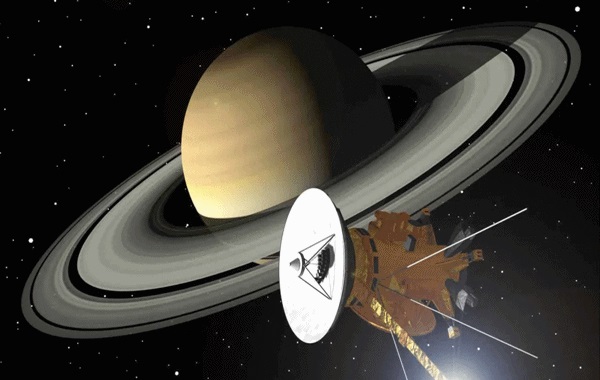
Student deciphers Saturn’s ring transparency using old Cassini data
A Ph.D. student from Lancaster University has used historical data from the Cassini spacecraft to calculate the optical depth of Saturn’s rings. To avoid doubt, “optical depth” is a measure of the transparency of an object, which reveals how far light can pass through it without being absorbed or scattered. The study was conducted in collaboration with the Swedish Institute of Space Physics and is an exciting use of historical data to make discoveries about our celestial neighbors.
Money for old rope
George Xystouris, the Ph.D. student in question, analyzed historical data from the Langmuir Probe onboard Cassini. The probe measured cold plasma- consisting of low-energy ions and electrons in Saturn’s magnetosphere. They focused on the solar eclipses of Cassini, which are periods when it (the spacecraft) was in the shadow of Saturn or the main rings. The Langmuir Probe recorded dramatic changes in the data during each eclipse.
Cassini’s mission began in 2004 and ultimately ended in 2017 when it plunged into Saturn’s atmosphere after gathering considerable amounts of data about the planet, moons, and rings.
“As the probe is metallic, whenever it is sunlit, the sunlight can give enough energy to the probe to release electrons. This is the photoelectric effect, and the electrons that are released are so-called ‘photoelectrons. They can create problems, though, as they have the same properties as the electrons in the cold plasma around Saturn, and there is not an easy way to separate the two,” explained Xystouris.
“Focusing on the data variations, we realized that they were connected with how much sunlight each ring would allow to pass. Eventually, using the properties of the material that the Langmuir Probe was made of and how bright the Sun was in Saturn’s neighborhood, we managed to calculate the change in the photoelectrons number for each ring, and calculate Saturn’s ring optical depth,” he added.
“This was a novel and exciting result! We used an instrument that is mainly used for plasma measurements to measure a planetary feature, which is a unique use of the Langmuir Probe, and our results agreed with studies that used high-resolution imagers to measure the transparency of the rings.”
Saturn’s main rings extend up to 86,992 miles (140,000 km) from the planet but have a thickness of only 0.62 miles (1 km). Starting in 2025, these rings will be difficult to view from Earth because they will be tilted edge-on to Earth. However, during the next phase of Saturn’s 29-year orbit, they will tilt back towards Earth and become more visible and brighter until 2032.
A great discovery
“It is always good to see a postgraduate student involved in using space probe instrumentation in an unusual and inventive way. Innovation of this kind is just what is needed in astronomical research – and an approach which many former students who are in a variety of careers are applying to help address the world’s problems,” added Professor Mike Edmunds, the President of the Royal Astronomical Society.
Source: Interesting Engineering
Student deciphers Saturn’s ring transparency using old Cassini data