Stonehenge’s older ‘sister’: Ancient monument in Dorchester’s dating stuns archaeologists
Researchers in the UK recently discovered that Stonehenge has an older “sister” in Dorchester, so it’s time to rewrite the history books!
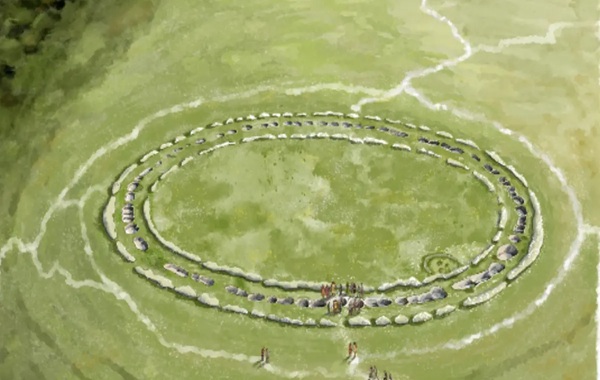
First discovered in the 1980s, Flagstones is a circular monument resembling a running track that might have even inspired Stonehenge.
Archaeologists from the University of Exeter and Historic England didn’t expect the mysterious enclosure to predate the legendary monolith. However, as stated in a study in Antiquity, the results of analyses placed the Stone Age site two hundred years earlier than they had expected.
Do we have to revise the history books around the age of Stonehenge? Archaeologists say we just might.
Moreover, Flagstones monument, which dates back to dates to 3,200 years BC, has assisted archaeologists in developing a clearer picture of the Neolithic communities across Britain and Ireland, as these Stone Age sites communicate a larger cultural network between them.
“The chronology of Flagstones is essential for understanding the changing sequence of ceremonial and funeral monuments in Britain,” said Dr Greaney, an expert in Neolithic and Bronze Age monuments told Exeter News.
Older than Stonehenge and just as mysterious
Road construction on the Dorchester bypass in the 1980s revealed a 328.08-foot diameter circular ditch of intersecting pits beneath the ground, according to the University of Exeter News.
Though most of the monument remains covered underneath the new bypass and even Thomas Hardy’s former home, historical artifacts and excavation archives were sent to Dorset Museum for safekeeping and preservation.
Four people were buried in the enclosure pits: a cremated adult and three un-cremated children. Additionally, three partial cremations of adults were also found.
Archaeologists observed a striking similarity between Flagstones and Stonehenge. They believed the two were built around the same time because the original plan for the world’s most intriguing monument matched the design of Flagstones.
Dr. Susan Greaney and Dr. Peter Marshall collaborated with ETH Zurich and the University of Groningen laboratories to conduct 23 new radiocarbon measurements, according to Exeter News.
Advanced radiocarbon dating revealed a puzzling history. The pits were dug around 3650 BC. Many centuries later, upon its completion, they buried bodies. One thousand years later, one additional adult male was laid to rest at the center.,
“Flagstones is an unusual monument; a perfectly circular ditched enclosure, with burials and cremations associated with it,” Dr. Greaney told Exeter News.
“In some respects, it looks like monuments that come earlier, which we call causewayed enclosures, and in others, it looks a bit like things that come later that we call henges. But we didn’t know where it sat between these types of monuments – and the revised chronology places it in an earlier period than we expected,” Dr. Greaney continued.
A larger cultural weave uniting the UK
Archaeologists discovered that Flagstones was constructed before Stonehenge, shedding a new quizzical light on its initial design plan. It resembled Flagstones, and it could change the history books.
Dr. Greaney called Flagstones Stonehenge’s “‘sister’ monument, whose first phase is almost identical, but it dates to around 2900 BC. Could Stonehenge have been a copy of Flagstones? Or do these findings suggest our current dating of Stonehenge might need revision?”
The artifacts recovered thus far across similar sites across Britain and Ireland suggest that Stonehenge might not be the region’s oldest circular enclosure or unique but rather part of a larger network that reflects a shared set of cultural practices.
Source: Interesting Engineering
Could This Ancient Flood Evidence Prove Noah’s Ark Was Real?
Stonehenge’s older ‘sister’: Ancient monument in Dorchester’s dating stuns archaeologists