Sexless seeds: how self-cloning crops could soon transform our food
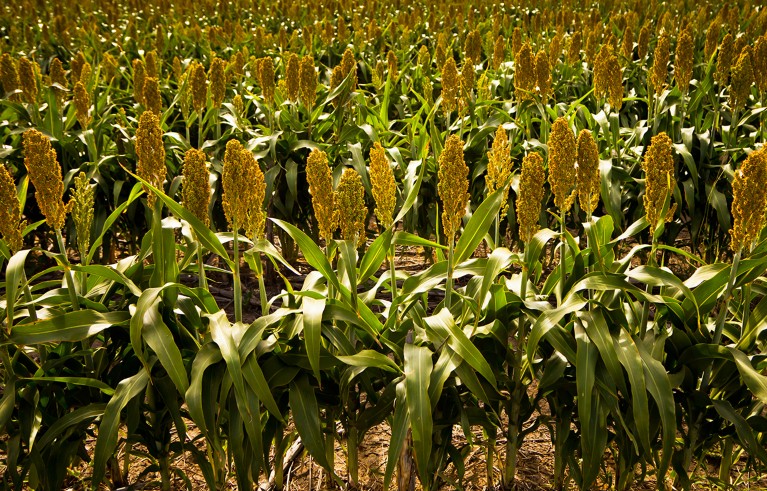
As early as next month, a trial crop of hardy sorghum could sprout under a mesh canopy in eastern Australia. The plants may look ordinary, but their genes hold a breakthrough: they can produce clonal seeds without sexual reproduction.
The Hy-Gain sorghum trial is the culmination of decades of research by plant physiologist Anna Koltunow at the University of Queensland. Her work harnesses apomixis — a natural phenomenon in which some 300 species of plants produce clonal seeds. None of these species, however, are staple crops. Scientists now believe apomixis can be engineered into grains such as sorghum, rice and maize, potentially transforming agriculture.
“It definitely will lead to a revolution,” says Kejian Wang, a geneticist at the China National Rice Research Institute.
Koltunow’s aim is to provide affordable, high-yielding seeds to smallholder farmers in sub-Saharan Africa, who could reuse clonal seed for years, cutting costs. Supported by the Gates Foundation, her research is also attracting seed giants like Corteva Agriscience, which see apomixis as a tool to fix desirable traits and speed up breeding.
Although market-ready varieties are close for crops like rice, researchers note that hurdles remain. “Now that we’ve shown it works, we need to fine-tune things,” says Venkatesan Sundaresan of the University of California, Davis.
Fixing vigour
The main promise of apomixis lies in preserving hybrid vigour. Hybrids, created by crossing two varieties, typically outperform both parents. This effect helped increase US maize yields sevenfold in the 20th century. But hybrid seeds must be remade each year, since self-pollination scrambles genes and reduces quality.
With apomixis, hybrids would clone themselves, giving farmers a permanent supply of uniform, high-quality plants. This would also enable hybrids in crops where producing them has been impractical, such as wheat and soy.
By the 1940s
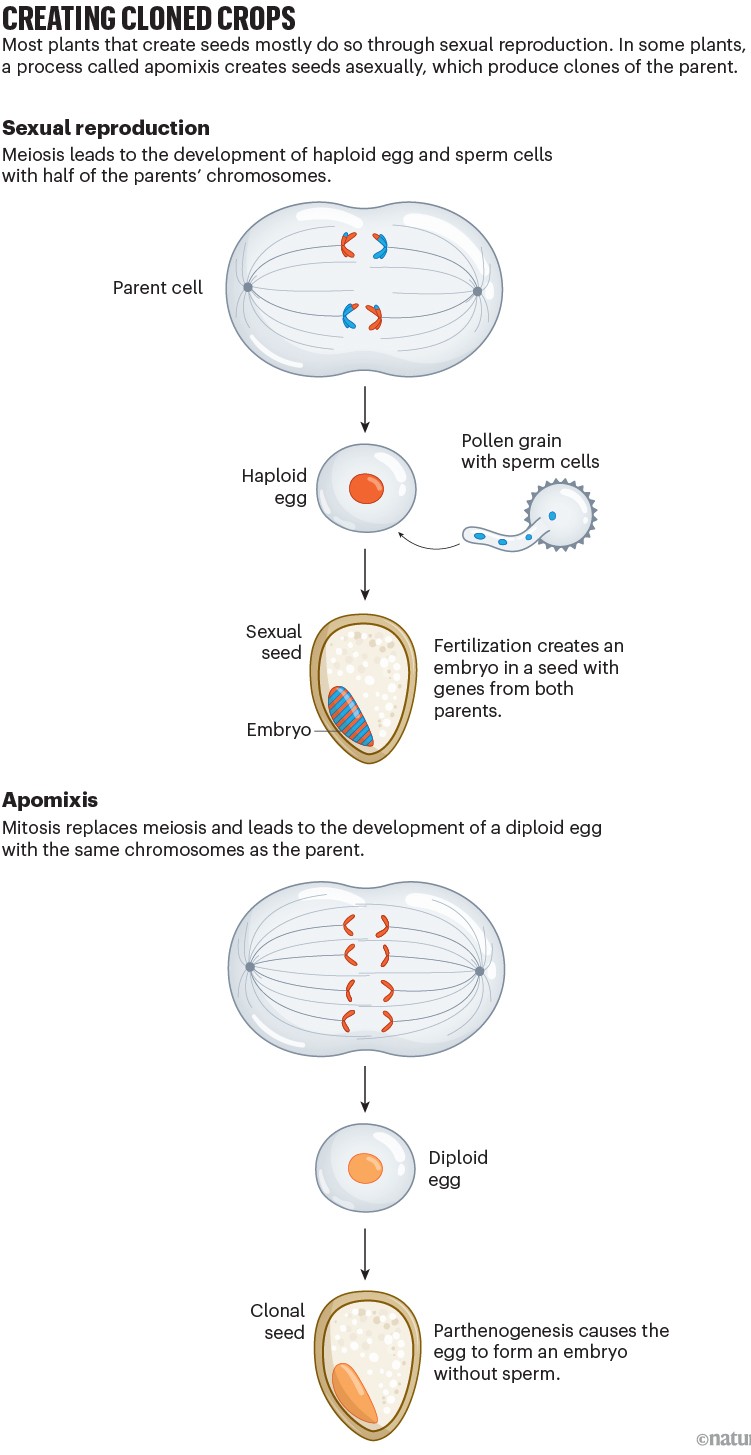
Researchers knew apomixis had a genetic basis. But it was not until the 1990s that scientists realized it is an altered sexual pathway, not a complete replacement of sex. Two steps are required: disrupting meiosis (the special cell division that halves chromosome numbers) and triggering embryo formation without fertilization.
In 2009, Raphaël Mercier in France disrupted meiosis in Arabidopsis, converting it into mitosis. His “MiMe” mutants produced egg and sperm cells with the same chromosomes as the parent. Later, he extended this to rice and tomatoes. These plants could reproduce, but carried double chromosomes, which reduced fertility.
Meanwhile, Ueli Grossniklaus at the University of Zürich identified another gene in maize (nrf4) that sometimes replaced meiosis with mitosis, producing the first clonal seed in a crop species.
Virgin birth
The second step, parthenogenesis, was studied by Peggy Ozias-Akins at the University of Georgia. In 2006, her team identified a gene in fountain grass similar to BABY BOOM, known to trigger embryo formation. A decade later, they inserted this gene into pearl millet, producing embryos without fertilization.
At the same time, Sundaresan was studying how fertilized egg cells activate embryogenesis. His team discovered that the BABY BOOM gene is normally delivered by sperm. By engineering rice so that BABY BOOM switched on directly in egg cells, they showed sperm was not needed at all.
Putting it all together
In 2016, Sundaresan learned of Mercier’s MiMe rice and suggested combining it with BABY BOOM. Together, the teams created an apomictic rice plant capable of cloning itself through seed. Although only 10–30% of the seeds were clonal, it was the first proof-of-concept that both elements of apomixis could be engineered into a staple crop.
Why it matters
If perfected, apomixis could reshape global agriculture:
Farmers would gain cheaper, reusable seed.
Breeders could preserve elite hybrids permanently.
Seed companies would save time and money developing new varieties.
Challenges remain — clonal seed efficiency is still low, and more research is needed before large-scale rollout. But with support from governments, non-profits and industry, the technology is edging closer to reality.
As Koltunow notes, “The decrease in cost [could be] huge.” For farmers and consumers alike, the arrival of sexless seeds may be one of the most transformative advances in agriculture in decades.
Source: nature.com
Chemists Have Replicated a Critical Moment in The Creation of Life
Sexless seeds: how self-cloning crops could soon transform our food