Scientists Warn: Alien Probes Could Be Operating in Our Solar System Right Now
Self-Replicating Probes Could Already Be Operating in Our Solar System — How Would We Detect Them?
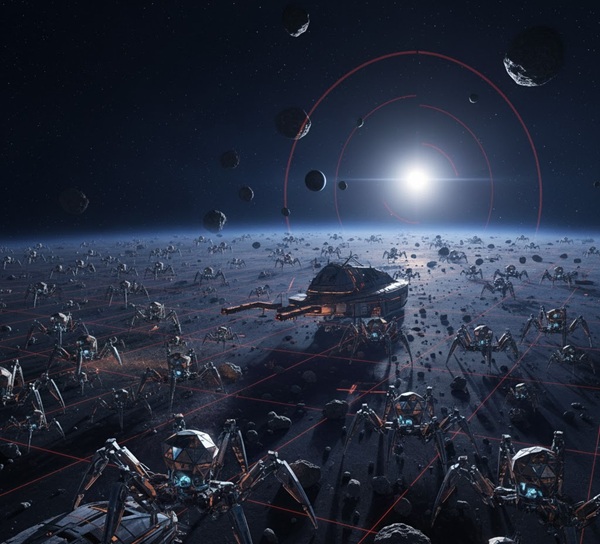
In 1949, mathematician and physicist John von Neumann proposed a mind-bending concept at the University of Illinois — the idea of a “universal constructor.” Years later, this idea evolved into what we now call self-replicating probes — autonomous machines capable of reproducing themselves using raw materials they find in space.
In the decades that followed, scientists involved in the Search for Extraterrestrial Intelligence (SETI) began to ask an unsettling question: What if advanced civilizations have already sent such probes to explore the galaxy — and some are here, right now, in our own Solar System?
That’s exactly what Professor Alex Ellery of Carleton University’s Centre for Self-Replication Research (CESER) is suggesting in his latest research. His paper argues that self-replicating probes could already be operating nearby — and that we should actively look for their technosignatures, the physical traces they might leave behind.
Von Neumann Probes: The Blueprint for Interstellar Exploration
Professor Ellery, an expert in mechanical and aerospace engineering, has long studied how robotics, 3D printing, and automation could one day allow humans to create our own self-replicating spacecraft. He’s even addressed the risks of such systems — including the possibility of “runaway replication,” famously warned about in the Berserker Hypothesis.
But Ellery’s main argument goes far beyond human engineering. He believes that if extraterrestrial civilizations exist, self-replicating probes would be the most efficient way for them to explore and even colonize the Milky Way. And if that’s true, then the Solar System is a prime place to start searching.
Why Would Advanced Civilizations Send Self-Replicating Probes?
Ellery offers a simple but powerful answer: survival.
Every civilization must eventually face existential risks — from its star’s death to environmental collapse or conflict. Sending self-replicating probes across the stars could ensure survival by spreading knowledge, technology, or even life itself far beyond home.
He also notes that exploration and reconnaissance could play major roles. Much like early Earth explorers who sought trade routes or resources, alien civilizations might send probes not out of curiosity, but to secure access to vital materials or to assess potential threats.
And unlike biological life, such probes would have none of our limitations. They wouldn’t need food, oxygen, or rest. They could withstand enormous acceleration and gather resources from asteroids, moons, or even rogue planets drifting through interstellar space.
This combination of efficiency, resilience, and motivation makes them a compelling solution to one of science’s biggest mysteries — the Fermi Paradox. If intelligent life is common, where is everyone? Perhaps, as Ellery suggests, they’re already here — but we’ve been looking in the wrong way.
What Would Alien Probes Do in the Solar System? Six Predictable Phases
Ellery proposes a six-step model describing how such probes might operate:
Resource Targeting: Identify asteroids and moons with valuable raw materials such as nickel, iron, and silica.
Survey Deployment: Construct smaller surveyor probes to map out the system in detail.
Base Establishment: Set up manufacturing outposts in resource-rich locations, ideally low-gravity environments.
Self-Replication: Build new generations of probes, expanding reach and capability.
Exploration and Observation: Conduct long-term monitoring and scientific study of the Solar System.
Execution of Higher Objectives: Construct large-scale structures like O’Neill Cylinders or, in some cases, engage in directed panspermia — seeding life on other worlds.
Each of these steps would leave detectable traces — from unusual isotope ratios to artificial heat signatures — that future SETI missions could search for.
The Moon: The Most Likely Hiding Place for Alien Technosignatures
If alien self-replicating probes visited our Solar System, where might they leave evidence? Ellery points to one place above all: the Moon.
The Moon’s composition — rich in silicates, iron, and nickel — makes it ideal for constructing and powering replicating systems. Moreover, it’s geologically stable, lacks an atmosphere, and preserves ancient surface materials for billions of years.
Ellery even suggests that such probes might have used nuclear reactors built from lunar resources, such as Magnox models, which use uranium, graphite, and carbon dioxide for cooling. These reactors would leave behind isotopic anomalies — unusual ratios of elements like Thorium-232, Neodymium-144, and Barium-137 — potential technosignatures we could detect with future lunar missions.
He also proposes a fascinating idea: what if ancient probes left “gifts” buried beneath asteroidal deposits on the Moon — technological artifacts only discoverable once a civilization reaches sufficient advancement to use them?
SETI’s New Frontier: Searching Our Own Solar System
For decades, SETI has focused almost exclusively on detecting radio signals from distant stars. But Ellery and others, like Professor Gregory L. Matloff, argue that we may need to look closer to home.
There are over 100 million objects in the Kuiper Belt alone — and we’ve examined only two. What if probes are hidden in lunar craters, disguised among asteroids, or operating quietly in the shadows of the outer planets?
With upcoming missions aiming to establish permanent lunar bases and expand commercial mining operations in space, we may soon be examining these environments closely enough to notice something… unexpected.
What If We’re Not the First to Industrialize the Solar System?
Humanity is on the brink of transforming from an Earth-bound species into a spacefaring civilization. But as Ellery warns, before we begin extracting resources and colonizing other worlds, we should also look for signs that someone else has already done so.
Could unusual isotope readings, unexplained magnetic anomalies, or buried artifacts reveal that our Solar System was visited long ago?
And if so — were these visitors explorers, observers… or the builders of something greater?
Perhaps the real question isn’t “Are we alone?” — but rather, “Have we already been found?”
Source: Scientists Warn: Alien Probes Could Be Operating in Our Solar System Right Now
Webb Telescope Spots Something No One Expected in Io’s Skies
Webb Telescope Spots Something No One Expected in Io’s Skies
Scientists Warn: Alien Probes Could Be Operating in Our Solar System Right Now