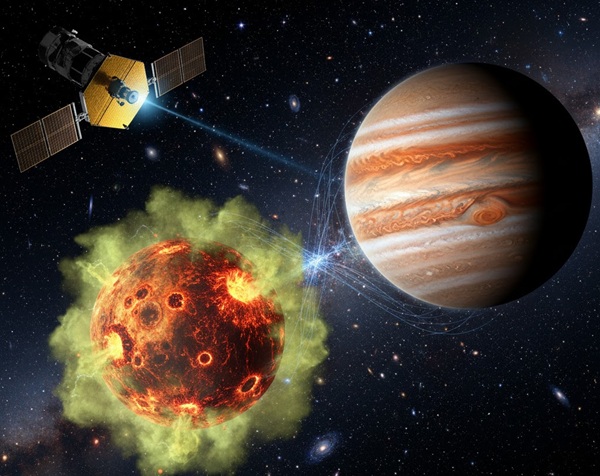
Webb Telescope Spots Something No One Expected in Io’s Skies
Webb Telescope Spies Io’s Explosive Volcanic Activity and Mysterious Sulfur Atmosphere
A Moon Trapped in Jupiter’s Gravitational Grip
Caught in a relentless tug-of-war between Jupiter and its neighboring moons, Io—the innermost of the Galilean satellites—is under constant stress. Its rocky surface is stretched and compressed so violently that the moon’s interior literally melts. The result? Io has become the most volcanically active body in our entire solar system.
But what drives this chaos beneath its frozen crust? And how can we study a world where lava lakes outshine entire cities?
How the James Webb Space Telescope Opened a New Window on Io
The James Webb Space Telescope (JWST), equipped with its powerful Near-Infrared Spectrograph (NIRSpec), has transformed how scientists see Io. By detecting specific infrared wavelengths, Webb allows researchers to identify chemical compositions and temperature variations across Io’s restless surface.
In November 2022, planetary scientist Imke de Pater and her colleagues turned Webb’s gaze toward Io. What they found exceeded even their own long-standing expectations: a massive and energetic volcanic eruption near the lava flow field known as Kanehekili Fluctus. For the first time, researchers confirmed that some of Io’s volcanoes emit excited sulfur monoxide gas, a long-hypothesized but previously unseen phenomenon.
At Loki Patera—Io’s colossal lava lake—JWST captured a surge in thermal emissions caused by the sinking of the lake’s solid crust into the molten magma below, an event that essentially resets Io’s largest volcano.
Eruptions on a Planetary Scale: What Nine Months Revealed
Nine months later, in August 2023, JWST revisited Io, capturing the moon while it again passed through Jupiter’s shadow—a crucial window that lets astronomers study volcanic emissions without interference from sunlight.
This time, Webb’s infrared vision showed that the Kanehekili lava flows had expanded to cover over 4,300 square kilometers—four times their previous reach. Meanwhile, Loki Patera had cooled, forming a new crust in a repeating cycle that scientists have tracked for decades.
Could these cycles hint at a deeper, rhythmic engine powering Io’s eruptions—a planetary heartbeat pulsing beneath its surface?
Sulfur, Stealth Volcanoes, and the Mystery of Io’s Atmosphere
Perhaps the most striking discovery was found high above Io’s volatile surface. JWST detected sulfur monoxide emissions not just above known volcanic sites, but also in two regions without any visible volcanic source—a phenomenon the researchers dubbed “stealth volcanism.”
Even more surprising, the telescope picked up new sulfur gas emissions at previously unobserved wavelengths, revealing a widespread, evenly distributed sulfur haze across Io’s northern hemisphere.
So where did all this sulfur come from if not directly from volcanoes? The answer lies in Io’s surrounding plasma torus, a donut-shaped region filled with charged particles trapped by Jupiter’s immense magnetic field. Electrons from this plasma belt slam into Io’s sulfur dioxide atmosphere, exciting sulfur atoms and triggering glowing emissions visible to JWST.
A Stable Dance Between Io and Jupiter’s Plasma Torus
The angle of JWST’s observations—combined with Io’s position relative to the plasma torus—helped explain why these sulfur emissions were concentrated in the north. Even more intriguingly, when scientists compared Webb’s data with older observations from the Keck Observatory and the Hubble Space Telescope, they found that this Io–plasma torus system has remained remarkably stable for decades.
It’s a cosmic partnership frozen in time: an endless electromagnetic dance between Jupiter’s radiation belt and its most tortured moon.
What’s Next for the Most Volcanic World in the Solar System?
As JWST continues to monitor Io, scientists are beginning to ask bigger questions:
Could Io’s extreme volcanism resemble what once happened on early Earth or other rocky planets?
How does its interaction with Jupiter’s magnetic field influence the entire Jovian system?
And could this tiny moon’s volcanic fury help us understand how worlds evolve under tidal forces?
Each new observation from Webb doesn’t just illuminate Io’s fiery surface—it deepens our understanding of how gravity, heat, and chemistry shape the most extreme environments in our solar system.
Io’s volcanic story, once hidden beneath Jupiter’s blinding light, is finally coming into full view. And as the Webb telescope keeps watching, the solar system’s most volatile world continues to burn—bright, restless, and endlessly fascinating.
Source: Webb Telescope Spots Something No One Expected in Io’s Skies
Our Universe Was Twice as Hot 7 Billion Years Ago, Study Reveals
Our Universe Was Twice as Hot 7 Billion Years Ago, Study Reveals