Scientists May Have Discovered The First Planet Orbiting Three Stars At Once
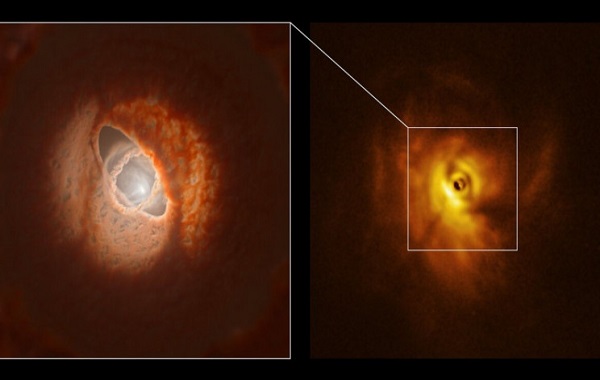
In the constellation of Orion, a star system named GW Ori stands 1,300 light years away from Earth, surrounded by a massive disk of dust and gas. It has piqued the interest of astronomers for a variety of reasons, but the most notable of which is that it’s a system with three stars rather than one.
The mystery doesn’t end there either: GW Ori’s disk is divided in two, resembling Saturn’s rings if there was a vast gap between them, and the outer ring is inclined at around 38 degrees.
Scientists are speculating that the gap in the disk could be caused by the formation of one or more planets in the system, and if this is the case, it would be the first known planet to orbit three stars at the same time, according to an European Southern Observatory (ESO) press release.
There is also another explanation that the stars’ gravitational torque clearing the space in the disk, but the researchers of the new study say there isn’t enough turbulence in the disk to support this theory.
How would it be like to be there?
If the planet could support life and you could somehow travel thorough interstellar space to arrive at the gas giant, you wouldn’t actually be able to see the three stars in the skies as Star Wars might have led you to believe, the New York Times reports. Rather, you would see only a pair because the two innermost stars orbit so close together that they seem like a single point of light. However, as the planet rotated, you would see the stars rising and falling in magnificent sunrises and sunsets that are unlike anything that can be seen on any other known planet.
The question of whether the planet exists is still being debated, but observations from the ALMA telescope and the Very Large Telescope in Chile in the next months may provide an answer.
Source:Interesting Engineering
Fastest orbiting asteroid discovered
Scientists May Have Discovered The First Planet Orbiting Three Stars At Once