Scientists Just Found The ‘Front Door’ To A Massive Cave On The Moon
The Sea of Tranquility is home to at least one lunar lava tube, which could preserve a pristine and unweathered record of lunar volcanism.
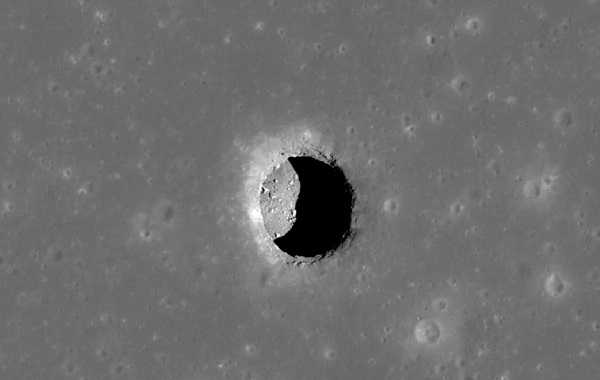
The Moon’s surface is pockmarked with more than 200 known pits where rocks and regolith collapsed into depths unknown. New research has found that one of those pits, in Mare Tranquillitatis, collapsed into a lava tube and made an underground cave conduit accessible from the lunar surface.
“We found a sort of front door to enter the subsurface,” said Leonardo Carrer, a planetary scientist at the University of Trento, Italy, and first author on the research. Its access to the otherwise shielded lunar subsurface makes this pit a tantalizing site for future human and robotic exploration and could provide new insight into lunar volcanism.
Reflections from below
The Moon was once covered in seas of magma that eventually cooled into the dark basaltic maria visible today. Lunar scientists have long thought that like Earth, the Moon could host other volcanic features such as lava tubes.
Lava tubes form when a lava stream cools and forms a hardened exterior shell. Hot lava continues to flow through it like sludge in a pipe. Eventually, lava flows out of the tube and leaves a hollow conduit that could connect to emptied magma chambers or caves.
“We had a lot of evidence on the surface of the Moon suggesting that lunar lava tubes could have existed,” Carrer said. Lunar pits, elliptical craters that formed not from an impact but from the surface collapsing into an underground void, have been some of the most compelling evidence for these tubes. More than 200 of these pits have been imaged on the Moon’s surface, and scientists speculate that they may be skylights into cave conduits, which happens on Earth when the top of a cave collapses and exposes it to the surface.
Carrer and his colleagues, including fellow University of Trento planetary scientist Lorenzo Bruzzone, wanted to know whether it was possible to map a hidden cave using orbital synthetic aperture radar (SAR) instruments. They first tested this method at two terrestrial cave systems in Lanzarote, Spain, and the Well of Barhout in Yemen, which are both planetary analogs. They used the SAR data to create 3D reconstructions of the two terrestrial cave systems near their entrances.
“We verified that the cave characteristics we were measuring from space matched what the speleologists measured on the ground,” Carrer said. That gave them the confidence to try out this technique on the Moon.
They focused their attention on the Mare Tranquillitatis pit, a nearly circular sinkhole about 100 meters across and 105 meters deep. The radar data were taken in 2010 by the Lunar Reconnaissance Orbiter, which sent a signal down into the pit at an angle and received a radar reflection from the bottom.
“We could detect from this pit…a reflection that clearly proved an opening on the bottom and the entrance of a cave, which probably is a part of a lava tube,” Bruzzone said. “It was quite easy to understand the signals seen on the Moon thanks to the Earth validation.”
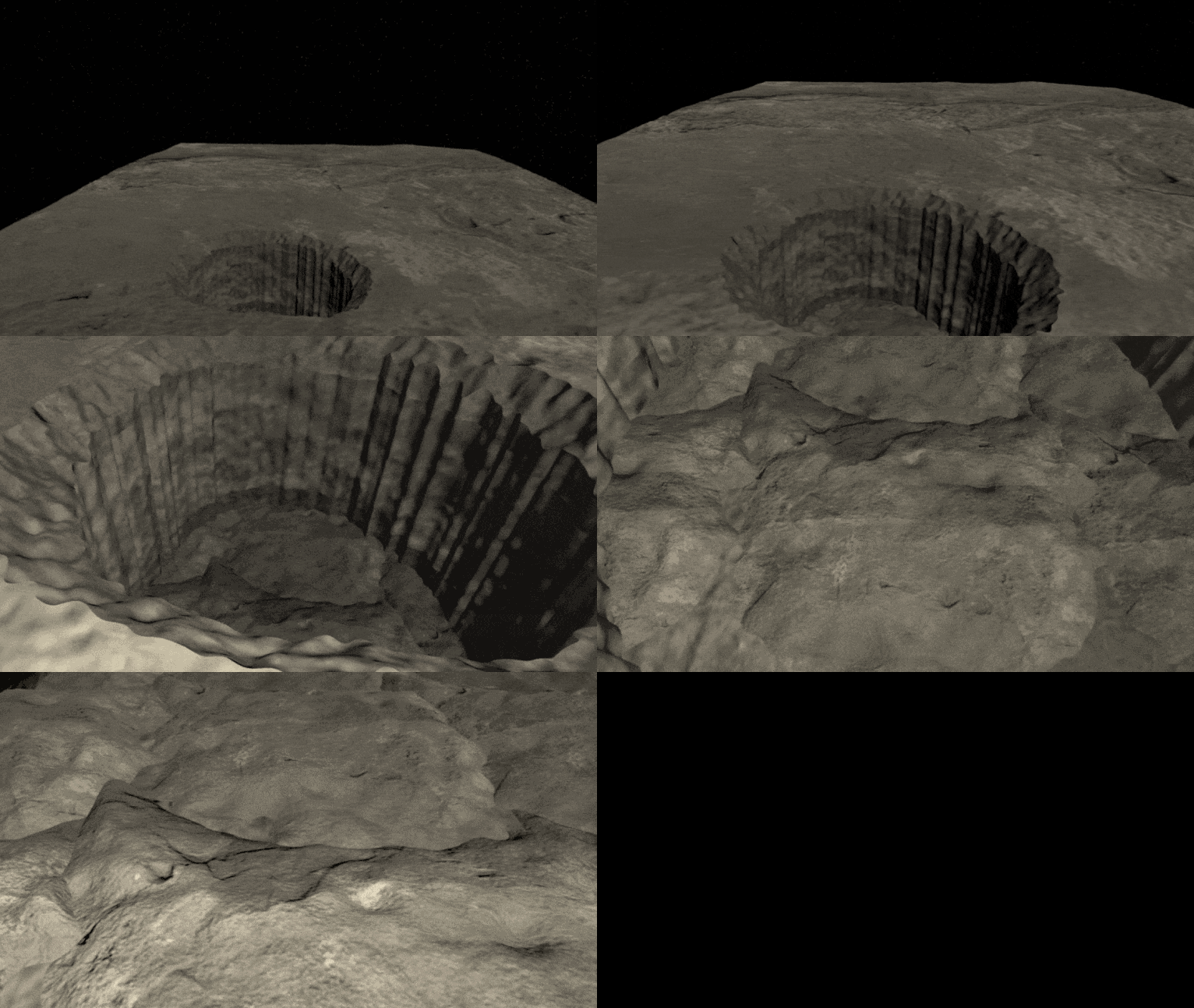
They fed those radar measurements into their computer model to create a 3D visualization of the lava tube with estimates of its dimensions. The model suggests that the entrance is at least 45 meters wide. Depending on how sharply the conduit slopes downward, it extends 30–80 meters from the entrance and reaches 135–175 meters below the lunar surface. The researchers published this research in Nature Astronomy.
Source: Scientists Just Found The ‘Front Door’ To A Massive Cave On The Moon
Two Super-Earths Orbiting Nearby Stars: What Secrets Do They Hold?