A Fourteen-Century-Old Monument Reveals a Forgotten Secret—But Whose Secret Was It?
Rare Pre-Hispanic Structure and Symbolic Monolith Uncovered in Veracruz: Could a Forgotten Civilization Rewrite Mexico’s Ancient History?
For centuries, the lands of Veracruz have concealed countless stories beneath their soil. Yet some discoveries do more than reveal ancient ruins. They challenge what archaeologists thought they knew. They raise questions that linger long after the excavation ends. And sometimes, they hint at forgotten cultures that vanished without leaving written records behind.
Now, an extraordinary archaeological discovery in eastern Mexico has opened a new chapter in the history of ancient Mesoamerica. Hidden beneath modern land destined for residential development, researchers have uncovered a ceremonial complex unlike anything previously documented in this part of Veracruz. Alongside it stood an enigmatic stone monument whose imagery may preserve memories of sacred rituals and cultural interactions that occurred more than fourteen centuries ago.
Rare Pre-Hispanic Structure and Symbolic Monolith Uncovered in Veracruz Reveals a Forgotten Ceremonial Center
A rescue archaeology project carried out by Mexico’s National Institute of Anthropology and History (INAH) in the municipality of Coatepec has revealed remarkable architectural remains dating to the Early Classic period, between approximately AD two hundred and six hundred.
The discovery emerged during investigations at the San Lucas residential development. However, what researchers expected to be a routine survey soon transformed into something much more intriguing.
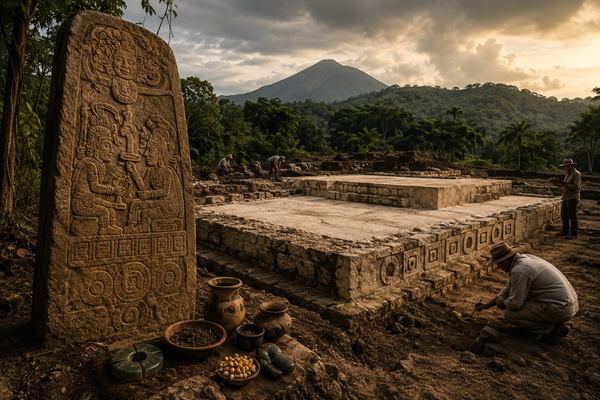
Archaeologists uncovered a large rectangular platform measuring approximately thirty meters in length and twelve meters in width. Builders constructed the platform using flagstones and white limestone covered with a plaster-like surface. Evidence suggests that ancient craftsmen intentionally exposed parts of the structure to heat, creating decorative finishes that distinguished the ceremonial building from ordinary constructions.
Yet the architecture itself presented an even greater mystery.
Decorative elements carved into the structure display geometric designs composed of squares and circles. In addition, circular stones embedded into the platform walls appear to follow patterns never before documented in this region.
Could these unusual features represent a local architectural tradition that has remained invisible to archaeology until now?
Or do they preserve influences from neighboring civilizations that historians have yet to recognize?
Ancient Veracruz Ceremonial Platform Displays Architectural Features Never Seen Before
Researchers from INAH emphasize that these decorative motifs differ from known styles associated with other Gulf Coast cultures.
Consequently, the discovery raises fascinating questions.
Did an independent population develop its own ceremonial traditions in central Veracruz?
Could entire cultural groups have flourished between larger civilizations without leaving extensive traces behind?
Ancient Mexico consisted of far more than famous societies such as the Maya, Aztec, and Totonac. Hundreds of local communities interacted, exchanged ideas, and created unique identities. Therefore, every new discovery adds another missing piece to an increasingly complex historical puzzle.
The Veracruz platform may represent one of those lost pieces.
Symbolic Monolith Discovery in Veracruz Preserves a Sacred Scene Frozen in Stone
Near the ceremonial platform, archaeologists uncovered a spectacular monolithic stela standing almost one point eighty-eight meters tall.
Its carvings depict two elite individuals seated opposite one another while dressed in elaborate garments. Above them appears a divine figure. This supernatural being pours a sacred liquid into a vessel held by the seated nobles.
The scene seems highly ceremonial. It may portray a ritual associated with divine legitimacy, ancestor worship, or sacred kingship.
Interestingly, one figure exhibits features commonly associated with Maya artistic traditions.
This observation immediately attracted researchers’ attention.
Could ancient Veracruz communities have maintained connections with distant Maya regions?
Did merchants, priests, or nobles travel between these areas carrying religious beliefs and artistic ideas?
Although definitive answers remain elusive, the monument hints at cultural exchanges that extended far beyond local boundaries.
Ancient Mesoamerican Rituals and Sacred Offerings Reveal Spiritual Beliefs
Excavations produced more than architecture and sculpture.
Archaeologists discovered buried pottery vessels carefully placed beneath the ceremonial complex. They also recovered charred maize remains and a greenstone bead intentionally broken into four pieces.
These objects were not discarded randomly.
Instead, they formed ritual offerings.
Ancient Mesoamerican societies often buried symbolic objects beneath temples and ceremonial platforms. Such offerings served as gifts to gods, ancestors, or supernatural forces connected to fertility, agriculture, and cosmic order.
The burned maize fragments hold particular importance.
Maize represented much more than food. Across Mesoamerica, it symbolized life itself. Many traditions viewed humans as beings created from maize by divine powers.
Could these offerings commemorate the dedication of the structure?
Or might they represent ceremonies intended to maintain harmony between people and the sacred world?
Researchers continue to investigate these possibilities.
Could This Rare Pre-Hispanic Structure Belong to an Unknown Veracruz Civilization?
Central Veracruz often evokes images of the Totonac civilization. However, researchers have not identified direct evidence linking the newly discovered complex to the Totonacs.
Instead, specialists increasingly suspect that a distinct local population occupied the area.
This possibility carries enormous implications.
History frequently focuses on large empires. Nevertheless, smaller societies often contributed innovations and traditions that shaped broader civilizations.
Perhaps ancient Veracruz contained communities whose stories disappeared over time.
Perhaps their descendants merged with neighboring cultures.
Or perhaps future excavations will uncover additional monuments capable of revealing names, beliefs, and identities lost for centuries.
Archaeological Conservation Efforts Aim to Protect Veracruz Heritage
Fortunately, both the platform and the monolithic sculpture survived in remarkably good condition.
Conservation specialists have already begun stabilizing the monument. They are applying protective consolidants to preserve delicate surfaces and preparing restoration work for the architectural remains.
Meanwhile, scientists transferred recovered artifacts to specialized laboratories. There, interdisciplinary teams led by INAH Veracruz Centre archaeologists Alberto Vázquez Domínguez and Lino Espinoza García will analyze the materials in detail.
Fieldwork began during late twenty twenty-five after landowners requested permission to modify the twelve-hectare property for residential construction.
Excavations will continue through August twenty twenty-six, while laboratory studies are expected to extend into early twenty twenty-seven.
Therefore, the most exciting discoveries may still lie underground.
Why Discoveries Like This Continue to Transform Ancient Mexican History
Mexico possesses one of the richest cultural landscapes on Earth. Beneath forests, mountains, and agricultural fields lie countless traces of civilizations that shaped human history.
Mexico’s Secretary of Culture, Claudia Curiel de Icaza, emphasized this point, stating that every object, structure, and symbol emerging from archaeological research strengthens our understanding of humanity’s shared past.
Indeed, discoveries such as this remind us that history remains unfinished.
How many forgotten cultures still sleep beneath the soil?
How many traditions disappeared before written records could preserve them?
And could future excavations reveal civilizations that historians have never imagined?
Perhaps the greatest mystery is not what archaeologists have already found.
Perhaps it is what still waits below our feet.
Scientific Importance of the Discovery
The Veracruz ceremonial complex represents much more than an isolated archaeological site.
Its architecture, ritual offerings, and symbolic monolith provide evidence of regional diversity during the Early Classic period. Furthermore, the unusual artistic elements suggest that local societies actively participated in broader Mesoamerican cultural networks while maintaining distinct traditions.
Because no comparable architectural examples have been documented in the area, the site may redefine scholars’ understanding of population movements, political organization, and religious practices along Mexico’s Gulf Coast.
As excavations continue, researchers may uncover additional structures, inscriptions, or artifacts capable of revealing who these people were and how they fit into the wider story of ancient America.
Source: A Fourteen-Century-Old Monument Reveals a Forgotten Secret—But Whose Secret Was It?
Scientists Say These 100,000-Year-Old Carvings Aren’t Language… But What Are They Then?
Scientists Say These 100,000-Year-Old Carvings Aren’t Language… But What Are They Then?
A Fourteen-Century-Old Monument Reveals a Forgotten Secret—But Whose Secret Was It?
Sources
National Institute of Anthropology and History (INAH), Mexico.
INAH Veracruz Centre archaeological reports.
Statements from Mexico’s Secretary of Culture, Claudia Curiel de Icaza.
Mesoamerican archaeology studies concerning the Early Classic period.
Ongoing investigations associated with the Campo Viejo archaeological zone.
Archaeological conservation and field reports from Coatepec, Veracruz.
A Fourteen-Century-Old Monument Reveals a Forgotten Secret—But Whose Secret Was It?