Voyager 1 Is About to Reach a Historic Cosmic Milestone—But What Happens After One Light-Day?
For nearly half a century, humanity has been extending its reach beyond the boundaries of the known Solar System. Now, one of the greatest achievements in the history of exploration is approaching another astonishing milestone. On November eighteenth, twenty twenty-six, Voyager One will officially become the first human-made object ever to travel more than one light-day away from Earth.
At first glance, a light-day may seem like just another astronomical measurement. However, when we truly grasp what it means, the scale becomes almost unimaginable. A signal traveling at the speed of light will require more than twenty-four hours to journey between Earth and Voyager One. In other words, a conversation with the spacecraft will take two days or more when a reply is considered.
Pause for a moment and consider that reality. How remarkable is it that a species that only recently learned to fly is now communicating with a machine located an entire light-day away from its home world?
VOYAGER ONE LIGHT-DAY DISTANCE MILESTONE MARKS A HISTORIC MOMENT FOR HUMANITY
According to calculations confirmed by NASA’s Voyager mission team, Voyager One is expected to reach this historic threshold at approximately ten sixteen and seven seconds Coordinated Universal Time on Wednesday, November eighteenth, twenty twenty-six.
Although slight variations may occur because both Earth and Voyager One continue moving through space, the date remains one of the most significant moments in the history of human exploration.
This achievement is not merely a technical record. Rather, it symbolizes the extraordinary ability of human beings to build machines capable of venturing into regions no human will physically visit for countless generations.
Yet an intriguing question remains. If Voyager One is already one light-day away, how much farther can it travel before its voice finally falls silent?
THE INCREDIBLE JOURNEY OF VOYAGER ONE AND VOYAGER TWO THROUGH THE OUTER SOLAR SYSTEM
The Voyager spacecraft were launched in nineteen seventy-seven during one of the most ambitious planetary exploration programs ever attempted.
Voyager One embarked on a trajectory that carried it past Jupiter and Saturn. Meanwhile, Voyager Two followed a different route and achieved something no spacecraft has accomplished since. It became humanity’s only close visitor to Uranus and Neptune.
These encounters transformed our understanding of the outer planets. Gigantic storms, active moons, complex ring systems, and unexpected geological activity were revealed in stunning detail.
As the spacecraft continued outward, they ventured beyond the protective bubble created by the Sun, known as the heliosphere. Voyager One crossed into interstellar space in twenty twelve, while Voyager Two followed in twenty eighteen.
This region remains one of the least explored environments accessible to science. Consequently, every piece of information returned by the spacecraft helps researchers better understand the boundary between our Solar System and the wider galaxy.
INTERSTELLAR SPACE EXPLORATION CONTINUES DESPITE AGING SPACECRAFT SYSTEMS
Few expected the Voyagers to remain operational for nearly fifty years.
Nevertheless, both spacecraft continue sending scientific information across billions of kilometers. This achievement is even more impressive when one considers the age of their technology. The onboard computers possess less processing capability than many modern household devices.
As power supplies gradually decline, mission engineers have been forced to make difficult decisions. Several scientific instruments have already been shut down to conserve energy. More recently, additional systems were deactivated in order to extend mission life as long as possible.
Even so, the Voyager engineering teams continue performing what many experts describe as technological miracles. They routinely diagnose and solve problems on spacecraft located farther away than any other machines ever created by humanity.
How many decades can these aging explorers continue functioning? No one knows for certain. Yet their survival has repeatedly exceeded expectations.
THE PALE BLUE DOT LEGACY AND THE LAST LOOK BACK AT EARTH
One of Voyager One’s most enduring contributions may not be a scientific measurement at all.
On Valentine’s Day in nineteen ninety, the spacecraft captured what would become one of the most famous photographs in history: the Pale Blue Dot.
In that image, Earth appears as a tiny speck suspended within a vast beam of sunlight. Every civilization, every war, every triumph, every dream, and every human life known to history existed on that almost invisible point of light.
The photograph transformed how many people viewed humanity’s place in the cosmos.
Today, Voyager One no longer carries out imaging operations. Its cameras have long since been turned off to preserve precious power. Nevertheless, the message contained within that image continues to resonate.
If our entire history can fit inside a single pixel, what does that reveal about our place in the universe?
ONE LIGHT-DAY AWAY YET STILL FAR FROM THE NEAREST STAR
Although Voyager One is traveling at extraordinary speed, interstellar space is unimaginably vast.
By mid-November of twenty twenty-six, the spacecraft will be approximately twenty-five point nine billion kilometers from Earth. Light itself will require more than a full day to cross that distance.
However, reaching another star remains a challenge on a completely different scale.
NASA estimates that it will take roughly forty thousand years before Voyager One comes closer to the star known as Gliese Four Hundred Forty-Five than it is to our Sun.
This fact highlights one of the most astonishing realities of astronomy. Even after traveling continuously for tens of thousands of years, Voyager One will have explored only a tiny fraction of the distances separating stars.
Could future civilizations discover the spacecraft drifting silently between the stars? Might intelligent life someday encounter it? These questions remain unanswered, yet they continue to inspire both scientists and dreamers alike.
THE GOLDEN RECORD: HUMANITY’S MESSAGE IN A BOTTLE TO THE COSMOS
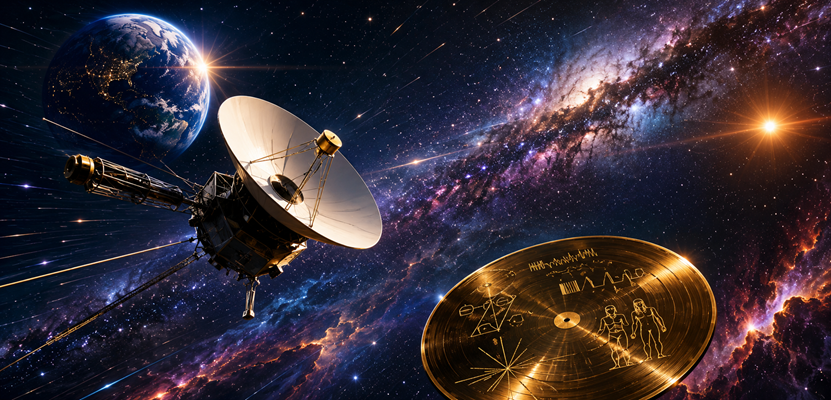
Perhaps the most poetic aspect of the Voyager mission is the presence of the Golden Record carried aboard each spacecraft.
These gold-plated records contain sounds, greetings, music, images, and cultural expressions representing life on Earth. They were designed as messages for any intelligence that might someday encounter the spacecraft.
Included are greetings in numerous languages, natural sounds from Earth, and visual snapshots of human civilization.
Scientists do not know whether anyone will ever find these records. In fact, the probability may be extraordinarily small. Nevertheless, the Golden Record represents something profoundly human.
It is an act of hope.
It is a declaration that humanity wished to introduce itself to the universe.
And perhaps that raises the ultimate question: if another civilization someday discovers the Golden Record, what will they learn about us from the messages we chose to send?
WHAT THE VOYAGER ONE LIGHT-DAY MILESTONE REVEALS ABOUT HUMANITY’S FUTURE IN SPACE
The story of Voyager One is ultimately not just about a spacecraft.
It is about curiosity.
It is about exploration.
It is about a species that emerged from ancient African landscapes, learned to observe the stars, developed science, and eventually built machines capable of traveling beyond the influence of the Sun.
The upcoming one light-day milestone serves as a reminder that exploration remains one of humanity’s defining characteristics.
While our world faces challenges and divisions, Voyager One continues moving outward, carrying evidence of our existence into the darkness between the stars.
Every additional kilometer it travels expands humanity’s reach.
Every signal it sends reminds us of what cooperation, ingenuity, and persistence can achieve.
And perhaps the most fascinating question of all remains unanswered.
If humanity has already sent a spacecraft one light-day from Earth, where will our explorers be one thousand years from now?
CONCLUSION: A COSMIC RECORD THAT WILL INSPIRE GENERATIONS
When Voyager One crosses the one light-day threshold on November eighteenth, twenty twenty-six, a new chapter in human history will quietly unfold.
No crowds will gather around the spacecraft. No celebrations will echo through interstellar space. Yet the significance of the moment will be immense.
For the first time, a human-made object will reside more than one light-day from its creators.
The achievement stands as a testament to human imagination and determination. Moreover, it demonstrates how far scientific curiosity can carry us when we dare to venture beyond the familiar.
Voyager One may eventually fall silent. Its instruments may cease operation. Its transmissions may stop forever.
Yet its journey will continue.
Long after our own era has passed into history, Voyager One will keep traveling among the stars, carrying with it a small but enduring reminder that humanity once looked into the darkness and chose to explore.
Source: Voyager 1 Is About to Reach a Historic Cosmic Milestone—But What Happens After One Light-Day?
Voyager 1 Is About to Reach a Historic Cosmic Milestone—But What Happens After One Light-Day?
Sources
NASA Voyager Mission
NASA Jet Propulsion Laboratory (JPL)
Voyager Interstellar Mission Data
IFLScience Interview with Dr. Linda Spilker
NASA Heliophysics Program
NASA Pale Blue Dot Archive
Voyager Golden Record Project Documentation
Voyager 1 Is About to Reach a Historic Cosmic Milestone—But What Happens After One Light-Day?