Scientists Found a Hidden Brain Signal That Predicts Social Behavior
Scientists discovered that the brain begins preparing for social connection before we even make the first move.
Why do we decide to approach other people? According to new research, the answer may start unfolding in the brain several seconds before any movement takes place.
A team of scientists from the Hebrew University of Jerusalem has identified a distinctive pattern of brain activity that appears before social interaction begins. Their findings suggest that the brain is already preparing for a social encounter before an individual takes action, and that the strength of this neural activity may reflect how socially motivated someone is.
The study was led by Dr. Lilah Avitan and conducted by PhD student Imri Lifshitz along with colleagues at the Edmond and Lily Safra Center for Brain Sciences (ELSC) at the Hebrew University of Jerusalem.
Tracking Social Decisions in Real Time
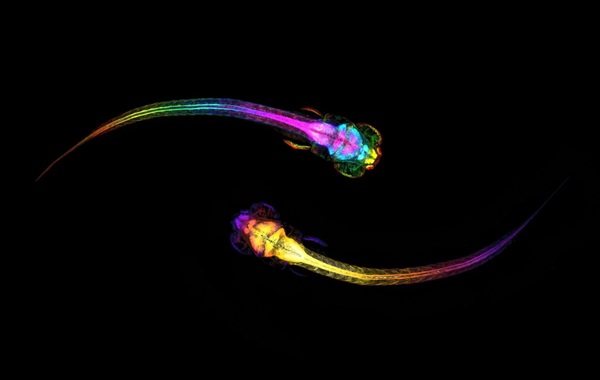
To investigate how social decisions are formed, the researchers used zebrafish, a popular model organism that allows scientists to observe activity across the brain at the level of individual cells.
The team created a new experimental system in which one fish watched and responded to another fish that was swimming nearby. While this happened, researchers recorded activity throughout the observing fish’s brain in real time.
This approach allowed them to follow the neural processes involved in social behavior as they unfolded, revealing how the brain transforms social information into action.
A Brain-Wide Signal Before Social Behavior
The researchers discovered that the brain begins shifting into a different state several seconds before a fish moves toward another fish.
Rather than relying on a single region dedicated to social behavior, the process involved coordinated changes across multiple parts of the brain.
Specifically:
- Activity increased in the pallium, a higher brain region associated with complex behaviors.
- Activity decreased in several other brain regions at the same time.
Together, these changes created what the researchers describe as a neural “pre-decision state.” This brain-wide pattern reliably signaled that a social approach was about to occur and could be used to predict the upcoming behavior before the movement even started.
Social Drive and the Pallium
The study also revealed a connection between this neural pattern and individual differences in sociability.
Fish that showed a stronger pre-decision signal tended to be more social overall. The results suggest that the intensity of this brain-wide activity reflects an individual’s social drive.
The findings further highlight the importance of the pallium, identifying it as a key brain region involved in promoting social approach behavior and helping drive interactions with others.
“This study identifies a brain-wide neural signature of social approach that emerges before movement begins,” said Dr. Avitan. “This signature predicts not only whether an upcoming action will be social, but also how strongly socially driven the individual is.”
Insights Into Social Behavior Across Species
Understanding how the brain generates social behavior may help explain why some individuals are naturally more social than others.
Because comparable brain structures contribute to social behavior across many species, the researchers believe these findings could eventually provide insight into human social functioning as well as conditions in which social behavior is disrupted.
Source: SciTechDaily
Scientists discover collagen, the human body’s most abundant protein, is liquid-like inside cells
Scientists Found a Hidden Brain Signal That Predicts Social Behavior