Scientists Say These 100,000-Year-Old Carvings Aren’t Language… But What Are They Then?
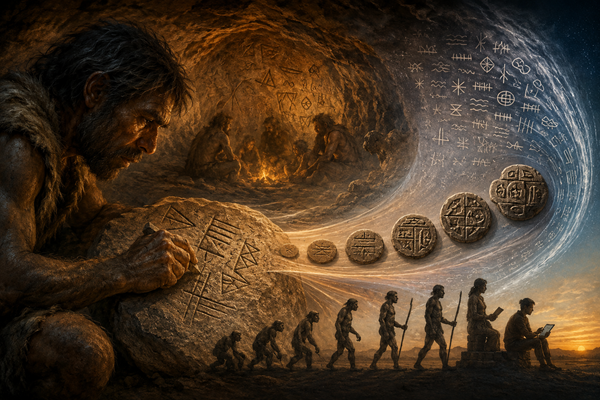
What were humans trying to express one hundred thousand years ago, long before alphabets, words, and writing systems existed? Were these mysterious engravings the first steps toward written language, or do they reveal something entirely different about the origins of human culture?
For decades, archaeologists have debated the meaning of ancient geometric markings engraved onto stone surfaces and animal bones. These abstract patterns, discovered at archaeological sites in South Africa, have been viewed by some researchers as evidence of an early symbolic language. Others, however, have argued that the engravings served different social or cultural purposes.
Now, a fascinating new study has added powerful evidence to this debate. The findings suggest that these ancient carvings were probably not an early form of written communication. Instead, they may represent one of humanity’s earliest expressions of identity, symbolism, and aesthetic creativity.
More importantly, the research offers a rare glimpse into how culture itself may have shaped the development of human cognition.
Blombos Cave And Diepkloof Rock Shelter: The Birthplace Of Early Symbolic Behavior
The study focused on artifacts recovered from two famous archaeological sites in South Africa: Blombos Cave and Diepkloof Rock Shelter.
These locations have produced some of the oldest known examples of symbolic engravings ever discovered. Dating back roughly one hundred thousand years, the markings consist of carefully etched geometric patterns that appear intentional rather than random.
The existence of these designs has long fascinated scientists. Why would early humans invest time and energy into creating abstract symbols? What purpose did these markings serve in societies that existed tens of thousands of years before writing emerged?
These questions have remained largely unanswered. However, researchers have now developed an innovative way to investigate them.
Archaeological Experiment Recreates The Cultural Evolution Of Ancient Engravings
Rather than studying the artifacts alone, scientists attempted to recreate the processes that may have shaped the original designs.
A total of one hundred and eight volunteers participated in an archaeological experiment designed to simulate cultural transmission across generations.
Participants were divided into twelve separate chains. Each chain contained nine generations of individuals.
The first participant in every chain was shown an image of an authentic prehistoric engraving. That individual was then instructed to reproduce the design as accurately as possible.
Next, the copied image was passed to another participant, who created a new version before handing it to the next person. This process continued through nine successive generations.
The experiment resembled a visual version of the classic telephone game. However, instead of words changing over time, symbols evolved through repeated copying.
As the researchers observed these transformations, a remarkable pattern emerged.
Human Cognition Naturally Creates More Order, Symmetry, And Structure
Across all twelve experimental chains, the designs gradually became more regular, balanced, and symmetrical.
This finding suggests that humans may possess an inherent tendency to impose order on visual information. In other words, our brains naturally favor structure and organization when reproducing symbols.
Even without explicit instructions, participants consistently altered the engravings in ways that made them appear cleaner and more coherent.
Could this cognitive preference explain why certain symbolic forms appear repeatedly across different cultures and time periods?
Perhaps the human mind has always been predisposed to transform visual information into recognizable patterns.
If so, the roots of symbolic culture may run far deeper than previously imagined.
Testing Whether Ancient Symbols Functioned As Communication Or Identity Markers
The experiment became even more revealing when researchers introduced three different cultural conditions.
Under the first condition, participants were simply asked to make their designs visually appealing. The symbols had no intended meaning beyond decoration.
Under the second condition, volunteers attempted to express group identity. Their goal was to create symbols that would allow observers to recognize which experimental chain an artist belonged to.
The third condition focused on communication. Participants attempted to transmit specific concepts such as “fire,” “cloud,” “fish,” or “eye” through their drawings.
At first glance, all three approaches seemed capable of producing symbolic designs. Yet subtle differences soon appeared.
As generations progressed, symbols in every condition became increasingly memorable, distinctive, and visually prominent.
However, the communicative symbols evolved differently from the decorative and identity-based symbols.
This distinction proved crucial.
The Surprising Evidence Against A Proto-Writing System
When researchers compared the experimental drawings to the actual prehistoric engravings, an unexpected pattern emerged.
The ancient carvings closely resembled symbols created under the decorative and group identity conditions.
By contrast, they differed significantly from symbols developed for direct communication.
This observation led to one of the study’s most important conclusions.
The cognitive signature associated with meaningful information transfer was largely absent from the prehistoric engravings.
As a result, the researchers argue that the carvings were unlikely to represent a proto-writing system.
Instead, they were probably created for aesthetic purposes, social identification, or both.
This conclusion challenges a popular interpretation that has gained attention in recent years.
If these symbols were not intended to communicate specific messages, what motivated their creators to produce them?
Could they have functioned as cultural badges? Were they markers of belonging, status, or shared traditions?
Or were they early artistic expressions created simply because humans found beauty and meaning in abstract forms?
How Culture May Have Shaped The Evolution Of Symbolic Thought
Perhaps the most intriguing aspect of the study involves the relationship between culture and cognition.
Researchers discovered that certain beneficial properties emerged automatically as symbols evolved.
For example, when a design became easier to remember, it also appeared more intentional.
Similarly, when symbols became more visually striking, they simultaneously became easier to recognize.
These improvements often occurred without deliberate planning.
Instead, they emerged naturally through repeated cultural transmission.
This finding suggests that symbolic systems may not require sudden biological changes or genetic mutations to develop.
Rather, culture itself may drive the evolution of symbolic complexity.
Generation after generation, simple marks can gradually acquire new properties as they are copied, refined, and shared.
If this process operated throughout prehistory, then culture may have played a far greater role in shaping human intelligence than previously recognized.
Did Culture Create The Human Mind As Much As The Human Mind Created Culture?
For many years, scientists assumed that advanced symbolic thought emerged primarily because human brains evolved new cognitive capabilities.
This study presents a more nuanced possibility.
Perhaps symbolic thinking was not merely a prerequisite for culture.
Perhaps culture actively contributed to the development of symbolic thinking.
Through countless acts of imitation, teaching, experimentation, and creativity, human communities may have gradually transformed simple visual marks into increasingly sophisticated symbolic systems.
In this view, culture becomes more than a product of cognition.
It becomes one of cognition’s architects.
Such an idea raises profound questions.
Did early engravings help shape the minds of those who created them?
Could the emergence of art, symbolism, and social identity have influenced the development of human consciousness itself?
And if culture helped build symbolic thought in the distant past, what cultural forces continue shaping our minds today?
The Ancient Engravings That Still Speak Without Words
The carvings from Blombos Cave and Diepkloof Rock Shelter may not represent humanity’s first written language. Yet their significance remains extraordinary.
These symbols reveal a world in which early humans were already experimenting with identity, aesthetics, memory, and shared meaning.
They demonstrate that long before written communication emerged, people were creating visual traditions capable of surviving across generations.
Most importantly, they remind us that some of humanity’s greatest innovations may not have appeared suddenly. Instead, they may have emerged gradually through countless acts of cultural transmission.
One hundred thousand years later, these ancient engravings continue to pose a captivating mystery.
They may not tell us exactly what our ancestors were thinking.
Yet they reveal something equally important: the remarkable journey through which culture, symbolism, and the human mind evolved together.
Source: Scientists Say These 100,000-Year-Old Carvings Aren’t Language… But What Are They Then?
A Face Hidden for 75,000 Years Has Emerged—And It’s Changing Everything We Thought We Knew.
A Face Hidden for 75,000 Years Has Emerged—And It’s Changing Everything We Thought We Knew.
Scientists Say These 100,000-Year-Old Carvings Aren’t Language… But What Are They Then?
Sources
Proceedings of the National Academy of Sciences (PNAS)
Research on Blombos Cave archaeological engravings
Research on Diepkloof Rock Shelter symbolic artifacts
Experimental archaeology and cultural transmission studies
Studies on the evolution of symbolic cognition and prehistoric culture
Scientists Say These 100,000-Year-Old Carvings Aren’t Language… But What Are They Then?