Scientists Found a Directly Dated Signature of Ancient Life — Could This Rewrite the Story of Earth’s Beginning?
For decades, scientists have searched for something that could answer one of the most profound questions in Earth science: When did life first become established on our planet?
The question sounds deceptively simple. Earth formed roughly four-point-five-six billion years ago, yet the geological record from its earliest era has been repeatedly altered by heat, pressure, erosion, melting, and tectonic activity. Almost everything that lived during that period has disappeared.
That is why a dark, finely layered rock from eastern India has attracted extraordinary attention.
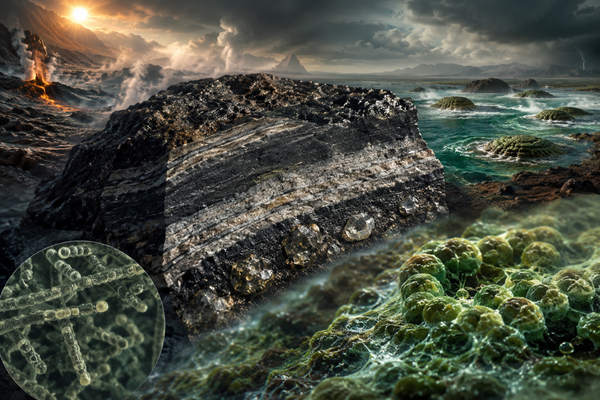
Researchers led by geologist Trisrota Chaudhuri of the Geological Survey of India have reported carbon-rich material preserved inside the Bhitardari chert, a silica-rich rock from the Singhbhum Craton. The material carries several chemical and structural features that the researchers interpret as remnants of an ancient microbial community. More importantly, zircon crystals embedded in the same rock provide a radiometric age of approximately three-point-four-nine-seven billion years, with an uncertainty of about five million years.
The significance is not merely the age.
It is the combination of age, geological context, carbon chemistry, isotope composition, microscopic structure, and zircon dating.
Could this be the moment when scientists finally obtained a direct chronological anchor for one of the oldest biological signatures on Earth?
And what does this ancient rock tell us about the world in which Earth’s earliest microbial ecosystems evolved?
Three-Point-Five-Billion-Year-Old Evidence of Life: Why This Rock Matters
Some geological formations contain possible traces of life that are considerably older than the Bhitardari material. However, determining their precise age can be difficult.
Scientists often date a rock layer by dating surrounding volcanic rocks or minerals deposited before or after it. That approach can provide an age range, but it does not always establish the exact age of the biological material itself.
The Bhitardari study addresses this problem in a different way.
The researchers found tiny zircon crystals within a black-and-white banded chert that also contains carbonaceous matter. Their interpretation is that the zircons formed from volcanic material and became incorporated into the sediment while the chert was being deposited. Four relatively undisturbed zircon grains produced closely matching uranium-lead ages of about three-point-four-nine-seven billion years.
That distinction is crucial.
The researchers are not claiming that scientists placed a radioactive clock directly inside an ancient microbial cell. Rather, they argue that the zircon crystals and the carbon-bearing sediment were deposited during the same geological episode.
In other words, the minerals provide the clock while the carbonaceous material provides the suspected biological signal.
Could this approach help settle some of the uncertainty surrounding other ancient claims of life?
Possibly.
But the discovery also reminds us that identifying life billions of years after it existed requires much more than simply finding carbon inside an old rock.
The Singhbhum Craton: A Geological Archive From Earth’s Deep Past
The discovery comes from the Singhbhum Craton in eastern India, one of the ancient fragments of continental crust that survived billions of years of geological destruction.
The region contains rocks dating back deep into the Archean Eon. Previous zircon studies have identified extremely old components within the craton, including material older than four billion years, demonstrating how valuable this geological region is for reconstructing Earth’s early history.
During the time represented by the Bhitardari chert, however, the planet looked nothing like the modern Earth.
There were no forests.
There were no animals.
There was no oxygen-rich atmosphere comparable to today’s.
Instead, volcanic activity was widespread, oceans interacted intensely with newly formed crust, and hydrothermal systems circulated chemically reactive fluids through the seafloor.
The ancient Singhbhum region preserves evidence of volcanic and marine environments that could have provided abundant minerals and chemical gradients.
That raises a fascinating possibility.
Were such environments merely hostile places in which primitive organisms barely survived?
Or were volcanic oceans actually among the most productive habitats available to Earth’s earliest microbial life?
The Bhitardari evidence points toward the second possibility.
Ancient Microbial Mats Hidden Inside Silica-Rich Chert
One of the most striking characteristics of the rock is its structure.
The carbon does not appear as a random black stain distributed throughout the stone. Instead, the researchers describe extremely fine layers of carbonaceous material alternating with quartz-rich layers.
At microscopic scales, these repeated bands resemble the laminated architecture associated with microbial mats.
Microbial mats are communities in which microorganisms live together in dense, layered biofilms. Different populations can occupy different chemical zones, creating structures that sometimes become preserved in sediment.
Modern microbial mats provide a useful comparison.
A thin microbial community living on a seafloor can trap sediment, alter local chemistry, concentrate organic material, and gradually produce layered structures. If silica rapidly entombs the community, some of those features can survive for geological timescales.
But can a structure that formed billions of years ago really be distinguished from a purely geological pattern?
That is one of the central problems in the search for ancient life.
The researchers therefore did not rely on the appearance of the layers alone.
They combined several independent lines of evidence.
Raman Spectroscopy Reveals the History of the Ancient Carbon
The first major question was whether the carbon actually belonged to the original rock.
Ancient rocks often contain minerals and fluids introduced long after their initial formation. Hydrothermal fluids can move through cracks, alter minerals, and deposit new carbon. A modern geological event can therefore imitate an ancient biological signature.
To investigate this possibility, the researchers used Raman spectroscopy.
This technique exposes material to laser light and analyzes the resulting molecular vibrations. For carbonaceous material, those signals can reveal aspects of its structural state and thermal history.
The analysis indicated that the finely laminated carbon experienced temperatures roughly between three hundred and twenty-four and three hundred and sixty-nine degrees Celsius during its geological history. According to the researchers, those temperatures are compatible with preservation of an ancient carbonaceous signal.
The distinction between carbon types became especially important.
The chert contains at least two different textural forms of carbonaceous matter.
One occurs as extremely fine material within the original rock matrix.
The other occurs as graphite flakes within later quartz veins.
The second form appears to have been associated with much younger hydrothermal activity. By contrast, the finely laminated carbon remained within the original fabric of the chert.
That difference matters because it strengthens the argument that at least part of the carbon was present when the sediment itself formed.
But structure alone still cannot prove that microbes produced it.
The next clue came from the atoms themselves.
Carbon Isotopes Ask a More Difficult Question
Carbon occurs naturally in several isotopic forms. The most abundant is carbon-twelve, while carbon-thirteen is less abundant.
Biological reactions can preferentially use the lighter isotope.
That does not mean that every carbon sample depleted in carbon-thirteen must be biological. Geological processes can sometimes produce isotope fractionation as well.
Yet an unusual isotopic composition can become powerful evidence when it appears alongside other biological indicators.
In the Bhitardari chert, the researchers measured a bulk carbon isotope composition of approximately minus thirty-point-nine per mille. They interpret this strong depletion in carbon-thirteen as consistent with biological carbon fixation.
This is where the story becomes even more intriguing.
The researchers argue that the isotopic chemistry is compatible with carbon-fixation processes that were already relatively sophisticated by three-and-a-half billion years ago. Their interpretation includes the possibility of pathways comparable to the Calvin cycle, although that metabolic assignment requires caution because the original biological machinery has not been preserved.
If that interpretation survives further testing, it would have a remarkable implication.
The evolution of early life may not have started with organisms that merely consumed whatever simple organic molecules happened to exist around them.
Instead, microorganisms capable of actively transforming inorganic carbon into organic matter may already have been established in ancient ecosystems.
So another question emerges:
How much metabolic sophistication had life already achieved before three-and-a-half billion years ago?
Zircon U-Pb Dating Provides the Geological Clock
The most important chronological evidence comes from zircon.
Zircon is an exceptionally useful mineral for geochronology because its crystal structure readily incorporates uranium while strongly excluding lead when it forms.
Over time, radioactive uranium isotopes decay into lead at predictable rates.
By measuring uranium and lead isotopes within the zircon, scientists can calculate when the crystal formed.
This is known as U-Pb zircon dating, one of the most powerful methods available for determining the age of ancient geological materials.
The researchers analyzed eight zircon crystals associated with the carbon-bearing chert.
Four displayed evidence that their isotopic systems had been disturbed during their immense geological histories.
The remaining four, however, produced consistent ages.
Together, those four zircons yielded a weighted age of approximately three thousand four hundred ninety-seven million years, with an uncertainty of roughly five million years and a tightly clustered statistical result.
That agreement is extremely important.
Yet one potential problem remained.
What if the zircons were older than the sediment?
Ancient rivers and geological erosion can transport zircon crystals from one formation into another. Such grains are called detrital zircons.
If that had happened here, the zircon age would tell us when the crystal formed rather than when the biological carbon-bearing sediment formed.
The researchers therefore examined the crystals themselves and their geological setting.
Why the Zircons May Have Formed With the Ancient Sediment
The Bhitardari zircons are described as small, elongated, needle-like crystals. Their characteristics differ from what researchers would expect if they had simply been eroded from an ancient source rock and transported into the sediment.
Instead, the researchers interpret them as syn-volcanic zircons, meaning they crystallized from volcanic material and were incorporated into the chert during its formation.
The chert’s geological context strengthens that interpretation.
The crystals are considered consistent with volcanic ash deposited during sediment accumulation. If so, the zircons and the carbon-bearing layers formed during essentially the same episode of geological activity.
That is what makes the result different from many older claims.
The age is not simply borrowed from a nearby formation.
The researchers argue that the dated volcanic material was physically incorporated into the same sedimentary sequence that preserved the suspected biological carbon.
It is a subtle distinction, but scientifically it is enormous.
Because if the volcanic ash fell while the microbial-bearing sediment was forming, the zircon age becomes a temporal anchor for the entire deposit.
This is why the study describes the material as one of the oldest directly dated records of biogenic carbon.
The Carbon Does Not Look Like a Simple Geological Accident
Another reason the study attracts attention is that the biological interpretation does not depend on a single observation.
Several clues converge.
The carbon occurs in highly organized, fine-scale layers.
Its isotopic composition is strongly depleted in carbon-thirteen.
Its structure is consistent with carbonaceous material that underwent a long geological history without being completely erased.
The surrounding rock records a volcanic-sedimentary environment.
And the associated zircon crystals provide a closely constrained age of approximately three-point-four-nine-seven billion years.
Any single observation could potentially have a non-biological explanation.
Together, however, they create a substantially stronger argument.
This is a central principle of ancient biosignature research.
Scientists rarely ask, “Does this look like life?”
They ask a harder question:
“How many independent geological and chemical processes would have to imitate life before the biological explanation becomes more plausible?”
In the Bhitardari case, the researchers conclude that the combined evidence is best explained by ancient biological activity.
Was This Really a Microbial Mat?
The phrase microbial mat deserves careful attention.
A microbial mat is not a fossil in the familiar sense of a preserved skeleton or shell. It is a layered microbial ecosystem.
Its physical structure can emerge because different microorganisms occupy different chemical environments. Some regions may receive more light or nutrients. Others may experience different concentrations of oxygen, sulfur, iron, hydrogen, or other compounds.
Over time, these communities can produce layered organic and mineral structures.
When buried and mineralized, those structures can leave behind characteristic textures.
The Bhitardari material appears to fit this general pattern.
However, the researchers did not discover intact ancient cells.
There is no preserved bacterium sitting inside the rock waiting to be viewed under a microscope.
Instead, scientists are reconstructing an ecosystem from its chemical and mineralogical remains.
That distinction is important.
It prevents the discovery from becoming a simplistic claim that a particular species of ancient microbe has been identified.
What has been identified is evidence consistent with a microbial community and biological carbon fixation in a rock whose age can be tightly constrained.
And that may actually be more significant than finding one recognizable fossil.
Earth Three-and-a-Half Billion Years Ago Was Already Biologically Active
At three-point-five billion years ago, Earth was still in the Paleoarchean.
The atmosphere was radically different from today’s.
Free oxygen was scarce compared with modern levels.
Volcanic activity was widespread.
The oceans interacted with seafloor rocks and hydrothermal systems.
Chemical gradients were common.
Yet life was apparently not waiting for the planet to become comfortable.
It was already adapting to it.
That may be the most profound implication of the Bhitardari discovery.
The early Earth was not necessarily a tranquil laboratory in which life slowly evolved under stable conditions.
It may have been an unstable, chemically intense world in which life repeatedly exploited volcanic energy, mineral-rich fluids, sunlight, and changing chemical gradients.
The research therefore contributes to a growing picture of early Earth in which microbial ecosystems were already capable of occupying challenging environments remarkably early in planetary history.
What does that tell us about life’s resilience?
Perhaps something fundamental.
Life may not require a planet that looks like modern Earth.
It may require only sustained chemical disequilibria, a source of energy, suitable solvents, and enough time for evolution to exploit them.
Did Life Emerge Earlier Than Three-and-a-Half Billion Years Ago?
This discovery does not establish that life began three-point-five billion years ago.
That would be an important overstatement.
The evidence tells us something narrower and scientifically more defensible.
By approximately three-point-four-nine-seven billion years ago, Earth appears to have hosted biological processes capable of leaving a detectable carbonaceous record.
Therefore, the origin of life must have occurred at or before that time, although exactly how much earlier remains unknown.
Some studies have proposed evidence for life substantially older than three-and-a-half billion years. Proposed traces from rocks in Greenland, Quebec, and other ancient terrains have generated continuing scientific debate because geological alteration can create structures and chemical signatures that resemble biological activity.
This is why directly constraining the age of a biosignature is so valuable.
The farther scientists travel into Earth’s geological past, the greater the danger that metamorphism, hydrothermal alteration, deformation, and contamination will blur the original signal.
The Bhitardari study does not erase those problems.
Instead, it offers an unusually well-constrained case for discussion.
And that makes the search even more interesting.
If life was already thriving three-point-five billion years ago, how far back could its evolutionary history extend?
Could Volcanic Oceans Have Been Cradles for Early Life?
The setting of the Bhitardari chert adds another dimension to the discovery.
Ancient volcanic environments have long been considered promising candidates in theories concerning the origin and early evolution of life.
Hydrothermal systems can generate strong chemical gradients. They can also supply metals, sulfur, hydrogen, carbon compounds, and other ingredients relevant to prebiotic chemistry and microbial metabolism.
The Bhitardari evidence is consistent with an environment in which volcanic processes interacted with marine sediments and silica-rich material.
That does not prove that life originated there.
But it demonstrates that microorganisms were capable of occupying such an environment by three-point-five billion years ago.
This distinction matters.
A habitat where early life survived is not automatically the place where life began.
Nevertheless, if volcanic marine systems were already supporting organized microbial communities at this stage, they become increasingly important when scientists reconstruct the ecological landscape available to early evolution.
Could the same chemical instability that made the early Earth dangerous also have made it biologically productive?
That possibility continues to attract intense scientific interest.
Why This Discovery Changes the Timeline of Early Life
The greatest value of the Bhitardari chert may not be that it pushes the oldest possible date for life dramatically backward.
Instead, its strength lies in how several forms of evidence converge on the same geological moment.
The study links the carbonaceous material to a well-characterized rock.
It identifies a microbial-mat-like laminated structure.
It measures an isotopic signature consistent with biological carbon fixation.
It distinguishes original carbon from later hydrothermal carbon.
It identifies zircon crystals interpreted as syn-volcanic.
And finally, it uses uranium-lead isotope dating to establish a tightly constrained age for those crystals.
Science advances when separate observations reinforce one another.
The Bhitardari example demonstrates exactly that principle.
A microscopic carbon layer becomes meaningful because of its texture.
Its texture becomes more persuasive because of its isotope chemistry.
Its isotope chemistry becomes more informative because of its geological context.
And the entire argument becomes chronologically powerful because zircon provides a radiometric clock.
That chain of evidence is what makes the discovery remarkable.
What Could Scientists Discover Next?
The discovery opens several new questions rather than closing the debate.
Could similar carbonaceous cherts be found elsewhere in the Singhbhum Craton?
Could researchers locate additional zircon-bearing horizons in ancient microbial deposits?
Would independent laboratories reproduce the same isotopic signatures?
Could microscopic analyses reveal additional structures associated with microbial activity?
And perhaps most importantly, could researchers determine which metabolic pathways produced the carbon signal?
The last question may be especially revealing.
The researchers interpret the isotope data as compatible with relatively sophisticated carbon-fixation mechanisms by three-point-five billion years ago. If future studies strengthen that conclusion, the result could imply that the evolutionary history of microbial metabolism extends considerably deeper into Earth’s past than the fossil record alone suggests.
The rocks may therefore preserve not simply evidence that life existed, but clues about how capable that life already was.
An Ancient Rock May Be Preserving a Turning Point in Earth’s History
Imagine the Earth approximately three-and-a-half billion years ago.
There are no cities.
No plants cover the continents.
No animals move through oceans.
The atmosphere contains little free oxygen.
Volcanoes reshape the landscape.
Hydrothermal fluids circulate beneath ancient seas.
And somewhere within that extreme environment, microscopic organisms form thin communities across a mineral-rich surface.
They capture carbon.
They interact with minerals.
They alter their surroundings.
Eventually, they die and become buried.
Silica surrounds them.
Geological time begins its relentless work.
Mountains rise and disappear.
Continents collide.
Oceans open and close.
Rock is buried, heated, deformed, and exposed again.
Yet a thin carbon-rich layer survives.
Billions of years later, scientists find it.
They illuminate it with lasers.
They analyze its isotopes.
They inspect its microscopic structure.
They examine the zircon crystals locked inside the same ancient geological system.
And finally, a number emerges:
three-point-four-nine-seven billion years.
That number is more than an age.
It is a window into a planet that no human will ever see.
The Deepest Question Is Still Waiting
The Bhitardari chert may now stand among the most important directly dated records of ancient biogenic carbon yet reported.
It does not prove that life began exactly three-point-five billion years ago.
It does not identify a specific species.
It does not preserve an intact microbial cell.
Instead, it provides something scientists desperately need when investigating Earth’s deepest past: multiple independent clues preserved in a geological context that can be tightly dated.
And that changes the question.
We are no longer asking only whether life existed on Earth three-and-a-half billion years ago.
We are asking how long before that moment life may already have been evolving.
How quickly could primitive organisms develop sophisticated metabolism?
How many ancient ecosystems disappeared without leaving a recognizable fossil?
Could the earliest life have existed in environments even more extreme than the volcanic seas recorded by this rock?
And if microorganisms had already established complex ecological communities when Earth was only a little more than a billion years old, how much of life’s earliest history is still hidden in rocks we have not yet learned how to read?
Source: Scientists Found a Directly Dated Signature of Ancient Life — Could This Rewrite the Story of Earth’s Beginning?
A Healed Leg and a Tall Frame: What Did This Denisovan Hunter Endure That We Still Don’t Understand?
A Healed Leg and a Tall Frame: What Did This Denisovan Hunter Endure That We Still Don’t Understand?
Scientists Found a Directly Dated Signature of Ancient Life — Could This Rewrite the Story of Earth’s Beginning?
Sources
Chaudhuri, T. et al. “Direct dating of three-point-five-Ga biogenic carbon in a microbial mat remnant, Singhbhum Craton, India.” Proceedings of the National Academy of Sciences, volume one hundred twenty-three, issue thirty-four, twenty twenty-six. DOI: ten-point-one-zero-seven-three slash pnas dot two-six-one-seven-nine-one-two-one-two-three.
Nature India. “Earth’s earliest microbes may be embedded in this rock.” Published August twentieth, twenty twenty-six.
ScienceAlert. “Scientists Directly Date Three-Point-Five-Billion-Year-Old Evidence of Life.” August twenty-first, twenty twenty-six.
Research background on the Singhbhum Craton and its ancient zircon record. Journal of Geology and Geoscience Frontiers.