Scientists Finally Solved Venus’ Giant Atmospheric Mystery… But What Is Hiding Inside Those Clouds?
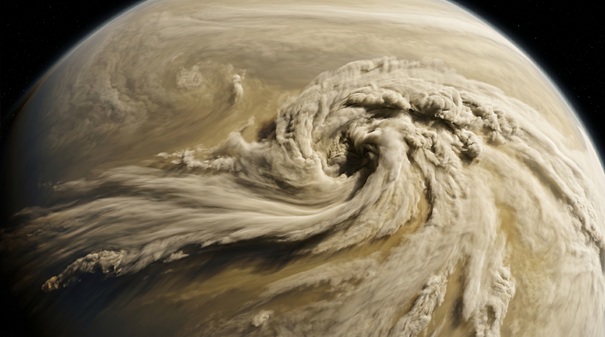
For years, scientists stared at the skies of Venus and wondered about a colossal atmospheric structure that repeatedly wrapped around the planet like a moving scar across its clouds. This strange disturbance stretched nearly six thousand kilometers across the Venusian atmosphere. It circled the planet for days at a time. Yet despite years of observation, nobody fully understood what could create something so massive, so stable, and so alien.
Now, a research team that included scientists from the University of Tokyo believes it has finally uncovered the answer. According to a study published in Journal of Geophysical Research: Planets, the mysterious cloud wave is caused by the largest known “hydraulic jump” ever discovered in the Solar System.
But what exactly is a hydraulic jump? And how can a process seen every day in a kitchen sink reshape the atmosphere of an entire planet?
The answer may completely change how scientists understand planetary weather systems, atmospheric superrotation, and even the future of space exploration itself.
How Venus’ Thick Sulfuric Acid Clouds Create Planet-Wide Atmospheric Waves
Unlike Earth, where clouds come and go, Venus remains permanently hidden beneath a suffocating blanket of thick clouds. These clouds are composed largely of sulfuric acid droplets. They trap heat with terrifying efficiency and help make Venus the hottest planet in the Solar System.
However, the clouds do far more than trap heat.
They move.
And they move unbelievably fast.
Scientists have long known that Venus experiences a phenomenon called “superrotation.” In simple terms, the atmosphere races around the planet about sixty times faster than the planet itself rotates. Although Venus takes roughly two hundred forty-three Earth days to complete one rotation, its upper atmosphere circles the planet in only a few days.
Why does this happen?
That question has puzzled planetary scientists for decades.
Then, in two thousand sixteen, the Japanese spacecraft Akatsuki observed something extraordinary. Massive atmospheric wave fronts repeatedly appeared near the equator. Some extended nearly six thousand kilometers across the cloud tops. These giant structures drifted around the planet like enormous walls in the sky.
At first, scientists struggled to explain them.
Were they caused by thermal instabilities?
Could volcanic activity somehow trigger them?
Or was there an entirely unknown atmospheric mechanism operating inside Venus’ violent cloud system?
The new research now points toward a surprising answer rooted in fluid dynamics.
The Giant Hydraulic Jump on Venus Explained Through Fluid Dynamics
Most people have already seen a hydraulic jump without realizing it.
Turn on a kitchen faucet and watch water hit the sink surface. Initially, the water spreads outward rapidly in a thin layer. Then suddenly, the flow slows down. The water becomes deeper and more turbulent. That abrupt transition is called a hydraulic jump.
Now imagine the same physical principle occurring not in a sink, but across the atmosphere of an entire planet.
That is precisely what scientists now believe is happening on Venus.
Researchers discovered that an eastward-moving atmospheric disturbance known as a Kelvin wave becomes unstable within Venus’ lower and middle cloud layers. When this instability develops, the atmospheric flow suddenly slows down. As a result, a powerful vertical updraft forms.
This updraft pushes sulfuric acid vapor higher into the atmosphere. Once the vapor rises into colder regions, it condenses into enormous cloud formations. Those clouds then trail behind the disturbance, creating the gigantic atmospheric wave front observed by the Akatsuki spacecraft.
What makes this discovery astonishing is the scale involved.
Hydraulic jumps on Earth usually occur in rivers, spillways, and laboratory experiments. On Venus, however, the process spans thousands of kilometers and affects an entire planetary climate system.
Could similar hidden processes also exist inside the atmospheres of other worlds?
That question now fascinates planetary researchers around the globe.
Why Venusian Atmospheric Superrotation Still Baffles Scientists
One of the greatest mysteries surrounding Venus is how its atmosphere maintains such incredible speed.
Superrotation should theoretically lose energy over time. Yet Venus’ atmosphere continues racing around the planet with astonishing stability.
The new hydraulic jump discovery may finally reveal part of the answer.
According to the research team, the newly identified atmospheric process appears to help redistribute momentum throughout the Venusian atmosphere. In other words, the hydraulic jump may actually contribute energy that supports the planet’s extreme atmospheric circulation.
Professor Takeshi Imamura explained that previous climate models for Venus were largely adapted from Earth-based atmospheric systems. However, those simulations did not include the newly discovered hydraulic jump mechanism.
That omission may prove significant.
Without accounting for this process, scientists may have misunderstood critical aspects of Venusian climate behavior for years.
As researchers improve their models, they hope to understand how energy, heat, and momentum move through Venus’ cloud layers. Such discoveries could reshape planetary climate science far beyond Venus itself.
After all, if one missing atmospheric process can transform our understanding of an entire planet, what else might scientists still be overlooking?
Advanced Venus Climate Models Could Change Future Space Missions
To investigate the phenomenon, scientists used highly advanced numerical simulations.
One model focused on fluid dynamics, which allowed researchers to simulate atmospheric motion and instability. Another model examined cloud microphysics, tracking how sulfuric acid vapor condensed into clouds while traveling through Venus’ atmosphere.
Together, these simulations successfully reproduced the mysterious cloud disturbance observed by Akatsuki.
However, creating such models is enormously difficult.
Unlike Earth, Venus possesses crushing atmospheric pressure, violent winds, and extreme temperatures. Simulating those conditions requires immense computing power. Even modern supercomputers struggle with the complexity.
Still, scientists believe these improved models are essential.
Future missions to Venus may depend on accurate atmospheric predictions. Spacecraft descending through Venusian skies must survive intense turbulence, crushing heat, and corrosive sulfuric acid clouds.
Understanding hydraulic jumps could therefore become vital for mission planning.
Could these atmospheric structures threaten future probes?
Might they influence aerial exploration vehicles or floating habitats one day?
Those possibilities are no longer science fiction discussions alone. As space agencies prepare new Venus missions, atmospheric science becomes increasingly important.
Could Mars and Other Planets Also Experience Hydraulic Jumps?
Although this discovery focuses on Venus, researchers believe the same physics could occur elsewhere.
Professor Imamura suggested that under certain conditions, even Mars might support atmospheric hydraulic jumps.
That possibility opens an exciting scientific frontier.
If hydraulic jumps can emerge naturally in planetary atmospheres, they may represent a universal atmospheric process rather than a Venus-specific anomaly.
Scientists already know that atmospheric superrotation appears not only on Venus, but also within parts of Earth’s upper atmosphere and even on the Sun itself. Therefore, understanding one planetary atmosphere could help researchers decode many others.
What hidden wave structures might exist on distant exoplanets?
Could gas giants possess atmospheric jumps even larger than Venus’?
And if these phenomena influence climate systems, might they also affect planetary habitability?
Each answer seems to generate even bigger questions.
Why the Discovery of Venus’ Massive Atmospheric Wave Matters
At first glance, a strange cloud disturbance on a distant planet may seem disconnected from everyday life on Earth. Yet discoveries like this fundamentally change humanity’s understanding of how worlds behave.
Planetary atmospheres are not static systems. They are living, evolving engines driven by physics that scientists are still struggling to fully understand.
The discovery of a giant hydraulic jump on Venus reveals that even familiar physical laws can produce astonishing effects when scaled to planetary dimensions.
A simple process visible in a kitchen sink can, under the right conditions, create a planetary atmospheric structure visible from space.
That realization is both humbling and thrilling.
It reminds us that the universe often hides its greatest mysteries inside ordinary physics waiting to be recognized in extraordinary places.
And perhaps the biggest question remains unanswered:
If Venus concealed a phenomenon this massive for so long, what other secrets are still hidden inside the atmospheres of distant worlds?
Source: Scientists Finally Solved Venus’ Giant Atmospheric Mystery… But What Is Hiding Inside Those Clouds?
Mars Colonies May Depend on Asteroid Mining… But What Happens If We Fail?
Mars Colonies May Depend on Asteroid Mining… But What Happens If We Fail?
Scientists Finally Solved Venus’ Giant Atmospheric Mystery… But What Is Hiding Inside Those Clouds?
Sources
University of Tokyo
Journal of Geophysical Research: Planets
Akatsuki
Research statements from Professor Takeshi Imamura
Planetary atmosphere and fluid dynamics studies related to Venusian superrotation
Scientists Finally Solved Venus’ Giant Atmospheric Mystery… But What Is Hiding Inside Those Clouds?