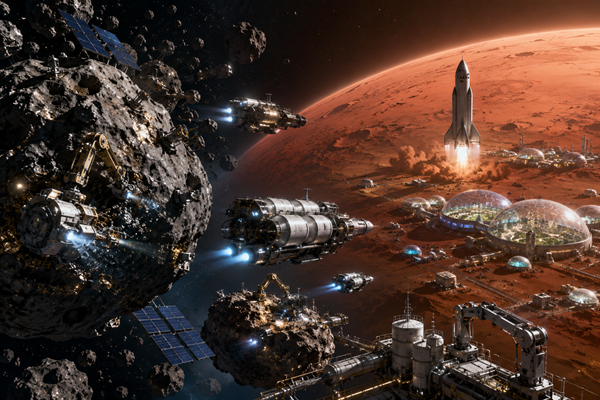
Mars Colonies May Depend on Asteroid Mining… But What Happens If We Fail?
Humanity dreams of building cities beneath the pale skies of Mars. Visionaries imagine domed settlements glowing red against endless deserts. Engineers discuss rockets, habitats, and terraforming as though these ideas already belong to tomorrow. Yet one brutal question refuses to disappear:
What will we build those cities with?
A new scientific study suggests that the answer may not lie on Mars itself. Instead, the future of Martian civilization could depend on something far more ambitious, dangerous, and unsettling — the industrial exploitation of the asteroid belt.
Could humanity one day strip-mine ancient asteroids drifting between planets just to keep a Martian city alive? And if so, would this become the first true interplanetary supply chain in history?
Mars Colony Resource Crisis: Why Building a City on Mars May Be Harder Than Building Ancient Rome
People often compare future Martian colonies to the great civilizations of Earth. However, even Roman Empire had access to forests, rivers, workers, stone quarries, and nearby trade routes. Mars offers almost none of these luxuries.
Although Mars contains iron and several useful minerals, it lacks many of the rare materials required for advanced industry. Scientists believe that future colonies will desperately need elements such as boron, molybdenum, nickel, cobalt, and platinum-group metals. Without them, producing advanced electronics, reactors, industrial tools, and high-performance alloys may become nearly impossible.
As a result, the first generations of Martian settlers could face a terrifying reality: they might possess the ambition to build cities, yet lack the materials needed to sustain technological civilization.
This problem forces scientists to ask a difficult question:
Could the asteroid belt become humanity’s first extraterrestrial mining frontier?
According to a recent preprint study led by researcher Serena Suriano, the answer may be yes.
Asteroid Belt Mining for Mars Colonies: The Hidden Industrial Backbone of a Future Civilization
The idea sounds deceptively simple. Send spacecraft to metallic asteroids. Mine valuable resources. Return the cargo to Mars orbit. Build civilization.
However, reality is far more unforgiving.
Space is governed by orbital mechanics, not human ambition. A spacecraft cannot simply accelerate toward an asteroid and return home like a truck making deliveries across a highway. Every kilogram of fuel matters. Every maneuver consumes enormous energy. Every planetary alignment changes the mission timeline.
The study modeled its logistics system using a spacecraft similar to SpaceX Starship.
The theoretical vessel contains:
- A dry mass of one hundred twenty tons
- A payload capacity of one hundred fifteen tons
- A propellant capacity of one thousand one hundred tons
That enormous fuel requirement reveals the brutal truth of deep-space travel. Rockets spend most of their energy carrying fuel needed to carry even more fuel.
This challenge is known as the tyranny of the rocket equation.
Even with full tanks, the spacecraft could only achieve a maximum delta-v of approximately six point four kilometers per second. Unfortunately, nearly every metallic asteroid useful for mining requires far more energy to reach and return from.
Many targets demand between ten and twelve point eight kilometers per second of total delta-v.
That means a direct round trip becomes impossible.
So how can humanity solve this impossible equation?
Deep-Space Fuel Stations: Could Asteroids Become Cosmic Gas Stations for Mars Missions?
The researchers propose a fascinating workaround.
Instead of flying directly to a metallic asteroid and returning home, spacecraft would follow a multi-stop route across deep space. In essence, humanity may need to build an interplanetary gas station network before building cities on Mars.
The process would unfold in several stages.
First, the spacecraft would travel to a metallic asteroid and collect mined material. Next, instead of returning immediately to Mars, the ship would fly toward a carbon-rich C-type asteroid.
Why?
Because these asteroids contain volatiles such as water ice and hydrocarbons. Those materials could potentially be converted into rocket propellant through a process called in-situ propellant production, or ISPP.
In theory, the spacecraft could refill its tanks directly in space.
Only then could it attempt the long return journey to low Mars orbit.
The concept sounds revolutionary. Yet it raises another haunting question:
Can humanity really build functioning fuel refineries on drifting asteroids millions of kilometers from Earth?
The Painfully Slow Reality of Asteroid Mining Missions to Mars
The study identified twenty-two viable asteroid pairings between metallic and C-type asteroids during a twenty-year launch window beginning in the year two thousand forty.
At first glance, that sounds promising.
However, the actual numbers reveal how difficult this vision truly is.
A single spacecraft operating on this route would deliver only around two hundred tons of metal to Mars across two decades.
That amount is shockingly small for an industrial civilization.
Why so little?
Because the missions themselves would move at an agonizing pace.
Each complete journey could take nearly a decade.
Planetary alignment windows may require spacecraft to wait years before traveling efficiently between destinations. Furthermore, fuel production on asteroids remains extraordinarily slow.
According to concepts proposed by Robert Zubrin in the famous “Mars Direct” architecture, ISPP systems might initially produce fuel at a rate of only two kilograms per day.
Not tons.
Kilograms.
At that speed, refilling a one thousand one hundred ton fuel tank would require more than one thousand five hundred years.
The implications are staggering.
Humanity may possess the scientific knowledge to imagine Martian cities, yet still lack the industrial power to sustain them.
Non-Chemical Space Propulsion: Could Solar Sails and Electric Engines Change Everything?
The researchers also explored another possibility.
What if future spacecraft abandoned chemical rockets entirely?
Emerging propulsion technologies could radically transform deep-space logistics. Solar electric propulsion systems already demonstrate remarkable fuel efficiency compared with conventional rockets. Meanwhile, solar sails promise propulsion driven entirely by sunlight itself.
If these systems mature rapidly, they could reduce the need for enormous fuel reserves and eliminate many limitations imposed by chemical propulsion.
Suddenly, asteroid mining missions that once seemed impossible could become economically viable.
Yet uncertainty remains everywhere.
Can solar-electric systems transport industrial cargo efficiently across interplanetary distances?
Can fragile solar sails survive years of exposure to radiation and micrometeoroids?
Will humanity solve these engineering problems before the first Martian colonies face resource shortages?
No one knows.
And perhaps that uncertainty is what makes this entire subject so fascinating.
Why the Future of Mars Colonization May Depend on the Asteroid Belt
The dream of a thriving Martian city often focuses on spectacular imagery. We imagine futuristic domes, advanced robots, underground habitats, and glowing skylines beneath alien sunsets.
However, civilization does not survive on dreams alone.
Every city in history depended on supply chains. Ancient empires needed roads. Industrial nations needed railways and ports. Future space civilizations may need asteroid mining fleets and orbital fuel depots.
Without them, Mars could remain permanently dependent on Earth.
With them, humanity could become something entirely new — a species capable of building self-sustaining civilizations across multiple worlds.
Still, unsettling questions remain.
If asteroid mining becomes essential, who will control those resources?
Will nations compete for ownership of space minerals?
Could future wars begin not over oil fields on Earth, but over metallic asteroids drifting silently through space?
And perhaps the biggest question of all:
If humanity must consume entire asteroids to build cities on another planet… how far are we truly willing to go to become an interplanetary species?
The Asteroid Belt and the Future of Human Civilization
This research does not merely describe spacecraft trajectories or fuel calculations. It reveals something deeper about humanity’s future.
For the first time in history, scientists are seriously studying how an industrial civilization might operate beyond Earth.
The challenges are enormous. The timelines feel overwhelming. The engineering borders on science fiction.
Yet every civilization in history once began as an impossible idea.
The first sailors who crossed oceans seemed reckless. The first aviators appeared absurd. The first astronauts were considered dreamers risking death inside fragile machines.
Now humanity stands before another frontier.
A city on Mars may one day rise beneath dusty red skies. However, its steel, machinery, and survival may ultimately depend on ancient asteroids drifting silently through the darkness between worlds.
And perhaps one day, when future generations look up from the streets of a Martian metropolis, they will realize something extraordinary:
Their civilization was not built only on Mars.
It was built from the bones of the asteroid belt itself.
Source: Mars Colonies May Depend on Asteroid Mining… But What Happens If We Fail?
Beyond Our Solar System: Is Canada’s POET Mission the Key to Alien Life?
Beyond Our Solar System: Is Canada’s POET Mission the Key to Alien Life?
Mars Colonies May Depend on Asteroid Mining… But What Happens If We Fail?
Sources and Scientific References
arXiv Preprint Repository
NASA Solar System Exploration
NASA In-Situ Resource Utilization Overview
Mars Direct by Robert Zubrin
European Space Agency – Asteroid Mining Concepts
SpaceX Starship Technical Information
Mars Colonies May Depend on Asteroid Mining… But What Happens If We Fail?