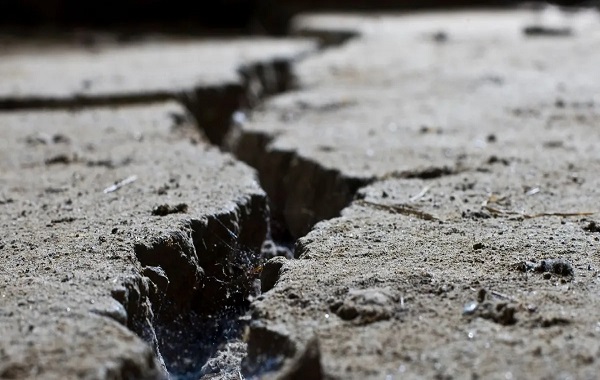
Researchers now may detect earthquakes 2 days before, with 80% accuracy
Predicting earthquakes by observing the sky is possible.
Israeli researchers predicts earthquakes using a support vector machine (SVM) algorithm to map total electron content in the ionosphere.
They also predict when an earthquake is not likely to occur with an accuracy of 87.5 percent
Researchers at the Ariel University in Israel have developed a method that can help predict large earthquakes up to 48 hours before they occur, the Jerusalem Post reported.
Land mass on our planet is made from the mantle and the crust of the Earth. However, these layers are not uniform but are made up of several pieces that are slowly moving around and bumping into each other from time to time. When these pieces, called tectonic plates, slide past or bump into another plate, an earthquake can occur.
Can earthquakes be predicted?
Depending on the strength of the earthquake, the impact on human life can be disastrous. While mild earthquakes can only send a few shockwaves through the ground, stronger ones can reduce buildings to rubble in a few seconds and bring life to a grinding halt. A magnitude 5.9 earthquake in eastern Afghanistan last month is estimated to have killed more than 1,000 people and wounded many more. So, it would be really useful to know when an earthquake is about to happen.
Although technology is available on the ground to record the strength of the earthquake as well as determine the exact location where the plates have rubbed against each other to cause the quake, geologists have not been able to predict their occurrence.
According to the United States Geological Survey (USGS) website, geologists have used various methods to predict earthquakes and can also accurately state if a tectonic plate will see an earthquake in the future or not. However, they cannot put an exact time or date to their prediction.
How did the Israel researchers claim it then?
Instead of looking at ground-based sensors, the Israeli researchers turned to the skies to make their predictions. Using a support vector machine (SVM) algorithm, the researchers mapped total electron content in the ionosphere, the uppermost layer of the atmosphere, to the GPS data to predict the earthquake.
In a research paper published in the journal Remote Sensing, the researcher state that when stressed, almost all types of rocks on the Earth’s surface activate positive holes that can carry and generate electric currents. As these charge carriers accumulate on the surface of the Earth, charged ions also accumulate near the stressed rocks, and this leads the current outward, which over a period of time ends up being transported into the ionosphere, where it can be detected.
According to the paper, the researchers claim that their method can detect a large earthquake up to 48 hours before it occurs with an 80 percent accuracy. The researchers classify a large earthquake as any tremor that has a magnitude of 6 or above. Additionally, the researchers could also predict when an earthquake is not likely to occur with an accuracy of 87.5 percent, the JP report said.
Source: Interesting Engineering
“Aurora Marijuanis?” Eerie Pink Glow Lights Up The Sky Above Australian Town
“Aurora Marijuanis?” Eerie Pink Glow Lights Up The Sky Above Australian Town
Researchers now may detect earthquakes 2 days before, with 80% accuracy