Is Regenerative Medicine About to End the Age of Irreversible Paralysis?
Breakthrough in Spinal Cord Injury Treatment with 3D Printing and Stem Cells
For the first time, scientists at the University of Minnesota Twin Cities have merged 3D printing, stem cell science, and lab-grown spinal tissues to pioneer a potential treatment for paralysis. The study, published in Advanced Healthcare Materials, marks a major step toward repairing spinal cord injuries that have long been considered irreversible.
Spinal cord injuries affect more than 300,000 people in the United States, according to the National Spinal Cord Injury Statistical Center. Despite decades of research, there is still no therapy capable of fully reversing paralysis. Why has progress been so limited? One of the greatest barriers is that once nerve cells die, the remaining fibers fail to regrow across the damaged region of the spinal cord. The Minnesota team set out to tackle this exact challenge.
How 3D-Printed Organoid Scaffolds Guide Nerve Cell Regeneration
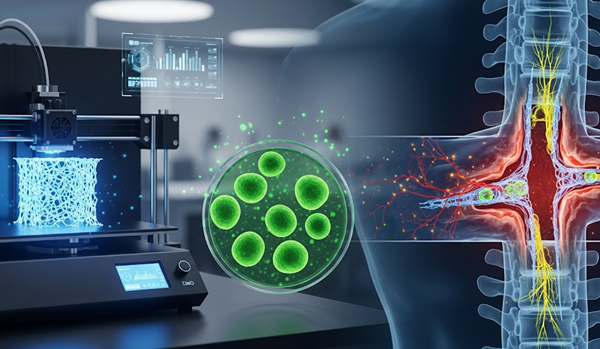
The researchers designed an organoid scaffold—a 3D-printed framework with microscopic channels engineered to house spinal neural progenitor cells (sNPCs). These cells, derived from human adult stem cells, can multiply and transform into specialized nerve cells.
“We use the 3D-printed channels of the scaffold to direct the growth of the stem cells, which ensures the new nerve fibers grow in the desired way,” explained Guebum Han, the study’s first author and former University of Minnesota mechanical engineering postdoctoral researcher, now at Intel Corporation. “This method creates a relay system that, when placed in the spinal cord, bypasses the damaged area.”
This innovative design does more than just replace lost cells—it provides a roadmap for new growth, giving the spinal cord a second chance to reconnect. Could this be the blueprint for healing paralysis?
Successful Spinal Cord Transplants in Animal Models
To test their approach, the team transplanted the scaffolds into rats with severed spinal cords. The results were striking: the stem cells developed into functioning neurons and extended their fibers both rostrally (toward the head) and caudally (toward the tail), reconnecting with the host’s nervous system.
Over time, the lab-grown neurons integrated seamlessly with the existing spinal cord tissue. Even more compelling, the rats demonstrated significant functional recovery—a signal that the method holds real therapeutic potential.
Regenerative Medicine and the Future of Paralysis Treatment
“Regenerative medicine has brought about a new era in spinal cord injury research,” said Ann Parr, professor of neurosurgery at the University of Minnesota. “Our laboratory is excited to explore the future potential of our ‘mini spinal cords’ for clinical translation.”
The research is still in its early stages, but the implications are profound. By combining 3D bioprinting, stem cell technology, and tissue engineering, scientists may one day restore movement to people living with paralysis.
What Comes Next in Healing Spinal Cord Injuries?
The Minnesota team aims to scale up their methods and refine the scaffolds for future clinical trials. While human application may be years away, their success in animal models raises pressing questions:
Could lab-grown spinal cords become the standard treatment for paralysis?
How soon before patients benefit from this technology?
What ethical and medical challenges will emerge as science approaches the possibility of reversing paralysis?
For now, the study offers a rare glimpse of optimism in a field where progress has been painfully slow. The possibility that tiny lab-grown spinal cords could one day heal broken connections is more than a scientific advance—it’s a promise of renewed hope for millions worldwide.
Source: Is Regenerative Medicine About to End the Age of Irreversible Paralysis?
4 Powerful Telescopes Agree: Interstellar Comet 3I/ATLAS Really Is Bizarre
4 Powerful Telescopes Agree: Interstellar Comet 3I/ATLAS Really Is Bizarre