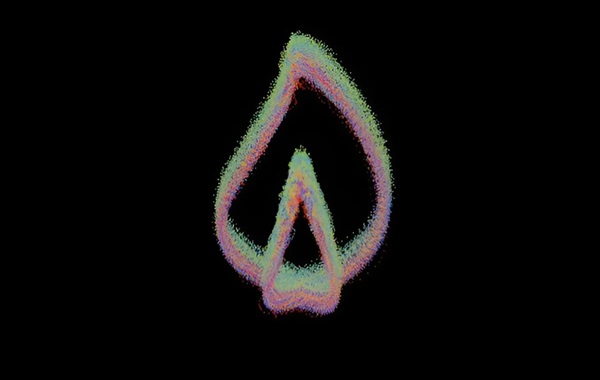
Physicists break record in time crystal research
Physicists from TU Dortmund University have set a new record in time crystal research by creating one that lasted at least 40 minutes – 10 million times longer than the previous record.
Spatial crystals are very common and have remarkable properties, such as symmetry, stability, and beauty. They can also be found in many technological applications, such as electronics, optics, and sensors.
What are time crystals?
Imagine a crystal that does not just have a regular pattern in space but also in time. A crystal that rhythmically changes its physical properties without any external influence. A crystal that defies the laws of thermodynamics and remains in perpetual motion.
This is the concept of a time crystal, a theoretical form of matter first proposed by Nobel laureate Frank Wilczek in 2012. Wilczek, a physicist at the Massachusetts Institute of Technology (MIT), wondered if there could be a counterpart to spatial crystals, which are made of atoms arranged in a repeating lattice.
Time crystals, on the other hand, are much more elusive and exotic. They would require a system that breaks time-translation symmetry, meaning its behavior is not the same at different moments. For example, a pendulum that swings faster and slower without any apparent reason or a magnet that flips its polarity at regular intervals.
Such a system would also violate the second law of thermodynamics, which states that entropy, or disorder, always increases in a closed system. A time crystal could maintain its order and periodicity indefinitely without losing any energy or heat to its surroundings.
How can time crystals be created?
The idea of time crystals sparked much controversy and skepticism among physicists, who doubted such a phenomenon could ever be observed. Some even argued that it was impossible or would require fine-tuning the parameters to an unrealistic degree.
However, in the past few years, several experiments have shown that time crystals are possible, at least in a modified sense. These experiments involved systems that were not isolated but rather driven by an external force with a certain frequency, such as a laser or a magnetic field.
Surprisingly, these systems responded with a different frequency, usually twice as long, creating a mismatch between the input and the output. This indicated that the systems had spontaneously developed a time-translation symmetry breaking and, thus, a time-crystalline behavior.
The first experimental evidence of this phenomenon was reported in 2017, using two platforms: a chain of trapped ions and a diamond with nitrogen-vacancy centers. Both systems exhibited signs of a time crystal under the influence of a periodic driving force.
However, these systems were still far from the original vision of Wilczek, who imagined a time crystal that would exist in equilibrium without any external perturbation. Such a system would be truly autonomous and self-sustaining, like a spatial crystal.
The closest approximation to this scenario was achieved in 2022, using a Bose-Einstein condensate, a state of matter where many atoms behave as a single quantum entity. The researchers created a time crystal that oscillated independently without any temporal modulation by applying a constant magnetic field.
However, the crystal was short-lived, lasting only a few milliseconds before collapsing.
A breakthrough in time crystal research
Now, a team of physicists from TU Dortmund University in Germany has made a breakthrough in time crystal research. They have created a time crystal that lasted at least 40 minutes, 10 million times longer than the previous record.
The team, led by Dr. Alex Greilich, used a special crystal made of indium gallium arsenide, in which the nuclear spins acted as a reservoir for the time crystal. A laser continuously illuminated the crystal so that a nuclear spin polarization formed through interaction with electron spins.
This nuclear spin polarization spontaneously generated oscillations equivalent to a time crystal. The team could control these oscillations’ frequency and amplitude by changing the laser power and the magnetic field.
The team also explored the regions where the time crystal “melted,” i.e., lost its periodicity. They found that these regions exhibited chaotic behavior, which could be analyzed using theoretical tools. This was the first time such tools were applied to study the dynamics of time crystals.
The team’s results, published in Nature Physics, have confirmed the existence and the robustness of time crystals and opened new avenues for further research. Time crystals could have potential applications in quantum computing, quantum metrology, and quantum information, as well as fundamental implications for our understanding of physics.
Source: Interesting Engineering
Physicists discover time can flow both ways in materials
Physicists break record in time crystal research