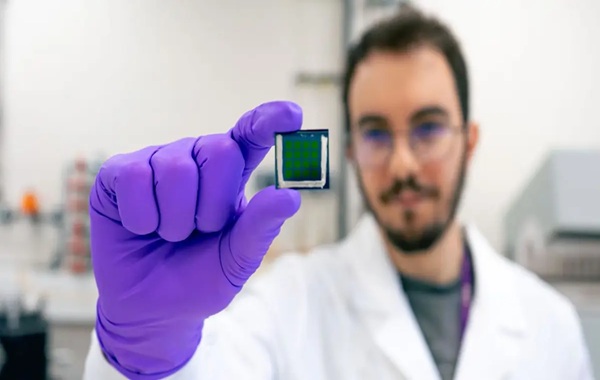
New tiny gold mirror could make solar panels lighter, cheaper, and stronger
Researchers from the International Iberian Nanotechnology Laboratory (INL) have developed a new kind of ultrathin solar cell. This breakthrough, the team explains, could open the door to future lightweight and versatile solar applications.
Such cells are highly attractive due to their low material requirements, flexibility, and lower production costs and time.
However, when the light-absorbing layer is made very thin, less sunlight is trapped and converted into electricity, and some of the energy “leaks” out the back. This makes the cells less efficient.
To this end, the INL team (in collaboration with Uppsala University, in Sweden), led by Pedro Salomé, designed a new kind of “nanostructured mirror” for the back of the solar cell. They achieved this by adding a very thin, patterned layer of gold, covered by aluminum oxide.
This structure acts like a light-trapping mirror, allowing it to reflect light back into the cell so it can be absorbed a second time.
New ultra-thin solar cells
The aluminum oxide coating also reduces electrical losses at the rear surface (a process called interface passivation), which helps prevent electrons from recombining and wasting energy.
Normally, making such nanostructures is expensive and complicated.
The INL team instead used a one-step “nanoimprint lithography” technique (think of it like stamping the tiny pattern directly onto the surface), which makes it faster and more suitable for industrial-scale production.
They tested this on ultrathin ACIGS (Ag,Cu)(In,Ga)Se₂ solar cells, which are a type of thin-film cell already known for high efficiency. They found that efficiency increased by about 1.5 percent, mainly because the cell absorbed more light.
The team also found that such cells worked best when manufactured at 842°F (450 °C), which prevented gold atoms from diffusing (a common issue that harms performance). They also allowed use on flexible materials, such as plastic films.
According to the INL team, this new design tackles two key challenges at once. The first is light management (trapping more photons), and the second is interface passivation (reducing energy losses).
Together, these make ultrathin, flexible solar cells more practical for real-world use, such as lightweight panels on vehicles, buildings, or portable devices. In short, the INL team has found a cheaper way to stamp a nanostructured gold “mirror” onto ultrathin solar cells, reflecting light back into them and cutting energy losses.
Interesting potential applications in the future
This not only boosts solar cell efficiency but also paves the way for flexible, high-performance solar panels.
“This architecture gives us a powerful way to manage light and reduce interface recombination in ultrathin devices, while keeping fabrication practical,” says first-author André Violas, a researcher from the Salomé group.
“It brings us closer to making lightweight, flexible solar cells efficient enough for real-world applications.” For researcher Jennifer Teixeira, “this paper is the outcome of our efforts in merging light management and interface passivation, and by being able to merge both, we are starting to create novel solar cell architectures,” she added.
Source: Interesting Engineering
World’s first space delivery vehicle can bring supplies anywhere on Earth in an hour
New tiny gold mirror could make solar panels lighter, cheaper, and stronger