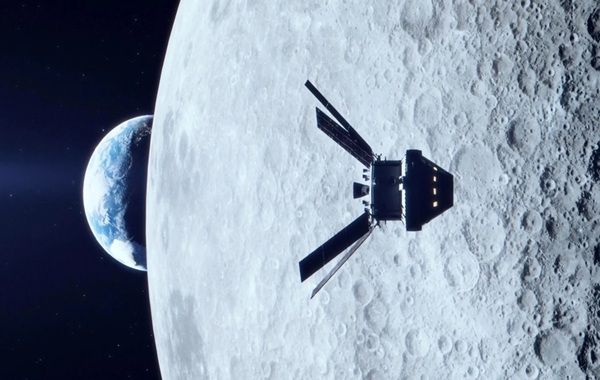
NASA’s Artemis I mission reveals surprising radiation levels near the Moon
NASA’s Artemis I mission has provided new insights into cosmic radiation exposure near the Moon, revealing differences between the lunar environment and low Earth orbit. Using experimental lithium fluoride crystal detectors aboard the Orion spacecraft, researchers obtained preliminary measurements that could help improve radiation monitoring and protect astronauts on future space missions.
During its uncrewed journey around the Moon in November and December 2022, Orion carried more than 10,000 tiny radiation-detecting crystals embedded in two human-shaped mannequins. The experiment, known as MARE (Matroshka AstroRad Radiation Experiment), included several dozen experimental fluorescent lithium fluoride detectors developed by scientists at the Institute of Nuclear Physics of the Polish Academy of Sciences (IFJ PAN) in Krakow. The team also supplied nearly 600 thermoluminescent crystal detectors.
The researchers described their findings and a new method for analyzing radiation measurements in the journal Radiation Measurements.
How Tiny Crystals Detect Cosmic Radiation
The lithium fluoride detectors record microscopic changes caused by energetic particles. When electrically charged particles pass through a crystal, they create defects in its atomic structure known as color centers. When scientists illuminate the crystals with blue light, these altered regions glow red, revealing particle tracks that can be examined under a fluorescence microscope.
Unlike conventional plastic track detectors, which require chemical etching to reveal radiation damage, lithium fluoride crystals can be examined directly. This simplifies analysis and produces clearer images of individual particle tracks.
However, calculating accurate radiation doses remains challenging. Cosmic radiation consists of different particles and atomic nuclei arriving from multiple directions and carrying a wide range of energies. Researchers therefore developed specialized calibration methods and software to distinguish meaningful signals from background interference.
After applying corrections, the team’s results differed by no more than 15% from conventional track detector measurements across the overlapping energy range. The researchers also identified particle tracks associated with energy deposits below the detection threshold of previously used detectors.
Why Radiation Near the Moon Is Different
The Artemis I measurements allowed scientists to compare radiation exposure near the Moon with earlier findings from the International Space Station (ISS).
Earth’s magnetic field traps charged particles in the Van Allen radiation belts. In low Earth orbit, low-energy protons from these belts can contribute substantially to astronauts’ radiation exposure. These particles deposit energy at different depths within the body, creating an uneven distribution of radiation doses.
The situation changes near the Moon, beyond the Van Allen belts. There, galactic cosmic rays make a greater contribution to radiation exposure. These high-energy particles can travel through the entire human body, releasing only part of their energy along the way.
Consequently, radiation doses recorded by the Artemis I detectors were distributed more uniformly throughout the mannequins than those observed during earlier experiments aboard the ISS.
The findings also revealed a potentially surprising result: although radiation exposure near the Moon is higher than in low Earth orbit, the difference is not as large as researchers might intuitively expect. The disappearance of radiation from trapped low-energy protons is partly offset by the substantial contribution from galactic cosmic rays.
A New Tool for Future Space Missions
The lithium fluoride detectors are produced using the Czochralski method, a technique for growing crystals. Developed at IFJ PAN about a decade ago, the technology has continued to improve.
Their compact size makes them particularly promising for astronaut radiation monitoring. Measuring only a few millimeters, the crystals could be worn comfortably and used to collect detailed information during future missions.
They can also distinguish individual particle tracks at relatively high radiation doses and detect a broad range of particle types and energies. When enriched with lithium-6, the crystals can detect neutrons through nuclear reactions that produce measurable secondary particles.
These capabilities could help scientists better understand the complex radiation environment beyond Earth. As NASA prepares for future crewed lunar missions, improved radiation measurements will be essential for evaluating astronaut exposure and developing effective protection strategies.
The MARE research was supported by Poland’s National Science Centre through its OPUS grant program.
Source: science daily
Perseverance Reveals Mars’s Hidden Danger—Can Astronauts Survive Its Ultrafine Dust?
NASA’s Artemis I mission reveals surprising radiation levels near the Moon