Perseverance Reveals Mars’s Hidden Danger—Can Astronauts Survive Its Ultrafine Dust?
Humanity’s journey to Mars will require far more than powerful rockets and successful landings. Astronauts must also survive the planet’s hostile environment for weeks, months, or even longer. Now, NASA’s Perseverance rover has revealed a microscopic challenge that could influence nearly every aspect of future human exploration: ultrafine Mars dust that clings to spacesuit materials and may threaten crew health.
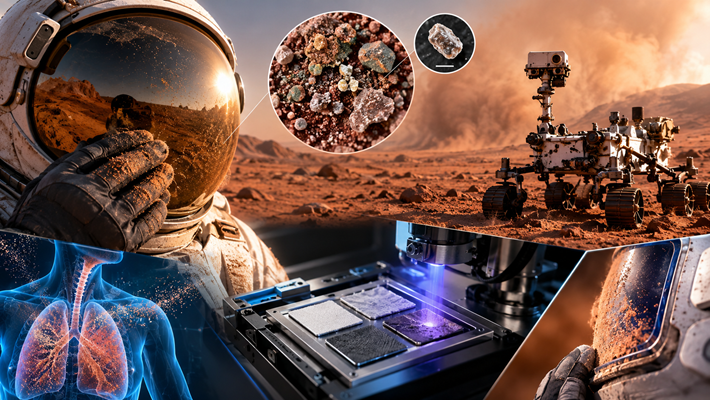
Over one thousand six hundred forty-five Martian days, Perseverance measured fine and ultrafine dust particles adhering to samples of spacesuit materials carried aboard the rover. Some particles measured approximately one hundred nanometers across. That is about seven hundred times thinner than a human hair.
The findings, published in the Proceedings of the National Academy of Sciences, could help engineers design safer spacesuits, improve habitat filtration, develop more effective dust-removal systems, and establish health standards for future Mars missions. Most importantly, the measurements provide direct evidence of just how small Martian dust particles can be. <Cite refs={[“turn652944search0″,”turn652944search2”]}/>
But why should particles invisible to the naked eye concern scientists preparing for humanity’s next great exploration? Could the smallest grains on Mars become one of the biggest obstacles to establishing a permanent human presence on the Red Planet?
Why Is Mars Dust Dangerous? Perseverance Reveals a Hidden Hazard
Mars may appear to be a vast, barren desert. However, its dust is far more complicated than the reddish coating visible across its landscape.
Powerful winds lift particles from the surface and carry them through the atmosphere. Regional dust storms can spread material across large areas, while global storms can keep dust circulating around the planet. As a result, dust may accumulate on scientific instruments, solar-powered equipment, spacesuits, and eventually the living quarters of future astronauts.
The chemical composition adds another layer of concern. Martian dust contains silicate minerals and is enriched in elements such as iron, sulfur, and chlorine. Researchers also detected signals indicating phosphorus enrichment and the presence of calcium sulfate in the material examined by Perseverance.
These characteristics matter because the danger of dust depends on more than its ability to scratch or damage equipment. Particle size, chemical composition, electrical charge, and exposure duration can all influence the risks.
A grain that causes little mechanical damage might still pose a biological concern if it enters the respiratory system. Conversely, detecting a potentially hazardous substance does not automatically mean it will cause illness under every condition.
Could Mars dust damage astronauts in ways that ordinary spacesuit inspections would never reveal? That question makes microscopic analysis essential before humans begin working on the planet’s surface.
Mars Dust vs. Moon Dust: What Did the Apollo Missions Teach NASA?
NASA has been dealing with extraterrestrial dust hazards since the Apollo era. Astronauts who walked on the Moon discovered that lunar dust could scratch helmet visors, degrade outer spacesuit layers, and damage seals.
Some Apollo crew members also reported symptoms resembling hay fever after exposure to lunar dust. Those experiences demonstrated that dust could affect astronauts as well as their equipment.
Mars dust has some different physical characteristics. Wind-driven collisions can round its grains, making them less abrasive than lunar dust in certain circumstances. Nevertheless, lower abrasiveness does not necessarily mean lower health risk.
Mars dust also differs chemically from lunar material. Its composition and atmospheric behavior create challenges that cannot simply be addressed by copying the solutions developed for the Moon.
For example, dust that remains suspended in the atmosphere may settle on equipment long after a storm has passed. Furthermore, fine particles may lodge in spacesuit fabrics and surface irregularities, making complete removal difficult.
This creates a critical distinction for mission planners: protecting equipment from abrasion is not the same as protecting astronauts from inhalation or chemical exposure.
How Did NASA Measure Mars Dust? Inside the Perseverance PIXL and SHERLOC Investigation
Perseverance’s primary mission is to investigate Mars’s ancient environments and search for evidence that microbial life might once have existed there. However, NASA also designed the rover to support preparations for future human explorers.
Among its scientific equipment are calibration targets containing small samples of materials used in spacesuits. Researchers can examine these samples to understand how the materials behave under actual Martian surface conditions.
The rover carries five spacesuit-material samples, each measuring approximately twenty millimeters square. These samples form part of a calibration target associated with the SHERLOC instrument. Another calibration target, used by PIXL, includes Teflon and basaltic glass.
Two instruments played particularly important roles in the investigation.
PIXL — Planetary Instrument for X-ray Lithochemistry: This instrument uses X-rays to analyze the elemental composition of materials.
SHERLOC — Scanning Habitable Environments with Raman and Luminescence for Organics and Chemicals: This instrument uses spectroscopic techniques to investigate minerals and organic compounds.
The instruments provide complementary information about the materials and the dust adhering to them.
Teflon proved especially useful for the PIXL measurements because it contains no elements that the instrument can directly detect. Consequently, elemental signals measured from dust resting on the Teflon surface could help researchers investigate the dust’s composition.
Scientists also examined Teflon and Vectran samples associated with SHERLOC. Comparing these materials with the PIXL targets helped reveal differences in the sizes of particles that accumulated on different surfaces.
Rather than simply collecting a sample of Martian soil, the team investigated how real surface dust interacted with materials that could eventually protect human explorers.
Ultrafine Mars Dust: Particles Up to Seven Hundred Times Thinner Than Human Hair
One of the most important results involved the size of the particles.
Earlier measurements on Mars could resolve dust particles down to approximately three micrometers across. PIXL detected much smaller particles, including fine particulate matter measuring less than two point five micrometers and ultrafine particles around one hundred nanometers.
To understand the scale, consider the diameter of a human hair, which measures roughly seventy micrometers.
A particle measuring one hundred nanometers is approximately seven hundred times thinner. At that scale, the material behaves very differently from the larger grains that astronauts might see on their gloves or boots.
The measurements also revealed differences between the sampled surfaces. Dust particles on PIXL’s Teflon target and SHERLOC’s Vectran sample averaged about two micrometers. On PIXL’s basaltic glass and SHERLOC’s Teflon sample, particle sizes extended down to approximately one hundred to three hundred nanometers. <Cite refs={[“turn652944search0″,”turn652944search2”]}/>
These results matter because larger dust clumps may be easier to dislodge than individual ultrafine grains. The smallest particles can remain attached even after repeated movement and mechanical disturbance.
However, the measurements do not establish that every particle of this size will enter an astronaut’s body. Instead, they identify a potential exposure pathway that future missions must investigate and control.
If a particle is too small to see and difficult to remove, how can astronauts know whether their spacesuits are truly clean?
That challenge makes surface measurements, material testing, and effective decontamination procedures essential components of Mars mission planning.
Why Does Mars Dust Stick to Spacesuits? The Science of Electrostatic Forces
Particle size alone does not explain why certain dust grains remain attached to specific materials. Electrical interactions may also play a major role.
As dust grains collide in the atmosphere, they can acquire electrical charges. Those charges influence how particles interact with different surfaces. Depending on the material and the particle’s properties, some grains may adhere more strongly than others.
Perseverance’s measurements suggest that different calibration-target materials attract different particle sizes. Teflon, Vectran, and basaltic glass did not collect identical distributions of dust.
The smallest particles also remained attached through years of rover driving and drilling activities. Larger clumps could be shaken loose over time, but some of the finer material persisted.
This finding has direct implications for spacesuit design. Organic polymers, including materials similar to Teflon, are used in spacesuit components. If certain polymers readily collect fine dust, engineers may need to reconsider surface treatments or combine them with other protective materials.
Simply brushing a suit or shaking it after an excursion may not remove every particle. In addition, aggressive cleaning methods could damage delicate fabrics, seals, and flexible joints.
Future systems may therefore need to combine several approaches: selecting less dust-attracting materials, preventing contamination from spreading, and using dedicated cleaning technologies.
What Is Mars Dust Made Of? Iron, Sulfur, Perchlorates, and Potential Health Risks
The physical size of a particle influences where it might travel, but its chemistry helps determine what it could do once it reaches a biological system.
PIXL measurements found that the dust’s composition was consistent with earlier observations of iron-rich and sulfur-rich Martian material. Researchers also identified phosphorus enrichment and indications of calcium sulfate.
Much of Mars dust consists of silicate minerals. However, scientists must also consider chemically reactive substances associated with the Martian environment.
Perchlorates are particularly important because they can interfere with thyroid function under certain exposure conditions. Reactive iron compounds may also contribute to cellular damage through chemical reactions.
Nevertheless, scientists cannot determine the precise health effects of Martian dust from its elemental composition alone. The chemical form of each substance, its concentration, its ability to dissolve in bodily fluids, and the route of exposure all influence its biological effects.
The amount of dust an astronaut inhales will matter as well. So will the frequency of exposure and the effectiveness of protective equipment.
This is why Perseverance’s findings are valuable without being definitive evidence of human illness. The rover has provided direct measurements that researchers can use to design laboratory experiments, refine toxicological models, and estimate possible exposure levels.
The next step is to determine which combinations of particle size and chemical composition present the greatest risk under realistic mission conditions.
Can Mars Dust Enter Astronauts’ Lungs and Bloodstream?
On Earth, scientists have extensively studied airborne particulate matter and its effects on human health. Fine particles measuring less than two point five micrometers can penetrate deep into the lungs, where they may contribute to respiratory and cardiovascular problems.
Some particles or the substances they carry can also cross biological barriers and enter the bloodstream under certain conditions. Research into ultrafine particles has further examined whether material deposited in the nasal cavity can travel along the olfactory pathway toward the brain.
These findings raise legitimate concerns for future Mars explorers. However, scientists must distinguish between established evidence about terrestrial particles and predictions about Martian dust.
Mars dust has a different mineral composition and may contain substances that are uncommon in the same combinations on Earth. Its biological effects cannot be inferred with complete certainty from particle size alone.
For example, a one-hundred-nanometer particle made from one mineral may behave differently from a particle of the same size containing reactive iron compounds or other substances. Researchers must examine these differences before defining safe exposure limits.
The problem becomes more complicated during long-duration missions. Astronauts could repeatedly encounter dust during surface excursions. Some particles might remain on their suits, enter airlocks, and gradually accumulate inside a habitat.
Even if each exposure were small, repeated contact could create a different risk profile from a single brief encounter.
Could the greatest danger come not from a dramatic dust storm, but from the tiny particles astronauts encounter during ordinary daily activities?
Scientists do not yet know the precise answer. Nevertheless, Perseverance’s findings provide an important starting point for developing monitoring systems, exposure limits, and protective procedures.
How Will NASA Protect Astronauts From Mars Dust? Spacesuits, Airlocks, and Habitat Design
Protecting astronauts will require more than a single piece of equipment. Engineers will need to control dust at several stages, beginning with the materials used in spacesuits and ending with the air astronauts breathe inside their habitats.
One promising design concept is the suitport. In this arrangement, a spacesuit attaches to the outside of a habitat. An astronaut can enter the suit from inside the living quarters and return without bringing the entire dust-covered exterior into the habitat.
Dual-chamber airlocks offer another potential solution. By creating an additional transition area between the Martian environment and the habitat, these systems could help prevent dust from spreading into living spaces.
Material selection will also be important. If certain fabrics and coatings collect less dust, engineers may be able to reduce contamination before it begins. Researchers could then combine these materials with filtration systems and controlled cleaning procedures.
However, no single measure is likely to eliminate every risk. Dust can collect in seams, joints, connectors, and other difficult-to-clean areas. Any long-term habitat must therefore account for maintenance, equipment wear, and the possibility of repeated contamination.
Engineers will also need to determine how cleaning systems affect the materials they are intended to protect. A method that removes particles effectively but damages a spacesuit’s outer layers could create a different safety problem.
The most promising strategy is likely to combine dust-resistant materials, controlled entry procedures, filtration, and regular monitoring.
NASA’s Dust-Removal Technology: Could Electric Fields Clean Future Mars Spacesuits?
NASA is already testing technologies designed to reduce extraterrestrial dust hazards. The Moon provides a useful proving ground because lunar missions expose equipment to a dusty environment before similar technologies are considered for Mars.
In March two thousand twenty-five, NASA reported successful demonstrations of its Electrodynamic Dust Shield aboard Firefly Aerospace’s Blue Ghost Mission One.
The system uses electrical forces to lift and move lunar dust away from surfaces. During the mission, it demonstrated dust removal from glass and thermal-radiator surfaces. These results showed that electrically driven cleaning can work under real lunar surface conditions. <Cite refs={[“turn652944search1″,”turn652944search3”]}/>
This approach could eventually help protect sensitive equipment, including optical surfaces, radiators, and other components that must remain clean to operate effectively.
For Mars exploration, the concept is attractive because dust can interfere with both scientific instruments and human-support systems. A technology capable of removing particles without relying on moving mechanical parts could offer useful advantages in some applications.
However, lunar success does not automatically guarantee success on Mars. The two environments differ, and engineers must establish how the technology performs with Martian dust, under Martian atmospheric conditions, and on the materials used in future spacesuits.
NASA is also conducting ground-based tests at its Johnson Space Center in Houston. Engineers use vacuum chambers and lunar-regolith simulants to evaluate spacesuit components, mechanical systems, and handheld electrostatic dust-mitigation tools in preparation for Artemis missions.
These tests can reveal how dust behaves around moving parts and delicate materials. They also help researchers identify failure modes before equipment reaches the lunar or Martian surface.
Could electrically powered cleaning systems eventually become part of the standard equipment used by astronauts? That remains an engineering question, but the early demonstrations provide a foundation for further development.
How Perseverance Is Preparing Humanity for Human Missions to Mars
Perseverance was designed primarily to investigate Mars’s ancient environments and search for potential signs of past microbial life. Yet its scientific and engineering contributions extend well beyond that central objective.
The rover carries technology demonstrations and instruments that help scientists understand how future explorers might operate on another planet.
For example, the MOXIE experiment demonstrated technology for extracting oxygen from Mars’s carbon-dioxide-rich atmosphere. Such technology could eventually contribute to producing oxygen for life support or other mission requirements, although operational systems would need to meet much greater demands.
The Ingenuity helicopter also demonstrated powered, controlled flight on another planet. Its flights provided valuable engineering experience for future aerial exploration.
The spacesuit-material investigation adds another piece to this preparation. By measuring dust that accumulates on different surfaces, Perseverance helps engineers understand a problem that human explorers will encounter directly.
These efforts address interconnected challenges. Astronauts will need reliable life-support systems, safe spacesuits, dependable equipment, and habitats that limit exposure to harmful environmental materials.
A successful Mars mission will depend on all of these systems working together.
Even so, many questions remain. How quickly will dust accumulate during repeated surface excursions? Which materials will retain the least contamination after months of use? How should habitats be designed to keep particles away from sleeping areas and air-recycling systems?
Answering these questions before astronauts arrive could reduce uncertainty and help mission planners prepare for conditions that cannot be fully reproduced on Earth.
Could Invisible Mars Dust Become One of Humanity’s Biggest Obstacles to Exploring the Red Planet?
Humanity’s first crewed landing on Mars would represent a historic achievement. Yet reaching the surface would be only the beginning of the challenge.
Astronauts would need to work in an environment where dust can circulate through the atmosphere, cling to equipment, and accumulate on materials designed to protect them. Some particles are so small that they require specialized instruments to characterize.
Perseverance has now provided direct measurements of fine and ultrafine dust on Mars. Those measurements can help researchers improve spacesuit materials, develop cleaning systems, and investigate the potential consequences of repeated exposure.
Still, the findings should not be mistaken for proof that Martian dust will cause a specific disease in astronauts. The actual health risks will depend on exposure levels, chemical composition, duration, and the effectiveness of protective systems.
The research instead offers something essential for safe exploration: evidence that can guide preventive measures before humans encounter the problem firsthand.
As engineers develop new materials, airlocks, filters, and electrostatic cleaning technologies, they will need to test these systems under increasingly realistic conditions. The goal is not merely to remove visible dust, but also to control the microscopic particles that ordinary cleaning might leave behind.
Mars may be millions of kilometers from Earth, but the lessons learned from Perseverance are already influencing how scientists think about human survival beyond our planet.
When humans finally set foot on Mars, could one of their greatest challenges be something they cannot even see—and will the technology that protects them from microscopic dust prove just as important as the rockets that carry them there?
Source: Perseverance Reveals Mars’s Hidden Danger—Can Astronauts Survive Its Ultrafine Dust?
Lumina simulation brings the early universe to life on a record-breaking scale
Lumina simulation brings the early universe to life on a record-breaking scale
Perseverance Reveals Mars’s Hidden Danger—Can Astronauts Survive Its Ultrafine Dust?
Sources and Further Reading
NASA — Perseverance Offers Clues to Protect Crews From Mars Dust: Read the original NASA report
NASA — Establishing Crew Exposure Limits of Martian Dust: NASA research resource
NASA — Electrodynamic Dust Shield Successfully Repels Lunar Regolith: Read about the lunar technology demonstration
NASA — Blue Ghost Begins Surface Operations: Mission update and technology demonstrations
Scientific journal: Proceedings of the National Academy of Sciences (PNAS), research on fine and ultrafine Martian dust measured by Perseverance’s PIXL instrument.
Perseverance Reveals Mars’s Hidden Danger—Can Astronauts Survive Its Ultrafine Dust?