NASA recreates 80,000 years of moon exposure to confirm sun can create water
For decades, scientists have wondered how the moon can have water.
It’s dry, airless, and lacks an atmosphere, so the presence of water on its surface is nothing short of a mystery.
Over the years, theories have pointed to icy comets, micrometeorite impacts, and buried reserves locked in ancient craters.
But a new NASA-led study flips the script on all of that. In the most realistic lab simulation to date, researchers have shown that the sun’s own solar wind could be creating water directly in the moon’s soil.
This breakthrough not only supports a decades-old hypothesis but also strengthens the case for using the moon’s natural resources in future human missions.
Custom lab setup mimics lunar environment
Led by Li Hsia Yeo, a research scientist at NASA’s Goddard Space Flight Center, the team built the most realistic simulation to date of how solar wind impacts the moon.
Working with fellow NASA researcher Jason McLain, Yeo designed a custom experiment that replicated the moon’s harsh, airless environment using a unique chamber containing a solar particle beam, vacuum conditions, and a molecule detector.
“It took a long time and many iterations to design the apparatus components and get them all to fit inside,” McLain said. “But it was worth it, because once we eliminated all possible sources of contamination, we learned that this decades-old idea about the solar wind turns out to be true.”
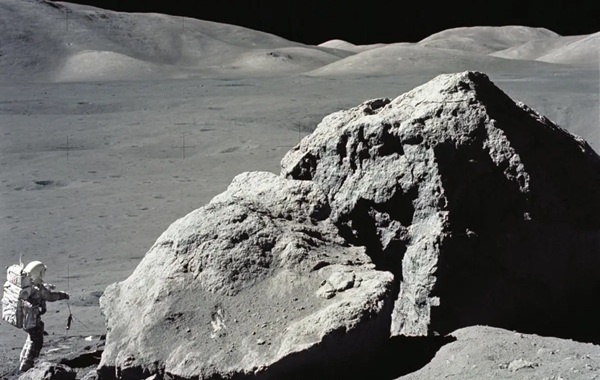
The experiment used lunar dust samples collected during NASA’s Apollo 17 mission in 1972.
After removing any traces of moisture by baking the samples, the team exposed them to simulated solar wind using a particle accelerator, mimicking about 80,000 years of lunar exposure in just a few days.
Sunlight-triggered chemistry hints at moon’s water cycle
When solar wind protons, essentially hydrogen nuclei, slam into the moon’s surface, they find no resistance.
Earth’s magnetic field and atmosphere protect it from these particles, but the moon, which lacks both, takes the full impact.
These protons collide with electrons in the moon’s regolith, forming hydrogen atoms. Those hydrogen atoms then combine with oxygen in minerals like silica to form hydroxyl (OH) and possibly water (H₂O).
“The exciting thing here is that with only lunar soil and a basic ingredient from the sun, which is always spitting out hydrogen, there’s a possibility of creating water,” Yeo said. “That’s incredible to think about.”
Researchers used a spectrometer to monitor how the chemical makeup of the lunar dust changed over time.
They noticed a dip in infrared light absorption around 3 microns, a signature associated with the presence of water.
Although the team couldn’t confirm if pure water formed, the data strongly pointed to the production of both hydroxyl and water molecules.
Implications for Artemis and search for lunar water
NASA’s Artemis program aims to return astronauts to the moon, particularly the South Pole, where much of the moon’s frozen water is believed to exist in permanently shadowed craters.
The study’s findings offer important insight into how water may continue to form even today.
In past spacecraft observations, researchers noted that the spectral signal associated with water shifts throughout the lunar day.
The signal intensifies in the cooler morning and fades as the surface heats—likely due to the movement or escape of water molecules. As the surface cools again at night, the signal returns.
This cycle hints at an active, ongoing process, driven primarily by the solar wind.
While other factors like micrometeorites may contribute, this new research strengthens the case for the sun’s role as the moon’s water source and opens new possibilities for harvesting that water to support future human exploration.
Source: Interesting Engineering
Stars That Sing: How Hidden Frequencies Unravel the Milky Way’s Mysteries
NASA recreates 80,000 years of moon exposure to confirm sun can create water/NASA recreates 80,000 years of moon exposure to confirm sun can create water