Mysterious Smoke on Europa: Sign of Life or Illusion?
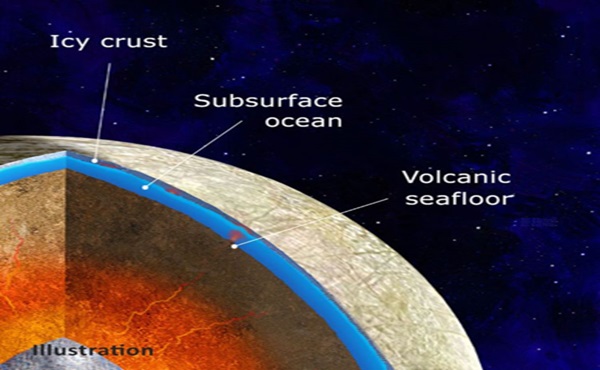
In 2013, the Hubble Space Telescope discovered water vapor on Jupiter’s moon Europa. That water vapor was evidence of a plume similar to the one on Saturn’s moon Enceladus. This water vapor is a plume similar to the one on Saturn’s moon Enceladus. This led to speculation that life could exist in its oceans.
However, because the ocean is covered by a thick layer of ice, the only way to investigate the plume is to use it. Detecting the plume is extremely difficult and has not yet been confirmed.
The lead author of the paper that presented Hubble’s 2013 evidence is Lorenz Ross of the Southwest Research Institute. The simplest explanation for this water vapor is that it erupted from a plume on Europa’s surface. If these plumes are connected to the groundwater ocean thought to exist beneath Europa’s crust, future studies could directly examine the chemical composition of Europa’s habitable environment without having to drill through layers of ice. That would be very exciting,” he said.
But first, the scientists must find the plume.
Joachim Saul of the University of Cologne, co-author of the 2013 paper, said, “We have pushed Hubble’s limits and identified this very faint emission.
We have identified this very faint emission,” says Joachim Saul of the University of Cologne, co-author of the 2013 paper.
Recently, a team of researchers went looking for the plume. The results were presented at the IAU Symposium 383 “ALMA Spectroscopy of Europa: Searching for Active Plumes.” The lead author was M.A. Cordiner of the Solar System Exploration Division at NASA’s Goddard Space Flight Center.
“Europa’s subsurface ocean is a high priority target in the search for extraterrestrial life, but the presence of a thick icy outer shell prevents direct investigation. Researchers used ALMA to search for molecular emissions from the atmospheric plume. They investigated processes beneath the ice that help us understand Europa’s oceans and their chemistry.
The solar system is home to many icy bodies, including comets, Kuiper Belt objects, dwarf planets, and satellites such as Europa. Europa is denser than other icy bodies, indicating that its interior is quite rocky. Europa’s ocean covers about 10% of the Moon and is covered by an ice shell of uncertain thickness. It may be tens of kilometers thick. Scientists learned much of this from NASA’s Galileo mission.
In recent years, Europa and its oceans have risen to the top of the list of targets for life exploration. Liquid water is an irresistible marker in the search for habitable sites. Plumes emanating from Europa’s oceans are the only way to investigate Europa and its habitability.
Over the years, various telescopes have surveyed Europa looking for evidence of plumes. As a result, the possibility of intermittent plumes near the lunar South Pole was discovered. However, the plume discovered by the Hubble Telescope in 2013 could not be confirmed, and JWST surveyed Europa in 2023. The observations “found no evidence of an active plume, indicating that the current activity is localized and weak.
To find the plume, the authors used ALMA (Atacama Large Millimeter/submillimeter Array Interferometer). The surface of Europa was observed over four separate days. Unfortunately, no plume was found.
The researchers write, “Despite almost complete coverage of both Europa’s anterior and posterior hemispheres, we found no evidence of absorption or emission of gas-phase molecules in the ALMA data.” Using ALMA’s unique combination of high spectral/spatial resolution and sensitivity, our observations enabled the first dedicated searches for HCN, H2CO, SO2 and CH3OH in Europa’s exosphere and plume. We found no evidence of the presence of these molecules.
The fact that we did not find evidence does not mean that these molecules do not exist. Rather, it means that if present, its concentration is so low that it is below the detection threshold. In this case, the concentrations detected would be lower than those detected in the Enceladus plume.
One chemical in particular illustrates this point: CH3OH (methanol).
On the other hand, our ALMA upper limit of <0.86% for the abundance of CH3OH would not have been sensitive enough to detect this molecule at the Enceladus plume abundance of 0.02%,” the authors write.
There is an interesting relationship between Europa and other icy bodies in the solar system. It has to do with abundance limits. The researchers set an upper limit for H2CO (formaldehyde) on Europa. In fact, the upper limit for the abundance of H2CO is considerably lower than the plume on Enceladus measured by Cassini, suggesting the possibility of chemical differences.
Despite the failure to detect the plume, this observation was valuable. Establishing detection limits will be useful in subsequent searches for the plume. And this will not be the last attempt by scientists to find the plume. The clues to Europa’s ocean are too fascinating to ignore, and this study shows that ALMA is well suited for this type of investigation.
The researchers write, “Our results show that ALMA is a powerful tool for searching for outgassing from icy bodies in the solar system, justifying follow-up searches for other molecules in further epochs (on Europa and other icy bodies).” He concludes. Could you please rewrite the above article, removing the repetitive sentences and correcting the spelling errors?
Source: Mysterious Smoke on Europa: Sign of Life or Illusion?
Magnetic Star Awakens After Sleeping For 10 Years And It’s Acting Super Weird
Mysterious Smoke on Europa: Sign of Life or Illusion?