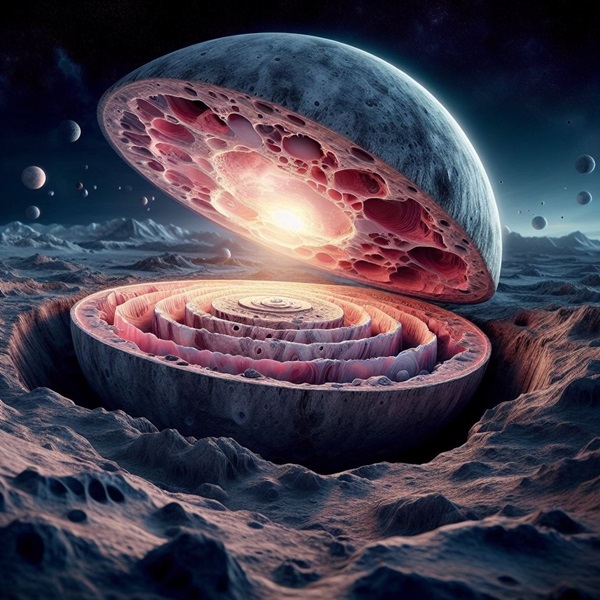
Moon’s Ancient Secret Revealed: The Strange Event That Shaped Its Surface
Moon Turned Inside Out Billions of Years Ago, Scientists Reveal
The Moon is a strange celestial body in the sky, and scientists may have figured out part of the reason why.
The moon’s surface is chemically asymmetric, and new evidence suggests that this is because the lunar mantle turned inside out when the moon was still young. What was on top of the Earth’s moon fell down and what was underneath came out into the light.
Lunar scientists have pondered lunar mantle overturning for decades. Now, new evidence has been obtained that confirms it. A research team led by planetary scientists Weigang Liang and Adrien Broquet of the University of Arizona found that a lunar gravity map best fits this model of mantle overturning.
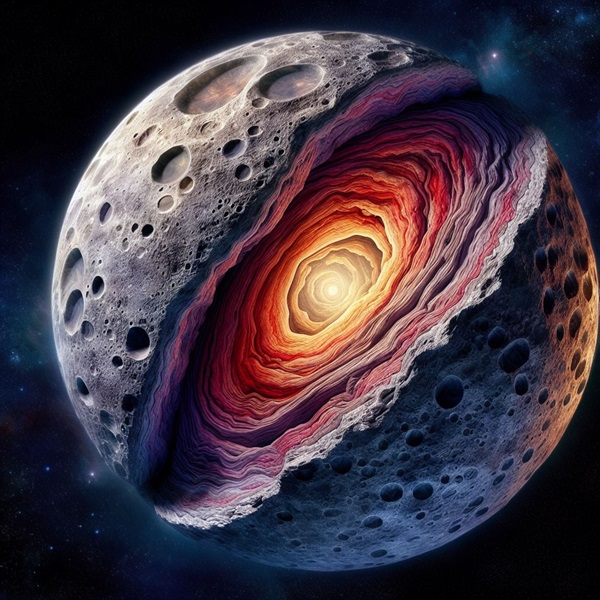
In a series of simulations, the team showed how the gravity anomalies on the lunar surface are consistent with the presence and location of dense rocks containing dense minerals preserved from the Moon’s earliest days.
In their paper, the team writes, “This interpretation is supported by the compelling similarity between the pattern, size, and dimensions of the observed gravity anomalies and those predicted by geodynamic models of cumulus remnants, including ilmenite.”

The researchers also dated exactly when this overthrow occurred. About 4.22 billion years ago, shortly after a violent collision early in the history of the solar system destroyed a chunk of the Earth and formed the Moon.
One of the strangest things about the Moon has to do with its surface. On the far side of the Moon, there is a region that is aptly described as “geochemically strange”: known as the KREEP terrane, it is rich in unexpected metals such as potassium, rare earth elements, and phosphorus.
The KREEP Terrane also coincides with the lunar maria, a large basalt plain that is the result of volcanic activity. This basalt is rich in a mineral called ilmenite. Composed primarily of titanium and iron, ilmenite is very dense, as are the rocks that contain it.
This is puzzling because the underlying rocks are less dense. Based on density, the ilmenite-bearing cumulative rocks (IBCs) would have sunk into the Moon, while the less dense rocks would have risen to the lunar surface.
Both the KREEP terranes and IBCs can be explained by crustal deformation shortly after the Moon formed. When the Moon was still hot and wet, it would have been covered by an ocean of molten magma, which cooled and formed the crust and mantle.
In this scenario, as the magma cooled and crystallized, dense minerals such as ilmenite formed in the layers between the crust and mantle, concentrating the KREEP elements into liquid reservoirs.
These dense minerals are expected to sink toward the lunar core. However, without modeling the physical processes that occurred within the Moon during its formation, scientists cannot be certain that this occurred.
It is also possible that after initially sinking inward, the IBC warmed and rose again, overturning the mantle in the process. If so, this would explain both the KREEP terrane and the titanium-rich basalts that were erupted to the surface by volcanic activity.
In this scenario, both elements should be more or less evenly distributed in the lunar mantle, but that is not what scientists have found.
The South Pole Aitken Basin on the far side of the Moon is a massive impact that left craters covering more than a quarter of the lunar surface.
It is possible that this impact created a hot spot that moved KREEP and ilmenite away from the impact site and concentrated them on the front side of the Moon. However, the researchers realized that such a migration should have left a clear gravitational signature. The researchers developed a lunar tilt model of ilmenite-rich material and observed the gravity patterns produced by the concentration of IBCs beneath the crust.
They obtained a clear polygonal pattern of linear gravity anomalies. The team compared their data with data from NASA’s Gravity Recovery and Interior Laboratory (GRAIL) spacecraft, which spent more than a year mapping the gravity of the lunar surface.
The patterns generated by the lunar mantle overturning model matched the observations collected by GRAIL. The model also revealed the time it takes for the pattern to evolve, constraining the timing of the overturn to be at least 4.22 billion years ago.
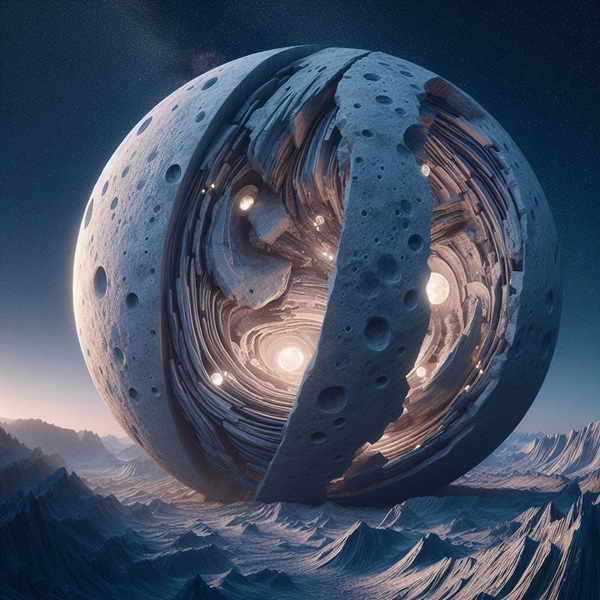
Gravity anomalies support the prediction that the final subduction of these dense materials took the form of sheet-like downwellings, and these features are preserved throughout the geologic history, simultaneously constraining the timing of the overturn.
Thus, the lunar gravity field preserves an important record of lunar mantle overturning. This is widely assumed to be one of the defining events of early lunar history, but its details have remained unknown until now.
Source: Moon’s Ancient Secret Revealed: The Strange Event That Shaped Its Surface
Astronomers detect potential ‘glory effect’ on a hellish distant world for the first time
Astronomers detect potential ‘glory effect’ on a hellish distant world for the first time
Moon’s Ancient Secret Revealed: The Strange Event That Shaped Its Surface