Meet the swirlon, a new kind of matter that bends the laws of physics
To explore active matter, Brilliantov and his colleagues used a computer to simulate particles that could self-propel. These particles weren’t consciously interacting with the environment, Brilliantov told Live Science. Rather, they were more akin to simple bacteria or nanoparticles with internal sources of energy, but without information-processing abilities.
The first surprise was that this active matter behaves very differently than passive matter. Different states of passive matter can coexist, Brilliantov said. For example, a glass of liquid water can gradually evaporate into a gaseous state while still leaving liquid water behind. The active matter, by contrast, didn’t coexist in different phases; it was all solid, all liquid or all gas.
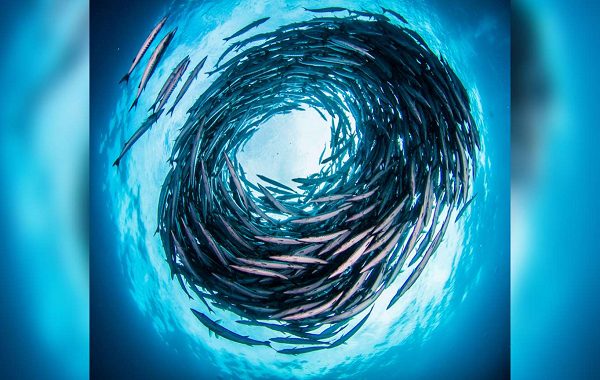
The particles also grouped together as large conglomerates, or quasi-particles, which milled together in a circular pattern around a central void, kind of like a swirl of schooling sardines. The researchers dubbed these particle conglomerates “swirlons,” and named the new state of matter they formed a “swirlonic state.”
In this swirlonic state, the particles displayed bizarre behavior. For example, they violated Newton’s second law: When a force was applied to them, they did not accelerate.
“[They] just move with a constant velocity, which is absolutely surprising,” Brilliantov said.
The simulations were basic, and experimental work with real-world active matter is an important next step, he said. Brilliantov and his colleagues also plan to do more complex simulations using active-matter particles with information-processing abilities. These will more closely resemble insects and animals and help to reveal the physical laws governing schooling, swarming and flocking. Ultimately the goal is to create self-assembling materials out of active matter, Brilliantov said, which makes it important to understand the phases of this kind of matter.
“It’s quite important that we see the nature of active matter” is much richer than that of passive matter, Brilliantov said.
The research was detailed in October 2020 in the journal Scientific Reports.
Originally published on Live Science.
/Meet the swirlon, a new kind of matter that bends the laws of physics/