Did the Universe Begin with the Greatest Fireworks Show Ever?
What If the First Stars Were Bigger Than Anything in the Modern Universe?
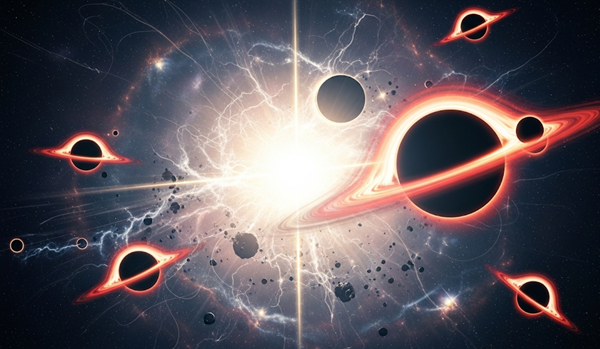
Imagine the cosmos erupting in a brief, blinding blaze—an instant so intense it illuminated the entire universe before vanishing, leaving behind titanic black holes unlike anything seen since. This is not science fiction, but the foundation of a groundbreaking new theory that may finally unravel one of astronomy’s greatest puzzles: how supermassive black holes formed so quickly after the Big Bang.
A Cosmic Mystery Unearthed by the James Webb Space Telescope
The enigma began when NASA’s James Webb Space Telescope (JWST) detected supermassive black holes lurking in the farthest reaches of space—black holes that existed when the universe was less than a billion years old.
These giants, millions to billions of times more massive than our Sun, should have taken far longer to form according to traditional models. The early universe was a sparse, raw environment—so how did these colossal objects grow so massive, so fast?
Introducing the “Pop III.1” Hypothesis
Astrophysicist Jonathan Tan from the University of Virginia proposes a radical framework called Population III.1 (Pop III.1)—a theory that not only explains the black holes’ rapid emergence but also reshapes our understanding of the universe’s first luminous age.
According to Tan, the first stars were nothing like the stars we see today. Instead, they were supermassive stellar giants, fueled by a surprising engine: dark matter annihilation, a process that pumped staggering amounts of energy into these cosmic behemoths.
Stars Born in a Pristine Universe
These Population III.1 stars emerged in a cosmos untouched by heavy elements, composed purely of hydrogen and helium. Without the metallic dust and elements that shape modern star formation, they could grow far larger—some perhaps reaching hundreds of thousands of solar masses before meeting their end.
But these stars didn’t go quietly. Instead, they blazed into existence with dazzling bursts of light, altering the very fabric of the universe.
The Universe’s First “Flash Ionisation” Event
Tan’s model suggests these supermassive stars unleashed brilliant light waves powerful enough to ionise hydrogen gas throughout all of space almost instantly.
“Our model requires that the supermassive star progenitors of the black holes rapidly ionised the hydrogen gas in the universe, announcing their birth with bright flashes that filled all of space,” says Tan.
This flash ionisation would mark an entirely new, earlier phase in the universe’s history—predating the well-known Epoch of Reionisation caused by normal galaxies.
Clues to the Hubble Tension?
If correct, this early ionisation could also shed light on the infamous Hubble Tension—the ongoing disagreement between different measurements of the universe’s expansion rate. Could these cosmic fireworks be the missing factor that explains why astronomers see different answers when they measure the universe’s growth?
From Cosmic Fireworks to Galactic Anchors
The aftermath of these spectacular explosions was just as important. When the supermassive stars collapsed, they left behind black hole “seeds” that grew rapidly, becoming the gravitational anchors around which galaxies formed. Without them, the Milky Way—and perhaps even life as we know it—might never have existed.
A Radical Rewrite of the Universe’s Origin Story
Instead of a slow cosmic dawn with faint starlight gradually brightening the universe, Tan’s theory paints a far more dramatic picture:
A sudden, all-encompassing light show—the greatest fireworks display in cosmic history—followed by the birth of the black holes that shaped the large-scale structure of the cosmos.
If proven true, the Pop III.1 model wouldn’t just explain a mystery—it would rewrite our understanding of the universe’s first billion years.
The question now is: Can we find the fingerprints of this long-lost light show buried in the universe’s oldest signals?
Source: Did the Universe Begin with the Greatest Fireworks Show Ever?