Beyond Our Solar System: Is Canada’s POET Mission the Key to Alien Life?
The search for worlds beyond our own has accelerated at an astonishing pace. Today, institutions like NASA report that the number of confirmed exoplanets is rapidly approaching six thousand three hundred. Among them, more than two hundred are classified as terrestrial—rocky planets that may resemble Earth.
But what does this surge truly mean? Are we simply cataloging distant rocks, or are we inching closer to discovering life?
As detection methods improve and telescopes become more sensitive, scientists are no longer asking if Earth-like planets exist—they are asking where to look next. And now, Canada may have found a powerful answer.
POET Mission for Earth-Sized Exoplanets: Why Ultracool Dwarfs Hold the Key
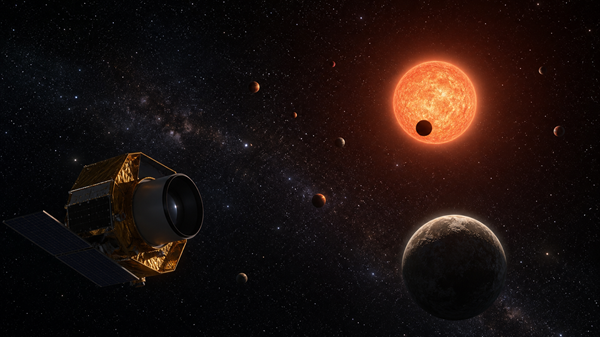
Canada’s proposed POET mission—short for Photometric Observations of Exoplanet Transits—aims to transform how we search for small, rocky planets. Unlike many previous missions, POET will focus on ultracool dwarf stars.
These stars, including K-type, M-type, and brown dwarfs, are smaller and cooler than our Sun. Because they are so compact—often only about ten percent of the Sun’s diameter—something remarkable happens.
When a planet passes in front of them, the drop in brightness is far more noticeable.
So, could smaller stars actually make it easier to find Earth-like planets?
That is exactly the premise driving POET. By targeting these dim stars, scientists expect to detect planets that might otherwise remain invisible around larger stars like our own.
Transit Detection Method Explained: How POET Will Spot Hidden Worlds
POET will rely on the transit method, one of the most successful techniques in modern astronomy.
When a planet crosses in front of its host star, it blocks a tiny fraction of the star’s light. This creates a measurable dip in brightness. While the concept sounds simple, detecting such dips requires extraordinary precision.
However, around ultracool dwarfs, the signal becomes stronger. The size ratio between planet and star is larger, making the transit easier to detect.
But here’s the deeper question:
If we can detect these dips more easily, does that mean we are overlooking entire populations of planets around smaller stars today?
POET may soon provide the answer.
From MOST to NEOSSat to POET: Canada’s Growing Space Telescope Legacy
The POET mission does not emerge in isolation. Instead, it builds on a legacy of Canadian innovation in space astronomy.
Earlier missions like MOST (Microvariability and Oscillations of Stars) and NEOSSat (Near-Earth Object Surveillance Satellite) laid the groundwork. Launched in two thousand three and two thousand thirteen, these microsatellites demonstrated that small telescopes could produce powerful science.
MOST, in particular, gained attention for studying stars and even contributing to exoplanet research, including observations of a hot Jupiter orbiting HD 209458.
So, what makes POET different?
It is not just an upgrade—it represents a strategic shift toward discovering potentially habitable worlds.
Advanced Telescope Technology in POET: Why Size and Wavelength Matter
POET will carry a twenty-centimeter telescope, larger than its predecessors. While this may sound modest, the increase in aperture significantly improves light-gathering ability.
Moreover, POET will observe across multiple wavelengths:
- Near-ultraviolet
- Visible light
- Near-infrared
- Short-wave infrared
This expanded range allows scientists to detect more subtle signals and study planetary environments in greater detail.
But the real intrigue lies here:
Could observing in these wavelengths reveal not just planets—but clues about their atmospheres?
If so, POET may do more than find planets—it may help identify worlds that could support life.
Targeting Ultracool Dwarfs Within One Hundred Parsecs: A Strategic Selection
To maximize its success, the POET team developed a refined catalog of ultracool dwarf stars. Initially, more than seven thousand two hundred candidates were considered.
However, through careful filtering—excluding binary systems and overly bright stars—the list was reduced to just over three thousand targets. All of these lie within one hundred parsecs, or roughly three hundred twenty-six light-years, from Earth.
From this pool, scientists identified one hundred to three hundred high-priority targets for a one-year mission.
Why such precision?
Because every observation counts. And in the vastness of space, choosing where to look may be the most important decision of all.
Habitable Zone Earth Analogues: Could POET Discover Life-Friendly Worlds?
One of the most exciting aspects of POET lies in its potential to find planets within the habitable zone.
Around ultracool dwarfs, this zone is much closer to the star. As a result, planets with orbital periods shorter than seven days may still maintain conditions suitable for liquid water.
This raises a fascinating possibility:
Could life exist on planets that orbit their stars in just a few days?
If POET detects such planets, they will become prime targets for further study by powerful observatories like the James Webb Space Telescope.
Future missions, including the proposed Habitable Worlds Observatory, could even analyze their atmospheres for biosignatures—gases that may indicate life.
Scientific Implications of POET Mission: Are We on the Brink of a Breakthrough?
The implications of POET extend far beyond cataloging planets.
If successful, the mission could identify Earth-sized worlds that are close enough for detailed atmospheric study. This would mark a major step toward answering one of humanity’s oldest questions:
Are we alone in the universe?
Yet, another question lingers:
Even if we find Earth-like planets, will they truly resemble our world—or surprise us in ways we cannot yet imagine?
Conclusion: A Small Satellite with a Massive Mission
POET may be a microsatellite, but its ambitions are anything but small. By focusing on ultracool dwarf stars, it challenges traditional search strategies and opens new pathways in the hunt for life.
As its planned launch in two thousand twenty-nine approaches, anticipation continues to grow.
Will POET uncover hidden Earths in our cosmic neighborhood?
Will it reveal atmospheres rich with clues of life?
Or will it redefine what we thought was possible in planetary science?
One thing is certain:
The search is no longer just about finding planets—it is about understanding our place among them.
Source: Beyond Our Solar System: Is Canada’s POET Mission the Key to Alien Life?
A lost galaxy called ‘Loki’ may be hiding inside the Milky Way
A lost galaxy called ‘Loki’ may be hiding inside the Milky Way
Beyond Our Solar System: Is Canada’s POET Mission the Key to Alien Life?
Sources and Further Reading
NASA Exoplanet Archive
POET mission preprint (arXiv)
Proceedings of SPIE Volume thirteen thousand six hundred twenty-seven
James Webb Space Telescope mission documentation