Lightning ‘Whistler’ Detected on Mars—Is the Red Planet Hiding Electric Storms?
For decades, scientists have debated a compelling question: Does lightning truly occur on Mars? Now, a breakthrough observation suggests that the Red Planet may indeed crackle with electrical energy.
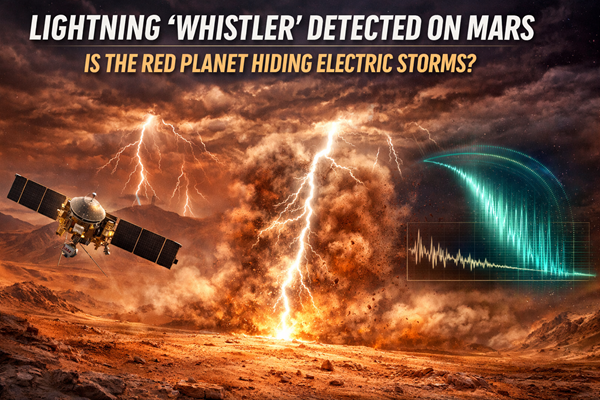
A distinctive radio “howl,” known as a whistler, has been detected in the Martian environment for the first time. The signal was recorded by NASA’s MAVEN spacecraft while orbiting Mars on June twenty-first, two thousand fifteen. Years later, detailed analysis confirmed that the unusual electromagnetic trace matched the signature of a lightning-generated whistler wave.
The finding is more than a curiosity. It suggests that electrical discharges do occur in the Martian atmosphere—and that the plasma physics governing their radio emissions follows the same fundamental rules observed on Earth.
So, is Mars more electrically active than we once believed?
Martian Lightning Whistler Signal: First Direct Electromagnetic Evidence
The detected signal displayed all the defining features of a classical whistler. On Earth, whistlers form when lightning releases electromagnetic radiation across a broad spectrum. The lowest frequency radio waves travel upward into the ionosphere, moving along magnetic field lines as plasma waves.
Because higher frequencies travel faster than lower ones, the signal stretches in time. When converted into sound, it produces a descending tone—eerily similar to the distant call of a whale.
The Martian event lasted about four-tenths of a second. It swept downward in frequency and stood nearly ten times stronger than the surrounding background noise. Remarkably, its structure closely resembled terrestrial whistlers.
Yet Mars lacks a global magnetic field. How, then, could such a signal propagate?
Crustal Magnetic Fields on Mars: Fossil Remnants Enabling Plasma Wave Propagation
Unlike Earth, Mars does not possess a planet-wide magnetosphere. However, it retains localized magnetic patches embedded within its crust—magnetized minerals that preserve a record of an ancient global field.
Decades ago, theoretical studies proposed that these crustal magnetic anomalies could guide plasma waves in a manner similar to Earth’s magnetic field lines. Now, observational evidence supports that hypothesis.
The whistler event was recorded at an altitude of three hundred forty-nine kilometers above the Martian surface, on the planet’s nightside. This detail is crucial. During daylight, solar radiation compresses the Martian ionosphere, suppressing plasma wave propagation. On the nightside, however, the ionosphere becomes sufficiently rarefied to allow these waves to travel.
When researchers modeled the magnetic geometry and plasma density in that region, they found an almost perfect agreement between prediction and observation.
Coincidence—or confirmation?
MAVEN Plasma Wave Data Analysis: One Signal Among Over One Hundred Eight Thousand Recordings
The discovery did not emerge easily. Led by atmospheric physicist František Němec of Charles University, researchers examined one hundred eight thousand four hundred eighteen plasma wave recordings collected by MAVEN.
Only one event exhibited the unmistakable dispersion pattern of a whistler.
Why just one?
Fewer than one percent of the wave snapshots were captured in regions with the correct magnetic orientation. The conditions had to align precisely:
A nearly vertical crustal magnetic field
A sufficiently weak ionosphere
A powerful electrical discharge
The spacecraft positioned at exactly the right place and time
Given these constraints, the rarity of detection becomes understandable.
However, rarity does not imply absence. It may instead indicate that lightning on Mars is more common than current instrumentation allows us to observe.
Dust Storm Electricity and Martian Lightning: How Discharges May Form Without Water
On Earth, lightning is strongly associated with water-rich storm clouds. Mars, by contrast, possesses a thin, dry atmosphere dominated by carbon dioxide. At first glance, this seems incompatible with lightning formation.
Yet moisture is not strictly required. Volcanic plumes on Earth generate intense lightning through particle collisions within ash clouds. Similarly, Mars experiences global dust storms in which sand particles collide violently, building static charge.
Recent observations have already suggested that dust-driven electrical discharges occur during Martian storms. The newly detected whistler strengthens that case.
If dust storms can electrify the atmosphere, could Mars host powerful lightning bolts invisible to optical cameras but audible in radio frequencies?
Energy Estimates: Comparable to Strong Lightning on Earth
Although the recorded signal appeared weak compared to many terrestrial whistlers, researchers accounted for propagation losses through plasma. After correction, the estimated source energy approached that of strong lightning discharges on Earth.
This result raises another intriguing possibility: Martian lightning may not be faint or insignificant. It may simply be difficult to detect.
What other energetic processes could be unfolding unseen within Martian dust storms?
Astrobiological Implications: Could Lightning Spark Prebiotic Chemistry on Mars?
The implications extend beyond atmospheric physics.
Laboratory experiments simulating early Earth conditions have demonstrated that electrical discharges can drive the formation of complex organic molecules. Lightning may have contributed to prebiotic chemistry before life emerged on our planet.
If similar discharges occur on Mars, even intermittently, they introduce another variable into the planet’s astrobiological equation.
Could electrical activity have influenced the chemistry of ancient Martian environments? Might lightning have played a role during epochs when Mars possessed thicker atmospheres and liquid water?
These questions remain open—but they are no longer speculative fantasies. They are scientifically grounded possibilities.
Why Detection Is So Difficult: Geometry, Timing, and Instrumentation Constraints
Compared to Earth, Mars is sparsely monitored. Only a limited number of orbiters carry plasma wave instruments capable of detecting whistlers.
Moreover, the geometry must be nearly perfect. The magnetic field must be aligned properly. The ionosphere must not be overly compressed. The spacecraft must be nearby. And the discharge must be powerful.
Such alignment is rare.
Therefore, the absence of repeated detections does not negate the phenomenon. Instead, it highlights the precision required for observation.
Mars Lightning Whistler Discovery: A Turning Point in Planetary Plasma Physics
This first confirmed whistler detection marks a milestone in planetary science. It demonstrates that even without a global magnetosphere, Mars can support lightning-generated plasma waves under the right conditions.
More importantly, it reveals that the same electromagnetic principles operate across planetary environments. Physics does not change at planetary borders.
Still, many mysteries persist.
How frequently does Martian lightning occur?
Are dust storms the primary driver?
Did lightning play a chemical role in Mars’ ancient past?
And could future missions detect optical flashes to accompany radio signatures?
Mars continues to surprise us. Each new signal reshapes our understanding—not only of the Red Planet, but of atmospheric electricity throughout the solar system.
The next question is simple yet profound:
If Mars can whisper with lightning, what else is it trying to tell us?
Source: Lightning ‘Whistler’ Detected on Mars—Is the Red Planet Hiding Electric Storms?
Lightning ‘Whistler’ Detected on Mars—Is the Red Planet Hiding Electric Storms?
Sources
NASA – MAVEN mission data
MAVEN Plasma Wave Instrument observations
Charles University research led by František Němec
Peer-reviewed plasma wave and planetary ionosphere studies published in geophysical research journals
Lightning ‘Whistler’ Detected on Mars—Is the Red Planet Hiding Electric Storms?