One of the Biggest Stars in the Universe Might Be Getting Ready to Explode—Are We About to Witness a Supernova?
The phrase “one of the biggest stars in the universe might be getting ready to explode” is not clickbait. It may describe a real-time astrophysical transformation unfolding in the outskirts of our cosmic neighborhood. According to a recent study published in Nature Astronomy and led by Gonzalo Muñoz-Sanchez at the National Observatory of Athens, the colossal star WOH G64 appears to have undergone a dramatic evolutionary shift.
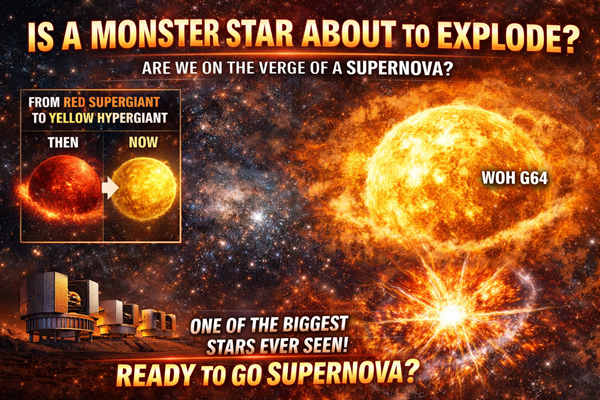
If confirmed, we may be witnessing a rare transition from red supergiant to yellow hypergiant—a phase that often precedes a catastrophic supernova explosion. But what does this really mean? And how close are we to seeing one of the universe’s giants die?
WOH G64: One of the Biggest Stars in the Universe Located in the Large Magellanic Cloud
WOH G64 was first identified in the 1970s inside the Large Magellanic Cloud, a satellite galaxy orbiting the Milky Way. From the beginning, it stood out.
It was not merely luminous. It was immense.
Estimates suggest its radius exceeds one thousand five hundred times that of the Sun. If placed at the center of our Solar System, it would extend far beyond Jupiter’s orbit. Such scale challenges comprehension. How does a star grow so large? And more importantly, how does something that massive die?
In two thousand twenty-four, another milestone was reached. Using the Very Large Telescope Interferometer, astronomers captured the first detailed image of a star beyond our galaxy. The image revealed a thick, asymmetric cocoon of dust surrounding WOH G64.
This was not decorative. It was diagnostic.
The dusty envelope confirmed intense mass loss. The star was shedding its outer layers at extraordinary rates. Therefore, something fundamental was changing inside.
Red Supergiant to Yellow Hypergiant Transition: Evidence of an Impending Supernova?
Massive stars evolve differently from stars like our Sun. WOH G64 is estimated to be less than five million years old. By contrast, the Sun is approximately four point six billion years old.
Massive stars live fast. They burn fuel rapidly. Consequently, their lives are short.
Initially, WOH G64 fused hydrogen in its core. Later, as hydrogen became depleted, helium fusion began. The outer layers expanded, and the star entered the red supergiant phase. This stage is common among high-mass stars.
However, not all red supergiants become yellow hypergiants. That transition is rare and unstable. Yellow hypergiants are among the most volatile stars known. Their atmospheres are loosely bound. Their pulsations are extreme. Their mass-loss rates can become explosive.
The new research argues that around two thousand fourteen, WOH G64 underwent such a transition. A significant portion of its outer surface appears to have been ejected. As a result, the star may have contracted slightly while increasing in surface temperature.
If true, this is extraordinary. We may be observing stellar evolution on human timescales.
But why did this change occur?
Companion Star Interaction or Pre-Supernova “Superwind” Phase? Competing Theories Explained
Two main explanations are being considered.
First, spectral analysis indicates that WOH G64 has a companion star. Stellar interactions in binary systems can destabilize outer layers. Gravitational effects may strip material away. If so, tidal forces could have triggered the observed transformation.
Second, the transition may represent a pre-supernova “superwind” phase. In this scenario, intense internal pulsations develop as nuclear fuel in the core is rapidly exhausted. Energy transport becomes unstable. The outer envelope is expelled in powerful winds.
Such a phase has long been theorized. Yet rarely has it been observed so clearly.
If WOH G64 is entering this stage, the implications are profound. A supernova would not occur tomorrow. However, in astronomical terms, it could be imminent.
So which hypothesis is correct? Is a companion star responsible? Or is the star internally collapsing toward its inevitable fate?
Supernova Implications: What Happens If One of the Biggest Stars in the Universe Explodes?
When a star of this magnitude dies, it does not fade quietly. It detonates.
A core-collapse supernova would release immense energy. Heavy elements would be forged. Shockwaves would propagate through the interstellar medium. Eventually, the remnant could form a neutron star or even a black hole.
Although WOH G64 resides in the Large Magellanic Cloud, far beyond any danger to Earth, its explosion would be visible across intergalactic distances. It would provide unprecedented observational data.
Moreover, scientists could refine stellar evolution models. The uncertain pathway between red supergiant and supernova could finally be clarified.
Still, uncertainty remains. Predicting the exact timing of a supernova is notoriously difficult. Massive stars often exhibit erratic behavior long before collapse. Therefore, caution is warranted.
Are we truly observing the final chapter? Or is this merely another unstable episode in a turbulent stellar life?
Why This Transformation Matters for Stellar Evolution Research
Most stars evolve over millions or billions of years without noticeable change during a human lifetime. Observing such rapid transformation is rare. Observing it in another galaxy is rarer still.
WOH G64 provides a natural laboratory. It allows astrophysicists to test theoretical predictions regarding hypergiant instability, mass-loss mechanisms, and pre-supernova activity.
Furthermore, direct imaging from advanced interferometry has opened a new era. Stellar surfaces beyond the Milky Way can now be resolved. Dust formation, asymmetry, and mass ejection patterns can be studied in detail.
Thus, this case is not merely about spectacle. It concerns fundamental physics.
How do the most massive stars regulate energy transport? What triggers envelope ejection? At what threshold does collapse become irreversible?
Conclusion: Are We Watching a Cosmic Giant’s Final Act?
WOH G64 has already surprised astronomers. It was once classified as a red supergiant. Now, evidence suggests it may be a yellow hypergiant. That shift alone is extraordinary.
If the current interpretation holds, the star is approaching the end of its brief existence. In cosmic terms, five million years is an instant. Its death could illuminate stellar physics for generations.
Yet only time will tell.
Will we witness the supernova of one of the biggest stars in the universe within our lifetime? Or will WOH G64 continue to defy expectations?
The universe rarely provides advance notice before rewriting its own rules. Perhaps this time, it has.
Source: One of the Biggest Stars in the Universe Might Be Getting Ready to Explode—Are We About to Witness a Supernova?
If the Milky Way Is Full of Signals, Why Does Earth Hear Nothing?
If the Milky Way Is Full of Signals, Why Does Earth Hear Nothing?
Sources
Muñoz-Sanchez, G. et al., study published in Nature Astronomy
Observational data from the Very Large Telescope Interferometer
Archival research from the National Observatory of Athens
Background data on WOH G64 in the Large Magellanic Cloud