James Webb Telescope’s Discoveries Disprove Dark Matter Theory—What Now?
Recent findings are shaking up the standard model of galaxy formation by questioning the role of dark matter in the early universe. Research led by astrophysicist Stacy McGaugh at Case Western Reserve University, published on November 12 in The Astrophysical Journal, shows that early galaxies observed by the James Webb Space Telescope (JWST) don’t match dark matter predictions. Instead, these observations align more closely with Modified Newtonian Dynamics (MOND), suggesting modified gravity may be the key to understanding the universe’s earliest structures.
Dark Matter Theory vs. MOND: A Clash of Models
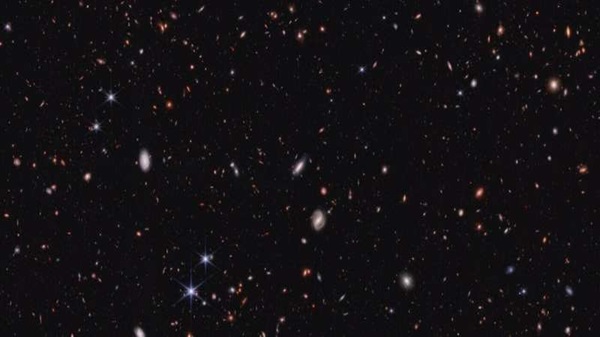
The conventional Lambda-Cold Dark Matter (Lambda-CDM) model has long been the dominant explanation for galaxy formation. It predicts that dark matter provided extra gravitational pull, allowing stars and galaxies to form gradually from small, faint precursors into larger structures. According to this model, JWST should detect dim signals from small, primitive galaxies, yet JWST data is revealing something quite different—large, bright galaxies in the universe’s infancy.
McGaugh, a professor and director of astronomy at Case Western Reserve, suggests these findings challenge the role of dark matter and support MOND, a theory from 1998 that posits galaxy formation happened much faster than Lambda-CDM predicts. In the MOND model, galaxies form through a rapid clumping of matter driven by stronger-than-expected gravitational forces, without any need for dark matter.
JWST Observations of Bright, Early Galaxies
JWST’s mission was to answer fundamental questions about how and when stars and galaxies emerged. Designed to peer deeply into space and time, JWST’s data has surprised researchers by showing bright and massive galaxies from very early in the universe’s history. This challenges Lambda-CDM’s assumption that large galaxies gradually assembled from smaller parts over long periods.
Instead of faint galaxy precursors, JWST is detecting large, bright structures even when observing at high redshifts, a measure of how far back in time the telescope is looking. These observations support MOND’s prediction that galaxies formed rapidly and initially expanded with the universe before collapsing under their own gravity to create the large galaxies we observe today.
A Prediction Fulfilled: MOND’s Early Universe Vision
“The large and bright structures seen by JWST very early in the universe were predicted by MOND over a quarter-century ago,” McGaugh says. This prediction, based on MOND’s view of gravity, suggests that galaxies formed differently than the dark matter model suggests, questioning whether dark matter is necessary for understanding galaxy formation.
McGaugh co-authored this research with Federico Lelli from INAF—Arcetri Astrophysical Observatory in Italy, former graduate student Jay Franck, and University of Oregon’s James Schombert. This groundbreaking study could lead to a paradigm shift in astrophysics as scientists work toward a theory that reconciles MOND with General Relativity.
The Future of Galaxy Formation Theory
This new evidence opens the door to a reevaluation of galaxy formation models. If further JWST data continue to support MOND over Lambda-CDM, astronomers may need to rethink the fundamental forces driving cosmic evolution. As McGaugh says, the scientific method is about making predictions and then observing which are confirmed—a process that could reshape our understanding of the universe.
Source: James Webb Telescope’s Discoveries Disprove Dark Matter Theory—What Now?