
Is This the First-Ever Exoplanet Orbiting a Hypervelocity Star?
NASA May Have Found the Fastest Planetary System Ever Discovered
A Record-Breaking High-Speed System in the Milky Way
Deep in the heart of the Milky Way, an extraordinary pair of celestial objects is racing through space at an unprecedented speed. Scientists believe this system consists of a high-velocity star and its exoplanet, potentially setting a new record for the fastest-moving planetary system ever observed.
Unlike most stars that drift through the galaxy at a few hundred thousand miles per hour, this pair is traveling at an astonishing 1.2 million miles per hour (540 kilometers per second)—twice the speed of our Solar System’s journey through space.
The First Exoplanet Orbiting a Hypervelocity Star?
Astronomers theorize that the system contains a super-Neptune-class exoplanet orbiting a low-mass star. If confirmed, this would mark the first known instance of a planet bound to a hypervelocity star—an object so fast it may be on its way to escaping the Milky Way entirely.
“We think this is a so-called super-Neptune world orbiting a low-mass star at a distance that would lie between the orbits of Venus and Earth if it were in our solar system,” researchers say.
Discovery Through Gravitational Microlensing
The objects were first detected in 2011 through gravitational microlensing, a technique that relies on the warping effect of massive objects on spacetime. When a celestial body passes in front of a distant star, its gravity bends and magnifies the starlight, allowing astronomers to study unseen objects.
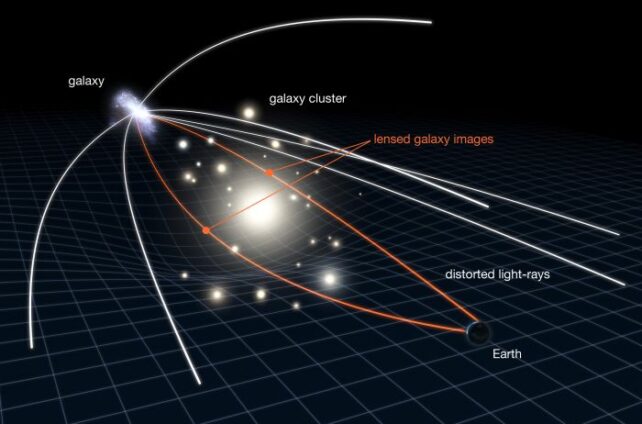
At the time, researchers calculated that one of the objects was 2,300 times more massive than the other. However, the absolute mass of each body remained a mystery, leaving room for two possibilities: a low-mass star with a super-Neptune exoplanet or a massive rogue planet with a smaller moon.
Tracking the System’s Speed and Motion
More than a decade later, scientists revisited the system using advanced data from the Keck Observatory in Hawaii and ESA’s Gaia satellite. Their analysis pointed to a location 24,000 light-years away, deep in the dense central bulge of the Milky Way.
By measuring the change in position since 2011, researchers determined the object’s staggering velocity. However, their calculations only account for movement in two dimensions, meaning the star could be moving even faster when considering additional motion toward or away from Earth.
A Star on the Edge of Escape
The extreme velocity suggests that this star could be on the verge of surpassing the Milky Way’s escape velocity—estimated between 550 and 600 kilometers per second. If confirmed, the system is effectively on a trajectory toward intergalactic space, though it will take millions of years before it fully exits the galaxy.
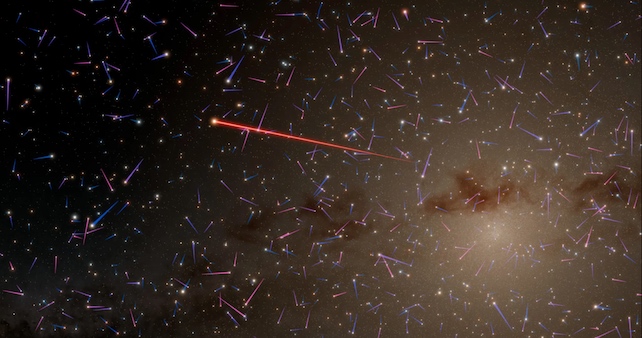
While this discovery aligns with the 2011 observations, scientists need further confirmation. Future observations will determine whether this star remains stationary relative to the microlensing event or if it continues moving in a predicted path.
A Mystery Yet to Be Solved
If follow-up studies show the star moving as expected, it would solidify the hypervelocity planetary system theory. However, if it remains stationary, another explanation gains traction: a massive rogue planet with a much smaller exomoon. Either scenario presents groundbreaking implications for our understanding of celestial mechanics and planetary formation in extreme environments.
The discovery of this possible high-speed planetary system challenges current models of star and planet dynamics, opening the door to further exploration of hypervelocity objects. As new observations come in, scientists will continue unraveling the mystery of these cosmic speedsters, providing deeper insight into the wild and unpredictable nature of our universe.
Source: Is This the First-Ever Exoplanet Orbiting a Hypervelocity Star?