What If El Castillo Isn’t Just a Pyramid—but a Living Calendar That Follows the Sun All Year Long?
What if a pyramid was not just a monument—but a precise instrument for measuring time? Recent research suggests exactly that. At the heart of Chichén Itzá, the iconic structure known as El Castillo appears to function as a living calendar.
For decades, scholars believed the famous “descent of Kukulcán” occurred only during the equinoxes. However, new findings indicate something far more astonishing. The phenomenon unfolds throughout the year. It follows a strict solar rhythm. And remarkably, it encodes the full Maya calendar within the pyramid’s geometry.
So the question arises: were the Maya simply building monuments—or engineering time itself?
The “Descent of Kukulcán” Light Phenomenon: How Solar Shadows Create a Living Serpent
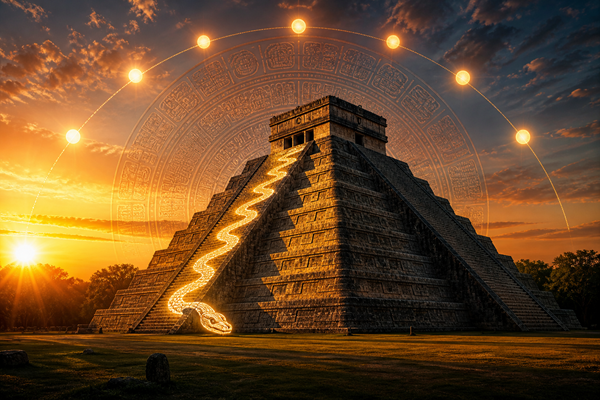
As the afternoon sun lowers toward the horizon, shadows begin to stretch across the pyramid’s northwest staircase. Gradually, triangular patches of light appear. These shapes align perfectly. Together, they form the illusion of a serpent slithering downward.
This is the legendary “descent of Kukulcán.”
However, this is not a random play of light. Instead, it is a carefully orchestrated solar event. The pyramid’s angles, edges, and terraces work together with the sun’s movement. As a result, light and shadow become tools of astronomical expression.
But here is the deeper mystery: why would ancient architects invest such precision into a visual illusion? Was it symbolic—or scientific?
Year-Round Solar Alignment at El Castillo: A Continuous Maya Calendar System
Contrary to earlier assumptions, the light phenomenon does not appear suddenly at the equinox. Rather, it evolves gradually over time.
- Around mid-February, faint traces of light begin to emerge.
- By early March, several triangles become visible.
- By mid-March, seven distinct triangles appear and persist until sunset.
Interestingly, the true equinox occurs right in the middle of this seven-triangle phase. This suggests something profound. Instead of marking a single day, the Maya may have identified a time window for astronomical accuracy.
Could this mean they tracked celestial events more flexibly than modern calendars allow?
Equinox, Solstice, and Zenith Passage: A Complete Solar Cycle in Motion
The phenomenon does not stop at the equinox. On the contrary, it intensifies.
By early April, all nine triangular segments become visible. Each one corresponds to the pyramid’s nine terraces. Then, as the sun continues its journey:
- The light expands toward full illumination.
- By late May, during the first zenith passage, the staircase is fully lit.
- This illumination continues through the summer solstice.
- A second zenith passage occurs in mid-July.
Afterward, the pattern reverses. The serpent dissolves. Shadows reclaim the structure.
So what does this continuous transformation represent? A ritual? An agricultural guide? Or a cosmic calendar unfolding in real time?
The Sacred Number Fifty-Two: Hidden Cycles in Maya Timekeeping
Perhaps the most intriguing detail lies in the periods of darkness. After late October, the light disappears entirely. The staircase remains in shadow for exactly fifty-two days before and after the winter solstice.
This is not a coincidence.
In Maya cosmology, the fifty-two-year Calendar Round marks the synchronization of two systems:
- the three hundred sixty-five-day solar calendar
- and the two hundred sixty-day ritual calendar
Thus, the pyramid encodes not only daily solar movement but also long-term sacred cycles.
Why embed such knowledge in architecture? And more importantly, who was meant to read it?
Mathematical Precision of El Castillo: Numbers That Mirror the Cosmos
The pyramid’s design reveals a striking numerical harmony:
- Each staircase contains ninety-one steps.
- Four sides produce three hundred sixty-four steps.
- Adding the top platform yields three hundred sixty-five—matching the solar year.
Moreover:
- The number sixty-three appears as the interval between key solar events.
- The number ninety-one emerges again as a structural constant.
- Sacred numbers such as seven, nine, and thirteen interconnect through precise ratios.
This is not decorative architecture. It is mathematical storytelling.
Could this mean the Maya understood time not just as duration—but as a structured, sacred system?
Archaeoastronomy and Maya Knowledge: Science, Ritual, or Both?
Modern researchers classify this field as Archaeoastronomy. It examines how ancient cultures observed and encoded celestial patterns.
In the case of El Castillo, the evidence suggests a fusion of science and spirituality. The pyramid may have served as:
- an astronomical observatory
- a ceremonial stage
- and a calendrical guide
Yet, one question remains unresolved:
Did the Maya build this for practical survival—or for cosmic connection?
Axis Mundi of the Maya World: A Bridge Between Realms?
Some interpretations go even further. The pyramid may represent the axis mundi—a symbolic bridge linking heaven, earth, and the underworld.
- The number thirteen is often associated with the heavens.
- The number nine is linked to the underworld.
- The serpent of light connects both through the earthly plane.
In this view, the descent of Kukulcán is not just light. It is a cosmic message.
But if that is true, then what exactly was being communicated—and to whom?
A Timeless Question: Monument or Machine?
The deeper we examine Chichén Itzá, the more complex it becomes.
This is not merely a relic of the past. It is a system. A mechanism. A dialogue between stone and sky.
So we are left with a final, lingering question:
Did the Maya simply observe the cosmos—or did they engineer a way to interact with it?
Source: What If El Castillo Isn’t Just a Pyramid—but a Living Calendar That Follows the Sun All Year Long?
What If El Castillo Isn’t Just a Pyramid—but a Living Calendar That Follows the Sun All Year Long?
Sources and Further Reading
Research published in Arqueología Mexicana
Studies in Archaeoastronomy
Investigations by institutions such as UNAM and INAH
Comparative studies on Mesoamerican calendrical systems
Archaeological surveys of Chichén Itzá