Is the Webb Telescope Changing What We Know About Black Holes Forever?
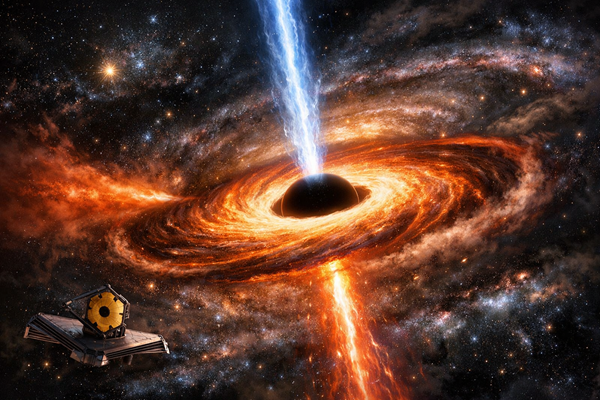
For the first time, astronomers are no longer guessing what happens inside a galaxy’s hidden core. With unprecedented clarity, NASA’s James Webb Space Telescope has peered into the heart of the Circinus Galaxy, revealing how a supermassive black hole is truly fed.
The Webb Telescope Circinus Galaxy observations are changing long-standing assumptions about how Active Galactic Nuclei (AGNs) work, how matter flows toward black holes, and how energy is distributed across galactic centers. What scientists expected to be dominated by violent outflows has instead been shown to be controlled by accretion — material falling inward.
So what does Webb really see when it looks into a galaxy’s deepest shadows? And how does this reshape our understanding of black hole behavior?
Webb Telescope Circinus Galaxy Discovery Reveals the Power of Supermassive Black Holes
At the center of many galaxies sit Supermassive Black Holes (SMBHs). These giants regulate galaxy evolution by powering Active Galactic Nuclei, regions so luminous they can temporarily outshine every star in the galaxy combined.
Until now, models suggested that infrared light around AGNs mainly came from energetic outflows — superheated material blasting away from the black hole. However, the Webb Telescope Circinus Galaxy data tells a different story.
Located about thirteen million light-years away, Circinus hosts a moderately bright SMBH. When Webb examined its core, astronomers discovered that most infrared radiation originates not from matter escaping, but from dust feeding the black hole itself.
Instead of chaos dominating the core, Webb reveals structure, flow, and order — a cosmic system quietly sustaining the monster at its center.
What if black holes grow less violently than we once believed?
How Webb Telescope Circinus Galaxy Observations Break Through Cosmic Dust
Studying AGNs has always been difficult. Their disks shine so intensely that inner galactic structures are blurred. Dense dust clouds hide infalling matter, and bright starlight interferes with measurements.
For decades, astronomers had to rely on indirect modeling. Different wavelengths were assigned to hypothetical regions: accretion disks, dusty tori, and jet outflows. Yet a persistent problem remained — unexplained infrared excess.
The Webb Telescope Circinus Galaxy project finally solves this puzzle.
Using Webb’s Aperture Masking Interferometer on the NIRISS instrument, scientists filtered out starlight and isolated dust emissions with exceptional precision. A special mask containing seven hexagonal openings transformed Webb into a virtual interferometer, combining light waves into interference patterns that reveal fine structure.
In effect, Webb’s six-point-five-meter mirror behaves like a thirteen-meter telescope in resolution.
Suddenly, the galaxy’s hidden core became visible.
What secrets had been hiding behind that veil of dust?
Webb Telescope Circinus Galaxy Data Rewrites Infrared Emission Models
Earlier theories claimed most infrared light near Circinus came from outflows of hot dust. Webb’s observations overturned that assumption.
The new breakdown shows:
Eighty-seven percent of infrared emission comes from dust closest to the black hole.
Less than one percent originates from hot dusty outflows.
Twelve percent comes from dust farther out, previously impossible to isolate.
This means the dominant process is not expulsion — it is accretion.
The Webb Telescope Circinus Galaxy analysis reveals that matter flows inward far more efficiently than expected. Instead of a turbulent blast zone, the heart of Circinus behaves like a cosmic feeding system.
If Circinus behaves this way, how many other galaxies have been misunderstood?
Webb Telescope Circinus Galaxy Imaging Achieves Historic Resolution
These observations represent the first extragalactic infrared interferometry from space. They are also the sharpest images ever taken of a black hole’s immediate environment outside the Milky Way.
By reconstructing the interference patterns, astronomers confirmed the structures were real and not image artifacts.
The result is a map of the galaxy’s nucleus that distinguishes torus dust, accretion flow, and weak outflows individually — something no previous telescope could accomplish.
The Webb Telescope Circinus Galaxy images allow scientists to study how material organizes itself around black holes, rather than assuming violent randomness.
Are we witnessing the true architecture of galactic engines for the first time?
Why Webb Telescope Circinus Galaxy Results Matter for Future Black Hole Studies
Circinus’ black hole is moderately bright, so its emissions are dominated by the torus rather than jets. But brighter black holes may behave differently.
That is why researchers plan to apply the same Webb technique to dozens of nearby galaxies. By building a statistical sample, astronomers can compare accretion mass, dust structure, and outflow power across many environments.
The Webb Telescope Circinus Galaxy project becomes a blueprint for studying black holes across the universe — separating myth from measurable reality.
Future surveys could finally answer:
When do outflows dominate?
When does feeding dominate?
How do black holes regulate star formation over time?
Every new target may rewrite cosmic history.
The Bigger Question Behind Webb Telescope Circinus Galaxy Exploration
The James Webb Space Telescope is not simply taking pictures — it is exposing the mechanisms that shape galaxies themselves.
By peering into Circinus, Webb has shown that black holes may grow more quietly, efficiently, and systematically than our explosive models suggested.
The Webb Telescope Circinus Galaxy discovery forces us to rethink how matter behaves near gravity’s most extreme objects.
If this is what Webb sees in one nearby galaxy, what will it uncover in hundreds more?
And ultimately, when we look into a black hole’s heart…
are we seeing destruction — or creation in progress?
Source: Is the Webb Telescope Changing What We Know About Black Holes Forever?
Are There Seeds of Life in the Depths of Space? A Discovery That Astonished Scientists
Are There Seeds of Life in the Depths of Space? A Discovery That Astonished Scientists