In a first, scientists map complete brain activity during decision-making
Mice moving tiny steering wheels to control shapes on a screen have given scientists an unprecedented view of how decisions unfold across the brain.
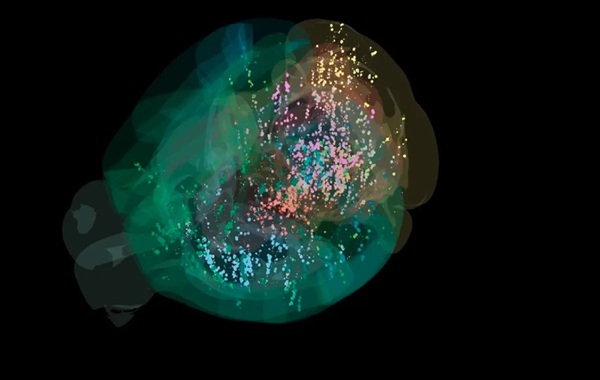
For the first time, researchers have mapped decision-making at single-cell resolution across an entire mammalian brain.
Traditional neuroscience studies have often focused on small clusters of neurons in isolated brain regions.
But “the brain is constantly making decisions during everyday life,” said Ilana Witten, Ph.D., a neuroscience professor at Princeton University.
“We’ve come to realize that there are many brain regions, rather than just one or two, contributing to decision-making.”
A collaborative leap for neuroscience
Witten and her colleagues at the International Brain Laboratory (IBL, a global consortium of 22 labs) used a standardized approach to track neural activity during behavior. By pooling data across labs, they could capture the complexity of decision-making in the brain.
The effort produced datasets covering more than 600,000 neurons across 279 brain regions in 139 mice, offering a comprehensive view of distributed neural networks in action.
Mapping an entire brain is no small feat. Alejandro Pan Vazquez, Ph.D., a contributing author, noted, “This had never been done before. There was a lot of innovation on the organizational side of things to integrate data from different labs. This turned out to be the first time such a large collaboration had ever been done in neuroscience.”
Three Princeton labs—led by Witten, Tatiana Engel, Ph.D., and Jonathan Pillow, Ph.D.—coordinated the effort.
They designed experimental parameters, collected data, and established quality-control metrics and standardized analysis pipelines that allowed the dataset to be combined into a single resource for the scientific community.
Steering wheels and flashing circles
The experimental setup was deceptively simple. Mice faced a screen showing a black-and-white striped circle on either the left or right.
Turning a tiny steering wheel moved the circle toward the center, earning the mouse a sip of sugar water, often within one second. Some circles were faint, forcing mice to rely on past experience, giving researchers a window into expectation-driven decision-making.
Researchers recorded neural activity using high-density electrodes that monitored hundreds of neurons across brain regions simultaneously. Each lab focused on a specific region, and the pooled dataset spanned 620,000 neurons from 139 mice in 12 labs, covering nearly the entire brain.
The map revealed that decision-making activity is widely distributed, including in regions traditionally associated with movement rather than cognition.
“One of the important conclusions of this work is that decision-making is indeed very broadly distributed throughout the brain, including in regions that we formerly thought were not involved,” Witten said.
The findings also serve as a “unique dataset,” Witten added. “They describe what the dataset is composed of, what it looks like, and provide a resource for the field to use for further analyses. We hope these papers inspire others to investigate the data and make new discoveries with it.”
Above all, coordinating 22 labs worldwide highlights the power of large-scale neuroscience. Engel said, “The brain-wide map is undoubtedly an impressive achievement, but it marks a beginning, not the grand finale. The IBL has shown how a global team can push each other beyond comfort zones into uncharted territories no single lab could reach alone.”
The study, published September 3 in Nature, sets a benchmark for testing new theories of decision-making and advancing the field of neuroscience.
Source: Interesting Engineering
Scientists Capture First Footage of Human Embryo Implanting in a Uterus
In a first, scientists map complete brain activity during decision-making