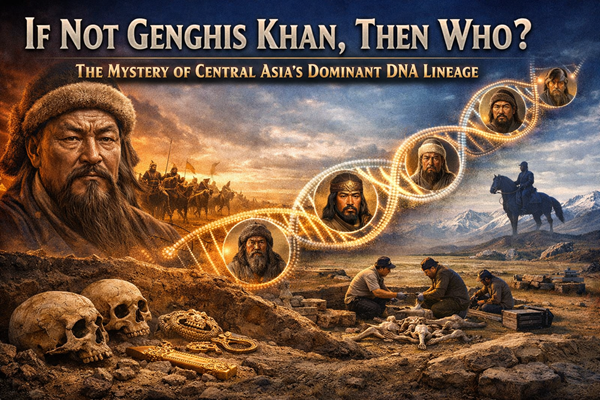
If Not Genghis Khan, Then Who? The Mystery Behind Central Eurasia’s Dominant DNA Lineage
For years, a striking claim has circulated in documentaries, textbooks, and popular media: one in 200 men alive today may be directly descended from Genghis Khan. The statement is compelling. It suggests that a single 13th-century ruler left a genetic imprint stretching across continents.
However, new ancient DNA research from Kazakhstan now urges caution. The genetic story, it seems, is more intricate than previously believed.
Ancient DNA Evidence from the Golden Horde and the Mongolian Genetic Legacy
In present-day Kazakhstan, both folklore and archaeology have long pointed to deep ties with the Mongol Empire. Recently, those traditions were tested through genomic science.
A team of researchers analyzed DNA extracted from four royal tombs attributed to elites of the Golden Horde—the northwestern extension of the Mongol Empire. Their findings were published in the Proceedings of the National Academy of Sciences.
The Golden Horde was founded by Jochi, the eldest son of Genghis Khan. According to local legend, one of the excavated tombs may belong to Jochi himself. Although this attribution cannot yet be confirmed conclusively, genomic analysis has revealed something equally important: the ruling elites buried there traced their ancestry back to the Mongolian plateau.
Thus, ancient DNA has begun illuminating what medieval chronicles could only suggest.
The C3 Y-Chromosome Cluster and the Genghis Khan Genetic Lineage Hypothesis
The genetic focal point of the study is the Y-chromosome haplogroup known as the C3* cluster (now commonly classified within haplogroup C2). Because the Y chromosome passes from father to son, it allows researchers to trace paternal lineages over centuries.
Approximately two decades ago, population geneticists identified a distinctive Y-chromosome lineage widespread across Central Eurasia. It was estimated that about 8% of men in the region—roughly 0.5% of the world’s male population—shared this genetic signature.
Consequently, a hypothesis emerged: this lineage might descend from Genghis Khan or his close male relatives. Given the vast territorial reach of the Mongol Empire and the reproductive advantages enjoyed by imperial elites, the idea seemed plausible. The claim that “one in 200 men” might share his ancestry quickly gained traction.
But was that conclusion premature?
Golden Horde Ruling Elite Genomes Reveal a More Complex Genetic Pattern
The new study complicates the narrative. While researchers did identify a branch of the C3* cluster in the genomes of the Golden Horde elites, it was not the same dominant branch commonly found in modern populations.
This distinction matters. Ancient DNA allows scientists to differentiate between closely related but distinct sub-branches of a haplogroup. The lineage identified in the royal tombs represents a specific branch within the broader C3* cluster. However, it does not correspond exactly to the most prevalent modern lineage previously associated with Genghis Khan.
Therefore, a critical question emerges:
If the Golden Horde elites were direct descendants of Jochi, and if Jochi was the son of Genghis Khan, why does their Y-chromosome lineage not perfectly match the dominant modern branch?
Several possibilities exist:
The popular branch may descend from another influential Mongol lineage.
Multiple elite lineages may have expanded simultaneously.
The “Genghis Khan haplotype” hypothesis may have oversimplified medieval demographic processes.
In short, the genetic landscape of the Mongol Empire appears more diverse than previously assumed.
Was the “One in 200 Men” Claim Overstated? Reassessing the Genetic Evidence
The phrase “one in 200 men” was derived from statistical modeling based on modern DNA frequency patterns. However, modern frequency alone does not prove direct descent from a single historical individual.
Demographic expansion can occur for many reasons:
Political dominance
Social hierarchy
Elite reproductive privilege
Population bottlenecks
Importantly, the Mongol Empire spanned from East Asia to Eastern Europe. Its ruling classes integrated with local populations over generations. Therefore, genetic mixing was inevitable.
Moreover, ancient DNA evidence now shows that at least one elite Golden Horde lineage represents a rarer branch of the C3* cluster. This finding suggests that the dominant modern lineage may not directly correspond to Genghis Khan’s own Y chromosome.
Until his burial site is discovered and genetically tested, certainty remains elusive.
The Missing Piece: Genghis Khan’s Undiscovered Tomb and Genetic Identity
One enduring mystery complicates the debate: the tomb of Genghis Khan has never been conclusively located. Without direct genomic material from his remains, all hypotheses remain inferential.
If his burial were discovered and successfully sequenced, researchers could compare his genome with both ancient elite remains and modern populations. Such a discovery would either validate or overturn the famous claim.
However, even then, interpretation would require caution. Genetic legacy is rarely the product of one man alone. Empires produce networks of related elites, collateral branches, and dynastic expansions.
Thus, another question must be asked:
Was the Mongol genetic footprint the result of a single patriarch—or of a broader aristocratic structure that amplified several lineages simultaneously?
Why Ancient DNA Research Is Transforming Central Eurasian History
Beyond the headline-grabbing claim, this research represents something more profound. Ancient DNA is reshaping our understanding of medieval Eurasia.
Previously, historians relied on chronicles, folklore, and archaeology. Now, genomic data can independently test historical narratives. In this case, the genomes of Golden Horde elites confirm ancestry from the Mongolian plateau. Cultural blending observed in burial practices is mirrored genetically.
Furthermore, collaboration between researchers in Kazakhstan, Japan, and the United States demonstrates how interdisciplinary science is redefining historical inquiry.
As additional medieval remains are sequenced, the genetic map of the Mongol Empire will become clearer. Patterns of migration, integration, and elite dominance may be reconstructed with increasing precision.
Conclusion: Genetic Legacy, Myth, and Scientific Uncertainty
So, are one in 200 men truly related to Genghis Khan?
The honest answer is: we do not yet know.
While earlier studies suggested a dramatic paternal expansion linked to the Mongol Empire, new ancient DNA evidence complicates the picture. The lineage found in Golden Horde ruling elites represents a branch of the C3* cluster—but not necessarily the dominant modern one.
Therefore, the genetic legacy of Genghis Khan remains partly shrouded in uncertainty.
Was the world’s most famous conqueror truly the most genetically successful man in history? Or has modern storytelling amplified a hypothesis that requires further refinement?
Until his own genome is sequenced, the question will continue to provoke debate.
And perhaps that uncertainty is precisely what makes the story so compelling.
Source: If Not Genghis Khan, Then Who? The Mystery Behind Central Eurasia’s Dominant DNA Lineage
Sources
Askapuli, A. et al. (2026). Ancient DNA analysis of Golden Horde elites. Proceedings of the National Academy of Sciences.
Zerjal, T. et al. (2003). The genetic legacy of the Mongols. American Journal of Human Genetics.
Hawks, J. et al. Population genetics research on Central Eurasian Y-chromosome diversity.
Archaeological reports from medieval burial sites in Kazakhstan.