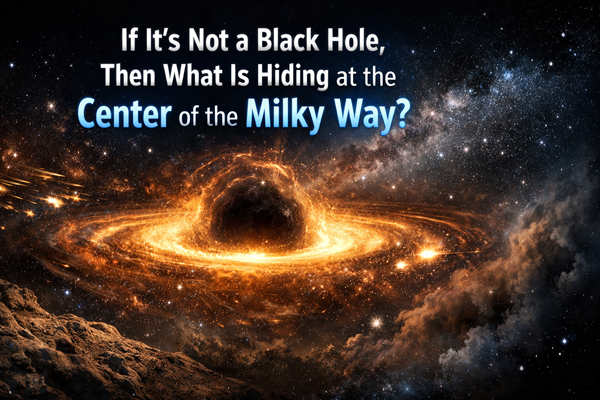
If It’s Not a Black Hole, Then What Is Hiding at the Center of the Milky Way?
For decades, astronomers believed a supermassive black hole sat at the center of the Milky Way. However, new research suggests a far more mysterious possibility. What if the heart of our galaxy is not a black hole at all, but a vast, invisible concentration of dark matter?
According to an international team of scientists, the Milky Way’s gravitational engine may instead be powered by an enormous clump of exotic matter. This unseen substance already makes up most of the universe’s mass. Now, it might also explain both the violent motion of stars near the galactic center and the gentle rotation of matter across the galaxy’s outskirts.
So, could the galaxy’s core be something stranger than we ever imagined?
Rethinking the Milky Way’s Dark Heart and Galactic Center
Traditionally, astronomers point to Sagittarius A star, known as Sgr A*, as the supermassive black hole anchoring our galaxy. Its presence supposedly explains why a group of nearby stars, called S-stars, race around the center at incredible speeds reaching thousands of kilometers per second.
Yet researchers now propose another idea. Instead of a black hole, a special form of fermionic dark matter could occupy the galactic center.
Rather than forming a single point of infinite density, this dark matter would organize into a unique cosmic structure. It would consist of a super-dense inner core surrounded by a vast, diffuse halo. Together, both parts would behave as one gravitational system.
As a result, the compact core could imitate a black hole’s pull. At the same time, the extended halo would influence the motion of matter far beyond the center.
Could one substance truly explain the entire galaxy from edge to core?
Fermionic Dark Matter Model Explaining S-Stars and G-Sources
Unlike ordinary cold dark matter, fermionic particles resist being squeezed infinitely. Because of this property, they naturally create a dense center without collapsing into a singularity.
Consequently, the inner core becomes massive and compact enough to reproduce the observed orbits of the S-stars. These stars circle the galactic center in dramatic, high-speed paths. Nearby, dusty objects called G-sources also follow similar trajectories.
Instead of invoking a black hole, the fermionic dark matter core accounts for these motions through pure gravitational influence.
In other words, what looks like a black hole might actually be an exotic dark structure pretending to be one.
Gaia Mission Data Mapping the Milky Way’s Outer Halo Rotation
Beyond the galactic center, the story continues.
The European Space Agency’s Gaia mission, particularly its third data release, has mapped the Milky Way’s outer halo with unprecedented detail. This massive survey reveals how stars and gas rotate far from the galaxy’s core.
Importantly, Gaia detected a Keplerian decline, meaning the galaxy’s rotation slows with distance from the center. Traditional models struggle to explain this behavior cleanly.
However, when scientists combine normal matter such as the disk and bulge with the fermionic dark matter halo, the rotation curve fits naturally.
Unlike standard cold dark matter halos that stretch outward with long power-law tails, the fermionic model predicts a more compact halo structure. Therefore, the galaxy’s motion appears smoother and more unified from center to edge.
Thus, one model begins to explain the Milky Way as a single, connected system.
Mimicking a Black Hole Shadow with Dark Matter Physics
Perhaps the most fascinating test involves the famous black hole image itself.
Previously, the Event Horizon Telescope captured what appears to be the shadow of Sgr A*. Many assumed this confirmed a black hole beyond doubt. Yet a separate study showed something surprising.
When an accretion disk shines around a dense dark matter core, light bends intensely. As a result, the core casts a shadow-like feature almost identical to a black hole’s image.
The dark matter core produces a central darkness surrounded by a glowing ring. Visually, it mimics the same structure expected from a black hole.
Therefore, the iconic shadow does not necessarily prove a singularity exists.
Instead, gravity alone may be enough to paint the illusion.
So, are we truly seeing a black hole—or just gravity wearing a clever disguise?
Testing Dark Matter vs Black Hole at the Milky Way’s Center
To evaluate their proposal, researchers statistically compared the fermionic dark matter model with the traditional black hole scenario.
At present, data from the central stars cannot yet decisively favor one explanation. Both models still match observations within uncertainties. However, the dark matter approach offers something new: a unified framework linking the galaxy’s core, halo, stellar orbits, and rotation curves.
Future instruments may finally break the tie.
The GRAVITY interferometer on the Very Large Telescope in Chile will deliver sharper measurements. Scientists also plan to search for photon rings. These rings are a unique signature of true black holes and should not appear in dark matter cores.
If those rings remain absent, the dark matter hypothesis gains powerful support.
Could Dark Matter Replace the Milky Way’s Supermassive Black Hole?
The implications reach far beyond our galaxy.
If dark matter can imitate black holes, then many galactic centers across the universe may need reinterpretation. Instead of singularities, they might host exotic quantum structures made from unknown particles.
Rather than replacing a black hole with another object, the scientists propose something deeper:
the central mass and the halo could be two expressions of the same cosmic substance.
So the Milky Way may not be ruled by a monster hole in space, but by a mysterious ocean of dark matter shaping everything from within.
And that leaves us with a final question:
What else in the universe looks familiar, yet hides something far more extraordinary beneath the surface?
Source: If It’s Not a Black Hole, Then What Is Hiding at the Center of the Milky Way?
Did a Student Recreate Life’s Origins in a Bottle? The Hidden Secrets of Artificial Cosmic Dust
Did a Student Recreate Life’s Origins in a Bottle? The Hidden Secrets of Artificial Cosmic Dust
If It’s Not a Black Hole, Then What Is Hiding at the Center of the Milky Way?