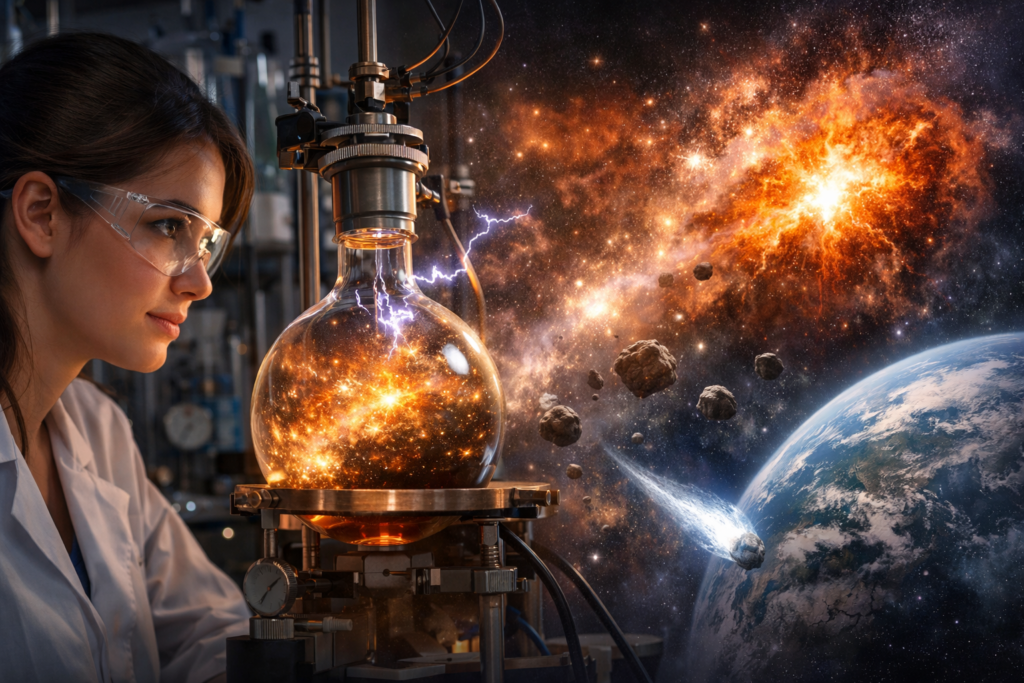
Did a Student Recreate Life’s Origins in a Bottle? The Hidden Secrets of Artificial Cosmic Dust
What if the origins of life did not begin on Earth at all? What if the chemical seeds of biology were forged in exploding stars, drifting through space long before our planet existed?
In Sydney, a Ph.D. student has recreated a tiny piece of the universe inside a laboratory bottle. By making cosmic dust from scratch, her work now sheds new light on how the chemical building blocks of life may have formed in space and eventually reached Earth.
Linda Losurdo, a doctoral researcher in materials and plasma physics at the University of Sydney, used a simple mixture of gases — nitrogen, carbon dioxide, and acetylene — to simulate the violent environments surrounding stars and supernova remnants. Under intense electrical energy, those gases transformed into carbon-rich “cosmic dust,” similar to material floating between stars and trapped inside comets, asteroids, and meteorites.
Her results, published in The Astrophysical Journal, offer a rare look into chemistry that usually happens far beyond our reach.
So, could life’s ingredients really come from the stars?
Lab-Made Cosmic Dust and Interstellar Chemistry
Cosmic dust forms in extreme astrophysical environments where molecules constantly collide with energetic ions and electrons. Normally, scientists can only observe this process from afar. However, Losurdo brought that chemistry into the laboratory.
First, she evacuated glass tubes with a vacuum pump, recreating the near-empty conditions of space. Then she introduced nitrogen, carbon dioxide, and acetylene. After that, the gas mixture was exposed to nearly ten thousand volts of electrical potential for about one hour.
As a result, a glowing plasma discharge formed. Under this energy, molecules shattered and recombined into more complex structures. Eventually, those compounds settled as a thin layer of dust on silicon chips placed inside the tubes. At times, the collected material even sparkled like miniature fragments of the cosmos.
Instead of waiting for asteroids to arrive on Earth, scientists can now reproduce their chemistry directly.
“We can build analog environments in the laboratory and reverse-engineer their structure using infrared fingerprints,” Losurdo explained. “It is like recreating a little piece of the universe inside a bottle.”
CHON Molecules, Organic Chemistry, and the Building Blocks of Life
The dust created in the experiment contains a complex mix of carbon, hydrogen, oxygen, and nitrogen — commonly known as CHON molecules. These elements form the backbone of organic chemistry and nearly every biological structure on Earth.
More importantly, the lab-made dust displayed the same infrared fingerprints astronomers detect in real cosmic dust. That match confirms the process mirrors what happens in space.
Because of this, researchers no longer guess how carbon-rich dust forms. Instead, they can observe the chemistry step by step.
So where does this lead us?
If cosmic dust already carries complex organic structures, then planets like Earth may inherit life’s ingredients before they even form.
Origins of Life on Earth and Cosmic Delivery Systems
One of science’s biggest questions remains unanswered: how did life begin on Earth?
Did organic molecules form locally in Earth’s early oceans? Did they arrive later aboard comets and meteorites? Or were they delivered during the birth of the solar system itself? Most likely, the answer involves all three.
Between roughly three point five and four point five six billion years ago, Earth endured heavy bombardment from meteorites, micrometeorites, and interplanetary dust particles. Many of these objects came from asteroids and comets loaded with organic material.
However, the true origin of that material stayed mysterious.
“Covalently bonded carbon and hydrogen in comet and asteroid material are believed to form in the outer envelopes of stars, in high-energy events like supernovae, and in interstellar environments,” Losurdo said.
Therefore, her work focuses on the specific chemical pathways that combine all CHON elements into the complex structures found in cosmic dust and meteorites.
In other words, she is tracing life’s chemistry back to the stars themselves.
Plasma Physics Experiments That Recreate Space Environments
Losurdo conducted the experiment with her supervisor, Professor David McKenzie. Together, they simulated conditions impossible to visit directly.
By generating plasma inside evacuated tubes, they reproduced the energetic collisions that happen inside stellar nurseries and dying stars. As molecules recombined, they formed the same type of dust astronomers observe across the galaxy.
“By making cosmic dust in the lab, we can explore the intensity of ion impacts and temperatures involved when dust forms in space,” McKenzie explained.
Because of this, scientists can decode what meteorites have experienced across billions of years. Every chemical signature becomes a record of its cosmic journey.
Instead of guessing, researchers can now read that record with precision.
Infrared Fingerprints, Astrophysics, and Mapping Cosmic Chemistry
Cosmic dust reveals itself through infrared radiation — a molecular fingerprint that shows its internal structure.
The dust produced in Losurdo’s laboratory emitted the same signatures seen in space. Consequently, the team plans to build a full database of infrared fingerprints from lab-made cosmic dust.
Astronomers could then scan stellar nurseries and supernova remnants, compare the data, and work backward to understand how cosmic environments evolve.
Eventually, this approach may point scientists toward regions where life-friendly chemistry is already underway.
So instead of asking where life exists, we may soon ask where life is forming right now.
Recreating the Universe to Understand Ourselves
By recreating cosmic chemistry on Earth, this research opens a new window into deep stellar processes — and into humanity’s oldest mystery.
If the building blocks of biology were born in ancient stars, then every living thing carries a piece of cosmic history.
Could life be a natural outcome of stellar evolution?
Did Earth simply inherit a pre-assembled chemical toolkit?
And if so, how common might life be across the universe?
Sometimes, the path to understanding our origins begins not in space — but inside a laboratory bottle glowing with artificial starlight.
Source: Did a Student Recreate Life’s Origins in a Bottle? The Hidden Secrets of Artificial Cosmic Dust
Did Mars Once Have Beaches Like Earth — and Could Life Have Walked Them?
Did Mars Once Have Beaches Like Earth — and Could Life Have Walked Them?
Did a Student Recreate Life’s Origins in a Bottle? The Hidden Secrets of Artificial Cosmic Dust