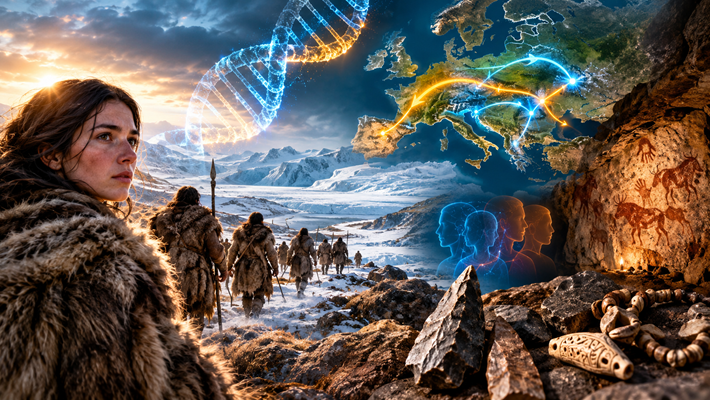
How did Ice Age humans establish connections between the two ends of Europe? Ancient DNA has revealed surprising clues.
Paleolithic Human DNA Reveals a Hidden Network Across Ice Age Europe
More than thirty thousand years ago, Europe was a world of glaciers, vast landscapes, dangerous predators, and small groups of hunter-gatherers struggling to survive. Yet new genetic evidence suggests that these prehistoric communities maintained connections across distances that may have been greater than scientists previously imagined.
An international research team led by the University of Vienna has uncovered evidence of genetic exchange between populations in eastern and western Europe. Published in Science Advances, the study combines genomic data from rare human remains with ancient human DNA recovered directly from cave sediments.
The findings challenge a long-standing assumption about the genetic separation of early European populations. Although archaeological discoveries have suggested that prehistoric groups exchanged materials, technologies, and cultural practices, genetic research had pointed toward relatively distinct eastern and western ancestry groups.
Now, researchers have identified evidence that complicates this picture.
How did people living thousands of kilometres apart encounter one another during an age of extreme climatic instability? Did individuals travel between distant regions, or did successive generations gradually carry genetic connections across Europe?
The evidence cannot yet reconstruct every journey. Nevertheless, it reveals that the social and demographic landscape of Ice Age Europe was more interconnected than a simple division between eastern and western populations would suggest.
The Gravettian Culture: How Did Ice Age Europeans Stay Connected?
The Gravettian culture flourished across substantial parts of Europe approximately thirty-four thousand to twenty-five thousand years ago. It represents an important chapter in the Upper Palaeolithic, when modern humans developed diverse hunting strategies, distinctive stone-tool traditions, and sophisticated artistic practices.
Archaeologists have identified Gravettian-associated sites across several European regions. Their discoveries include stone tools, personal ornaments, carved objects, and other remains that help researchers investigate how prehistoric communities lived.
However, a shared archaeological culture does not necessarily mean that every group belonged to the same biological population. Similar tools and artistic traditions can spread through contact, imitation, exchange, or independent innovation.
Genetics offers another way to investigate these relationships.
By comparing DNA from ancient individuals, scientists can identify patterns of shared ancestry and estimate when populations exchanged genetic material. These analyses provide clues about biological relationships that artefacts alone cannot establish.
The new research is particularly important because the Gravettian world existed during a period of substantial environmental change. Temperatures fluctuated, landscapes shifted, and human groups had to adapt to changing distributions of animals, plants, and habitable areas.
Under such conditions, maintaining contact with other communities may have provided access to partners, information, materials, and alternative territories.
Could these connections have helped populations survive periods of environmental stress? The genetic evidence does not prove a particular survival strategy, but it suggests that prehistoric communities were not simply isolated groups occupying separate corners of the continent.
A Thirty-Thousand-Year-Old Woman from Isturitz Cave Reveals East-West Genetic Exchange
One of the most important discoveries comes from Isturitz Cave in southwestern France. Researchers analysed the remains of a woman who lived approximately thirty thousand years ago.
Her genome provides the oldest genome-wide genetic dataset currently reported for a modern human from southwestern Europe. More importantly, it contains a mixture of ancestry signals that connect her to populations from different parts of Europe.
Most of her ancestry was associated with a western European genetic lineage. However, her genome also contained ancestry related to populations from central and eastern Europe.
Genetic modelling places this gene flow at approximately thirty-two thousand five hundred to thirty-one thousand five hundred years ago.
This finding suggests that the ancestry of people living in southwestern France reflected connections extending beyond their immediate region. The woman’s genetic profile preserves evidence of population interactions that took place before she was born.
But what did those connections look like in everyday life?
She might have belonged to a community whose ancestors had moved across Europe. Alternatively, the genetic pattern could have emerged through several generations of contact between neighbouring or more distant groups. The available evidence does not identify her personal travel history or the exact circumstances through which her ancestors met.
That distinction matters. Genetic ancestry can reveal that populations exchanged genes, but it rarely provides a complete account of the individuals, routes, or social arrangements involved.
Nevertheless, the discovery provides a rare opportunity to connect a specific prehistoric individual with a broader history of human movement.
Did Isturitz Cave Serve as a Meeting Place for Different Gravettian Groups?
The genetic evidence from Isturitz becomes even more intriguing when considered alongside archaeological findings.
Researchers identified a similar signal of eastern-related ancestry in a previously studied individual from Ormesson, France. Together, these observations strengthen the case for connections between populations associated with different parts of Europe.
The researchers also suggest that Isturitz may have served as a meeting place for different groups. Its archaeological record provides a setting in which the movement of people and the exchange of cultural practices can be investigated.
However, the genetic findings alone cannot establish that the cave hosted a particular gathering or seasonal event. Nor can they determine how frequently people met or how far individuals travelled.
Instead, the results support a broader interpretation: populations that appear geographically distant on a modern map may have participated in overlapping social and reproductive networks.
Imagine how different Europe would have looked to these hunter-gatherers. There were no national borders, roads, or permanent political territories in the modern sense. Travel depended on landscapes, weather, available resources, knowledge of routes, and relationships with other communities.
A journey could have taken place over many days or across several generations. Even when individuals remained within familiar territories, marriage and reproduction could connect their descendants to people living elsewhere.
Could the genetic boundaries identified in earlier studies have reflected incomplete sampling rather than genuine isolation? The new findings suggest that researchers must consider this possibility when interpreting the population history of Ice Age Europe.
Ancient Human DNA from Cave Sediment Reveals a Past Without Bones
Human remains are among the most valuable sources of information about prehistoric populations. Yet bones and teeth do not survive equally well in every environment, and many archaeological layers contain no identifiable human skeletons.
This creates a major problem for ancient DNA research. If scientists depend exclusively on skeletal remains, entire periods of human occupation may remain genetically invisible.
Sedimentary ancient DNA offers another route.
People shed biological material into their surroundings through skin cells, bodily fluids, hair, and other sources. Over time, some of this genetic material becomes incorporated into soil or cave sediment. Under favourable conditions, fragments can survive long after the individuals themselves have disappeared.
Researchers can then extract and analyse DNA preserved within archaeological layers.
This technique does not mean that every sediment sample contains usable human DNA. Genetic material can degrade, become contaminated, or mix with DNA from other organisms. Scientists must therefore establish that recovered sequences are authentic, identify their likely biological origin, and interpret them within their archaeological context.
Even with these limitations, sedimentary DNA can reveal information that conventional excavation methods might otherwise miss.
The technique also changes the questions archaeologists can ask. Instead of waiting for a human skeleton to appear, researchers can investigate whether people occupied a location and, where sufficient DNA survives, examine aspects of their genetic ancestry.
What if some of the most important chapters in human history survive not in visible bones or spectacular artefacts, but in the microscopic traces left behind in ancient cave floors?
El Mirón Cave: Twenty-Two-Thousand-Year-Old DNA Traces Human Survival
At El Mirón Cave in Cantabria, northern Spain, researchers recovered enough human nuclear DNA from a sediment layer dating to approximately twenty-two thousand years ago to investigate its genetic ancestry.
Remarkably, the layer yielded useful human genetic information despite the absence of human bones or teeth.
The result demonstrates the potential of sedimentary DNA to recover evidence from periods when conventional human remains are unavailable. It also provides a way to connect an archaeological layer with the ancestry of people associated with that location.
The genetic signal from El Mirón is especially significant because it supports evidence for the persistence of western European ancestry in southwestern Europe during a prolonged period of climatic hardship.
Researchers also analysed genomic data from Chufín Cave in northern Spain. Those results indicate that western European ancestry persisted in the region over thousands of years.
Together, the findings suggest that long-term regional continuity and genetic exchange across considerable distances could occur at the same time.
A population did not necessarily need to disappear whenever new ancestry entered a region. Nor did continued local ancestry mean that communities had remained completely isolated.
Instead, populations could retain substantial genetic continuity while exchanging genes with other groups.
This distinction is essential for understanding prehistoric migration. Human history rarely follows a simple pattern in which one population replaces another entirely or remains unchanged forever.
The Last Glacial Maximum: Was the Iberian Peninsula an Ice Age Refuge?
The El Mirón findings also contribute to the debate over human survival during the Last Glacial Maximum, the coldest phase of the last glacial period.
Around this time, extensive ice sheets covered large areas of northern Europe and North America. Colder and often drier conditions transformed ecosystems, altered the distribution of resources, and placed additional pressure on human communities.
However, the effects were not uniform across the continent. Some southern regions offered environments in which people could continue living, although conditions still varied considerably from place to place.
The Iberian Peninsula, which includes modern Spain and Portugal, has long been considered an important potential refuge for human populations during severe climatic episodes.
The genetic evidence from El Mirón supports the persistence of western European ancestry through the Last Glacial Maximum. This strengthens the case for long-term human survival in southwestern Europe during a challenging environmental period.
Yet the term refuge should not suggest that people occupied a completely safe or unchanging landscape. Communities still had to obtain food, respond to seasonal changes, and navigate local ecological pressures.
Some groups may have moved between territories as conditions changed. Others may have remained in the same broad region while adjusting their movements and subsistence strategies.
The crucial point is that the genetic record preserves evidence of continuity despite major environmental disruption.
How did people maintain their communities while glaciers advanced and resources shifted? The DNA cannot answer every detail, but it helps researchers distinguish population persistence from complete demographic disappearance.
A Prehistoric Mother and Son in Italy Reveal Clues About Reproductive Networks
The study also examines an individual from southern Italy known as Ostuni1b, a male fetus who was most likely the son of the previously studied woman Ostuni1.
Genetic analysis indicates that the father probably belonged to the same broad genetic population as the mother. However, the parents were not closely related.
This finding offers a glimpse into reproductive relationships among prehistoric people. In small populations, where communities may have included relatively few potential partners, close biological relationships could increase the risk of inbreeding.
Reproduction between individuals who were not close relatives could help maintain greater genetic diversity within a community.
Nevertheless, the evidence must be interpreted carefully. One mother-and-son relationship cannot establish a universal marriage system, prove that people followed deliberate rules against inbreeding, or reveal the full structure of their social networks.
The findings instead provide a specific example of reproduction within a population whose members were not all closely related.
This evidence complements the wider picture emerging from the study. Genetic continuity did not require every individual to descend from a small, tightly interconnected family group. Communities could retain a shared ancestry while maintaining reproductive relationships among people with different family histories.
What social customs shaped these relationships? Did people seek partners beyond their immediate communities, or did ordinary patterns of movement and contact naturally create opportunities for reproduction between less closely related individuals?
The available genomes cannot resolve those questions, but future discoveries may provide additional clues.
How Ancient DNA Changes Our Understanding of Prehistoric Migration
The findings highlight an important principle in population genetics: ancestry, migration, and cultural identity are related, but they are not interchangeable.
Archaeological evidence can reveal similarities in tools, ornaments, artistic styles, and settlement practices. Genetic evidence can reveal biological relationships and episodes of gene flow. When scientists combine these independent sources, they can construct a more detailed account of the past.
For example, similar artefacts at distant sites might indicate contact or shared cultural traditions. Genetic similarities can strengthen the case for biological connections, although they do not automatically prove direct contact between the individuals who left those artefacts.
Likewise, genetic differences do not necessarily mean that two groups had no social relationships.
The Isturitz genome demonstrates why this distinction matters. Its mixed ancestry provides evidence of connections that would be difficult to reconstruct from geography or material culture alone.
Sedimentary DNA adds another dimension by allowing researchers to investigate genetic signals even when excavations yield no human skeletons.
Together, these approaches make it possible to examine population history at multiple scales: individual ancestry, regional continuity, and connections extending across large geographical areas.
However, the record remains incomplete. DNA survives unevenly, and the individuals represented in existing datasets cannot capture every population or generation that lived during the Palaeolithic.
As more sites are studied, scientists may discover additional episodes of migration, contact, and population persistence that alter today’s interpretations.
What Researchers Hope to Discover Next About Ice Age Europeans
The research team is now combining sedimentary DNA with advanced proteomic analyses to investigate the early expansion of modern humans across Europe and their interactions with carnivores.
Proteomics examines proteins preserved in biological and archaeological materials. Because proteins can sometimes survive under conditions that destroy much of the DNA, they may provide complementary evidence where organic remains are scarce.
Used alongside archaeology and ancient genomics, these methods could help researchers investigate sites that have yielded few identifiable human remains.
They may also improve our understanding of the relationships between people, animals, and changing environments during the Palaeolithic.
The next challenge is to establish how widely the newly identified genetic patterns were distributed. Did east-west exchange occur across much of Europe, or did it involve particular regions and periods? How frequently did people move between communities? And how did climatic changes influence the routes they followed?
Answering these questions will require additional genomes, better chronological resolution, and careful comparisons between archaeological evidence and genetic models.
The new study does not provide a complete map of Ice Age migration. Instead, it offers a stronger foundation for investigating a continent whose prehistoric inhabitants were more connected than earlier genetic evidence suggested.
Paleolithic Human DNA Reveals a More Connected Europe Than We Imagined
The genetic evidence from Isturitz, Chufín, El Mirón, and southern Italy presents a complex picture of life during the Ice Age.
In southwestern France, a woman’s genome preserves evidence of ancestry connected to western as well as central and eastern European populations. In northern Spain, ancient DNA points to regional continuity, including during the Last Glacial Maximum. In southern Italy, the genetic relationship between a woman and her probable son provides clues about reproduction and relatedness.
Together, these findings reveal that long-distance genetic exchange and local population continuity were not contradictory processes. Both could shape the history of prehistoric Europe.
They also demonstrate the scientific value of sedimentary DNA. Even without bones or teeth, ancient cave deposits can preserve genetic traces that help reconstruct the lives of people who vanished tens of thousands of years ago.
The broader lesson is that Ice Age Europe was not simply a collection of isolated communities separated by cold landscapes. It was a changing human world in which ancestry, movement, and survival were intertwined.
But the most intriguing question remains: How many forgotten encounters between prehistoric communities are still hidden in the DNA preserved beneath our feet, waiting to change our understanding of human history?
Source: How did Ice Age humans establish connections between the two ends of Europe? Ancient DNA has revealed surprising clues.
Atlantis and the Santorini Eruption: Could These Two Mysteries Be Connected?
Atlantis and the Santorini Eruption: Could These Two Mysteries Be Connected?
How did Ice Age humans establish connections between the two ends of Europe? Ancient DNA has revealed surprising clues.
Sources and Further Reading
Primary research
Gelabert, P. et al. Early Gravettian genomic data from Western Europe reveal population movements before the LGM. Science Advances (two thousand twenty-six). DOI: ten point one thousand one hundred twenty-six slash sciadv.aeh6128.
Research and background sources
University of Vienna — Ancient human DNA reveals hidden connections across Ice Age Europe
Courthouse News Service — DNA from French cave suggests Ice Age Europeans were well traveled
University of Vienna — Exploring Mid-Upper Palaeolithic Human Lifeways
How did Ice Age humans establish connections between the two ends of Europe? Ancient DNA has revealed surprising clues.