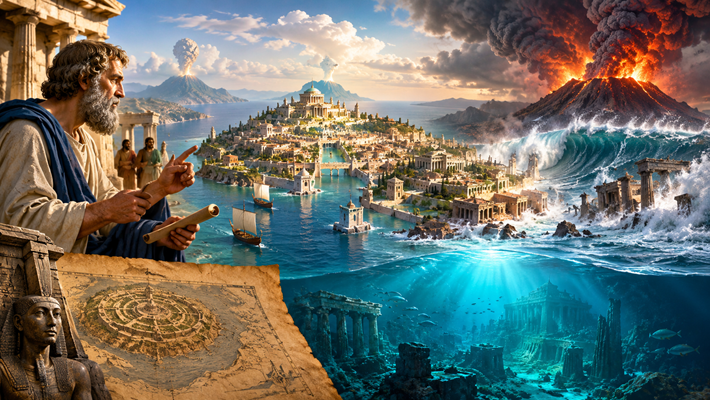
Atlantis and the Santorini Eruption: Could These Two Mysteries Be Connected?
For centuries, the legend of Atlantis has inspired explorers, archaeologists, and conspiracy theorists. But did an advanced civilization really disappear beneath the Atlantic Ocean, or did Plato create one of history’s most enduring mysteries?
Imagine a powerful island civilization with magnificent cities, extraordinary wealth, and a navy capable of challenging entire kingdoms. Then, in a single day and night, earthquakes and floods destroy everything. The land disappears beneath the sea, leaving behind only a story that survives for thousands of years.
This is the legend of Atlantis. Yet behind its dramatic imagery lies a difficult historical question: Was Atlantis a real place, or was it an ingenious philosophical story created by an ancient Greek thinker?
The answer depends on what we mean by real. Archaeologists have discovered civilizations destroyed by volcanic eruptions, earthquakes, tsunamis, and rising seas. Scientists have also established that a catastrophic eruption devastated the Aegean island of Thera during the Bronze Age. Nevertheless, no confirmed archaeological discovery connects these events directly to Atlantis.
The most important evidence comes from the writings of Plato. His dialogues describe Atlantis in remarkable detail, but they provide no independent confirmation that the civilization existed. Modern scholarship generally interprets the story as a philosophical creation, although some researchers have proposed that memories of genuine ancient disasters may have influenced it.
To understand why Atlantis continues to fascinate the world, we must examine the original account, the geological evidence, the civilizations proposed as possible inspirations, and the claims that have emerged over centuries of searching.
What Did Plato Actually Say About Atlantis?
The earliest surviving account of Atlantis appears in two works by Plato: Timaeus and Critias. These dialogues, written in the fourth century BC, remain the principal ancient sources for the legend.
According to the story, the Athenian lawgiver Solon travelled to Egypt, where priests in the city of Sais revealed the history of an ancient civilization. The priests claimed that Atlantis had once possessed extraordinary power and had fought a war against the ancestors of the Athenians.
In Plato’s Timaeus, Critias introduces the account as an unusual story that he insists is true and supported by Solon’s testimony. The Egyptian priest describes an island beyond the Pillars of Heracles, the ancient Greek name generally associated with the Strait of Gibraltar.
The island, according to the account, was larger than Libya and Asia combined. Its inhabitants controlled territories across the Mediterranean and beyond, making Atlantis a formidable maritime power.
Then came the catastrophe.
Plato describes violent earthquakes and floods that destroyed Atlantis. Within a single day and night, the island supposedly sank beneath the sea. Its remains became an impassable expanse of mud, preventing ships from navigating the region.
The story contains many elements that make it feel like a historical report: geographical descriptions, political conflict, a chain of witnesses, and a precise account of destruction. But does detailed storytelling establish historical truth?
Not necessarily. A convincing narrative can resemble history without documenting an actual event.
Why Did Plato Present Atlantis as a True Story?
One of the most intriguing features of the Atlantis narrative is its connection to Plato’s philosophical project.
In Timaeus, Socrates discusses the ideal state and the characteristics of a well-ordered society. Critias then proposes to transform the previously described city from an abstract model into a story about real people confronting a powerful enemy.
Atlantis becomes the opponent of an ancient Athens portrayed as disciplined, courageous, and virtuous. The contrast serves a philosophical purpose: it allows Plato to explore the relationship between political power, moral character, ambition, and decline.
In the narrative, Atlantis begins as a prosperous civilization. Over time, however, its rulers become increasingly dominated by greed and arrogance. Their moral deterioration accompanies their political ambitions, eventually bringing them into conflict with Athens and, ultimately, catastrophe.
This structure raises an important possibility. Perhaps Plato was less interested in preserving the memory of a lost civilization than in illustrating what happens when a powerful society abandons its principles.
The classicist Christopher Gill, in his scholarly study Plato’s Atlantis Story, treats the narrative primarily as philosophical fiction and examines its role within Plato’s broader thought. Other classical scholars have likewise argued that the account should not be read as straightforward historical documentation.
Yet the mystery remains. Why did Plato surround the story with claims of ancient Egyptian records and Solon’s testimony? Was this simply a literary device intended to make the narrative more convincing, or could the story contain fragments of older traditions?
The surviving evidence cannot answer that question conclusively. However, the structure and purpose of the dialogues provide strong reasons to be cautious about treating Atlantis as established history.
The Nine-Thousand-Year Mystery: When Was Atlantis Supposed to Exist?
One of the most striking details in Plato’s account concerns its chronology.
The Egyptian priest supposedly tells Solon that nine thousand years had passed since the ancient conflict between Atlantis and Athens. Solon lived around five hundred and ninety-four BC, when he introduced his famous political reforms in Athens.
If Plato’s chronology is taken literally, the war would have occurred around nine thousand six hundred BC.
That date creates a substantial problem for the search for Atlantis.
Around that time, human communities were undergoing major transformations. Some populations still depended heavily on hunting and gathering, while others were beginning to develop increasingly settled ways of life. Agriculture spread gradually across different regions, and complex urban civilizations emerged much later.
The Bronze Age societies commonly associated with sophisticated palaces, long-distance trade, monumental architecture, and centralized administration developed thousands of years after the date implied by Plato.
Does that make Atlantis impossible?
Not every aspect of an unknown prehistoric society can be reconstructed from surviving evidence. Nevertheless, a vast island empire with the scale, political organization, and maritime power described by Plato should leave substantial archaeological traces.
Researchers would expect to find settlements, tools, distinctive artifacts, trade networks, burials, and other evidence of a complex society. So far, no such evidence has established the existence of Plato’s Atlantis at the proposed location and date.
Some modern theories attempt to resolve the chronological problem by suggesting that Plato exaggerated or altered the numbers. But this introduces another difficulty: once the dates, distances, and geography are modified, how can researchers determine which details preserve historical information and which belong to the story?
Without an independent source, changing the numbers to fit a preferred location risks making the theory impossible to test.
Could the Thera Eruption Be the Real Atlantis Disaster?
Among the proposed explanations for Atlantis, the eruption of Thera, today known as Santorini, stands out because it is based on a genuine geological catastrophe.
During the Late Bronze Age, a massive volcanic eruption devastated Thera in the southern Aegean Sea. The eruption buried settlements beneath volcanic material, reshaped the island, and may have generated tsunamis that affected nearby coastal communities.
Could this disaster have inspired Plato’s account of an island destroyed by earthquakes and floods?
The idea has attracted considerable attention because the broad similarities are compelling. Both stories involve a powerful island setting, catastrophic destruction, and the disappearance of a familiar landscape. Furthermore, the eruption occurred in a region connected to one of the ancient Mediterranean’s most sophisticated Bronze Age cultures.
However, similarities do not establish a historical connection.
What Does Science Tell Us About the Santorini Eruption Date?
For many years, researchers debated when the eruption occurred. Archaeological evidence, Egyptian chronology, radiocarbon measurements, and tree-ring records have produced different constraints on the date.
In two thousand six, Walter Friedrich and colleagues published a study in Science based on an olive tree buried by volcanic deposits. Their radiocarbon analysis placed the eruption between sixteen hundred and twenty-seven BC and sixteen hundred BC, with a reported probability of ninety-five point four percent.
In two thousand eighteen, Charlotte Pearson and colleagues published further research using annual radiocarbon records from tree rings. Their findings supported a date in the sixteenth century BC, although they did not completely exclude an eruption in the late seventeenth century BC.
These studies demonstrate that the eruption was a real event whose timing can be investigated through scientific methods. They do not, however, establish that Atlantis existed.
The chronological gap remains enormous. If Plato’s nine thousand years are taken literally, the Atlantis conflict would predate the Thera eruption by approximately eight thousand years.
Supporters of the connection have therefore proposed that Plato’s numbers were exaggerated by a factor of ten. Under that interpretation, the disaster would move much closer to the Bronze Age.
But there is a critical weakness in this argument. No surviving ancient source independently confirms that Plato’s dates should be divided by ten. The adjustment makes the theory more compatible with the eruption, but compatibility is not proof.
Did the Minoan Civilization Inspire the Atlantis Legend?
The proposed connection becomes more interesting when we consider the Minoan civilization.
Centered on Crete, the Minoans built monumental palace complexes, maintained extensive maritime connections, and developed distinctive art and administrative systems. Their settlements reveal a society closely connected to the sea and to trade across the eastern Mediterranean.
The nearby island of Thera also supported a prosperous Bronze Age community. At Akrotiri, volcanic deposits preserved buildings, streets, and wall paintings that provide an unusually detailed glimpse into life before the eruption.
These discoveries raise an obvious question: could memories of the destruction of Thera and the changing fortunes of Minoan Crete have influenced later Greek stories about a powerful island civilization?
In nineteen thirteen, classical scholar K. T. Frost proposed that Plato’s narrative might preserve a distorted memory of the collapse of Minoan power. Rather than interpreting the catastrophe as an entire continent sinking, Frost suggested that the story could refer to a historical upheaval involving Crete.
He also argued that Plato’s description of an island connected to other islands fit Crete better than a location in the middle of the Atlantic.
Later, the Greek archaeologist Spyridon Marinatos proposed that the Thera eruption had contributed to the decline of Minoan civilization. The Greek seismologist A. G. Galanopoulos subsequently developed a connection between the eruption and Atlantis, arguing that Plato’s numerical descriptions might have been inflated.
This hypothesis offers a possible explanation for some of the story’s dramatic imagery. Yet the historical relationship between the eruption and the wider transformation of Minoan society remains complex. The eruption did not necessarily destroy the entire civilization in one event, and archaeological evidence indicates that Minoan settlements and political structures changed over time.
More importantly, no known ancient document directly identifies the Minoans or Thera as Atlantis.
Consequently, the Minoan hypothesis remains an intriguing possibility rather than an established discovery. It may help explain how memories of real disasters could become part of later storytelling, but it cannot demonstrate that Plato’s island existed as he described it.
Was Atlantis Really Somewhere in the Atlantic Ocean?
Plato places Atlantis beyond the Pillars of Heracles, traditionally associated with the Strait of Gibraltar. This geographical detail has inspired generations of researchers to search the Atlantic Ocean for a submerged island or continent.
Some theories suggest that a large landmass once occupied the region near the Azores and subsequently sank beneath the waves.
The idea is dramatic. An enormous island civilization disappears, the ocean conceals its ruins, and modern explorers must reconstruct its history from scattered clues.
Unfortunately, the geological evidence does not support the existence of a recently submerged Atlantic continent of the kind described in the legend.
Why Geologists Reject the Sunken-Continent Theory
In the early twentieth century, French geologist Pierre Termier suggested that parts of the ocean floor north of the Azores might have undergone substantial subsidence. This proposal encouraged speculation that Atlantis had once occupied the region.
In nineteen seventeen, Yale geologist Charles Schuchert examined the idea. He concluded that the Azores were volcanic islands rather than remnants of a large continental mass that had recently sunk.
Schuchert also found no known geological evidence that established Atlantis’s existence in historical times.
The fundamental issue is that continents do not ordinarily disappear beneath the ocean overnight. Earth’s crust consists of large tectonic plates that move over geological timescales. Although volcanic eruptions, earthquakes, landslides, and changes in sea level can dramatically alter coastlines, the sudden disappearance of a vast continent would require geological evidence on an enormous scale.
Scientists would expect to find recognizable continental crust, appropriate rock formations, sedimentary deposits, and other evidence consistent with the proposed landmass and its history.
No accepted geological findings demonstrate that a continent matching Plato’s description sank beneath the Atlantic during human history.
This does not mean that the ocean floor is fully explored. Many underwater regions remain difficult to investigate in detail. However, an unexplored area is not evidence that a lost civilization lies beneath it.
The scientific verdict is therefore clear: a submerged Atlantic continent that vanished during human history is an unsupported hypothesis, not a credible explanation established by geology.
Could Atlantis Have Been in Southern Spain?
Not every Atlantis theory places the lost civilization beneath the open ocean. Some researchers have instead looked toward the western Mediterranean and the Atlantic coast of southern Europe.
One proposal focuses on Doñana National Park, a landscape of wetlands, marshes, and coastal environments in southwestern Spain.
In two thousand four, researcher Rainer Kühne published a proposal in Antiquity suggesting that features visible in satellite images of the Marisma de Hinojos, within the Doñana region, might be associated with structures described by Plato.
Kühne drew attention to two large rectangular features. One measured approximately two hundred and thirty metres by one hundred and forty metres. He suggested that one might represent the remains of a temple associated with Poseidon, the sea god linked to Atlantis in the ancient narrative.
He also proposed that Plato’s story might refer to the Iron Age culture of Tartessos or an earlier Bronze Age society in the same part of Spain.
The suggestion attracted interest because southwestern Iberia contains evidence of ancient settlements and maritime connections. The location also fits some broad interpretations of Atlantis as a civilization situated near the Atlantic entrance to the Mediterranean.
Nevertheless, satellite imagery alone cannot establish the identity, age, or function of an archaeological feature. Geometric shapes in wetlands may have natural or human-made origins, and their resemblance to a literary description does not prove a connection.
To establish that Doñana was Atlantis, researchers would need securely dated archaeological remains, evidence of a settlement consistent with the proposed society, and a convincing link between the site and Plato’s account.
That connection has not been demonstrated. Doñana remains a proposed location, not a confirmed archaeological identification.
Could the region preserve memories of an ancient coastal civilization? That is a legitimate question for archaeological research. Is there enough evidence to call it Atlantis? Not at present.
The Richat Structure: A Giant Geological Eye Mistaken for Atlantis?
Another popular candidate lies thousands of kilometres away in the Sahara Desert.
The Richat Structure in Mauritania is an enormous circular geological formation with concentric rings that resemble a gigantic eye when viewed from above. Its unusual appearance has made it a favourite subject of online theories about ancient civilizations and lost cities.
Some Atlantis enthusiasts argue that its circular shape resembles Plato’s description of a capital organized around alternating rings of land and water. The apparent geometric pattern seems especially intriguing when viewed in satellite images.
But what does geology reveal?
The Richat Structure is a natural geological formation. Its circular appearance results from the erosion of uplifted rock layers, exposing concentric rings of different geological materials. It is not, on the available evidence, an excavated or submerged city.
Its location also creates difficulties for the Atlantis hypothesis. The structure lies deep within the Sahara, far from the Atlantic coastline. A theory that identifies it as Atlantis must explain not only its resemblance to selected details in Plato’s account but also the enormous geographical and environmental differences.
Most importantly, there is no established archaeological evidence showing that the Richat Structure was once the capital of Plato’s maritime empire.
The theory therefore remains speculative. A remarkable geological formation can inspire compelling images of the past, but visual resemblance cannot substitute for archaeological evidence.
How Do Scientists Distinguish an Ancient Mystery from a Modern Myth?
The enduring appeal of Atlantis reveals a broader challenge in archaeology: how can researchers distinguish a genuine historical memory from a story that has acquired new meanings over centuries?
The answer requires several independent lines of evidence.
First, researchers examine the original texts. What did the author actually say? Which details belong to the narrative, and which can be checked against independent historical records?
Second, archaeologists investigate physical evidence. They look for settlements, artifacts, structures, environmental changes, and securely dated deposits. A proposed lost civilization should leave traces that can be examined and compared with other known societies.
Third, geologists reconstruct the physical environment. They investigate whether the proposed catastrophe could have happened in the location and period suggested by the theory. Volcanic deposits, tsunami sediments, changes in sea level, and tectonic structures can help establish what happened and when.
Finally, researchers compare the independent findings. A strong historical hypothesis should explain the evidence without repeatedly changing dates, distances, or geographical details to make the theory fit.
Atlantis presents a particular challenge because Plato is the only surviving ancient author who supplies the central account. Later writers discussed the story, but their references do not provide independent contemporary confirmation of the civilization.
That distinction matters. Repeating an ancient claim does not automatically create a second independent source.
Similarly, discovering a real disaster does not establish that it inspired a particular legend. Researchers must demonstrate a plausible historical connection rather than assume one because the two stories share similarities.
Could an oral tradition preserve memories of an eruption or a vanished coastal settlement for centuries? Yes, that is possible in principle. But possibility alone cannot tell us whether it happened in this case.
What About the Missing Archaeological Evidence?
One of the strongest arguments against accepting Atlantis as a real empire is the absence of archaeological evidence that matches Plato’s description.
The claim is not simply that an ancient village has yet to be discovered. Plato describes a powerful society with extensive territories, maritime strength, monumental architecture, and a dramatic military conflict.
Such a society would be expected to leave multiple kinds of evidence.
Researchers might find settlements of different sizes, imported goods, distinctive pottery, weapons, administrative records, monumental buildings, or traces of trade routes. If the civilization disappeared in a major catastrophe, geological deposits or submerged landscapes might preserve additional clues.
Of course, preservation is uneven. Rising sea levels have submerged ancient coastlines, erosion has destroyed settlements, and many archaeological sites remain undiscovered. The absence of a particular artifact cannot prove that no related society ever existed.
However, the larger and more complex the proposed civilization, the more evidence researchers would reasonably expect it to leave behind.
At present, no accepted archaeological discovery establishes an Atlantic island empire that corresponds to Plato’s Atlantis.
This is why researchers must distinguish between two very different statements: Atlantis has not been found and Atlantis definitely never existed in any form. The first accurately describes the evidence. The second goes further than the evidence can establish.
The possibility that Plato’s story contains transformed memories of real places or disasters remains open. The existence of the civilization as described, however, remains unverified.
Why Has the Search for Atlantis Never Ended?
Atlantis offers something that few historical mysteries can match: a dramatic disappearance, a powerful civilization, a catastrophic ending, and the possibility that an extraordinary discovery could overturn our understanding of the past.
The story also appeals to a familiar human instinct. We know that civilizations rise and fall, coastlines change, and natural disasters can erase settlements. It is tempting to imagine that another great society once existed and vanished before its achievements could be recorded.
Moreover, the ocean itself provides an ideal setting for speculation. Much of the seafloor is difficult to study at high resolution, and underwater archaeology continues to reveal sites that were once dry land. These genuine discoveries encourage the idea that other lost places may await discovery.
Yet there is a difference between recognizing that the archaeological record is incomplete and claiming that a specific lost civilization must exist.
Atlantis has also accumulated centuries of interpretations, each reflecting the interests and assumptions of its own time. Some writers have treated it as a warning about political corruption. Others have searched for it in geological formations, ancient cultures, or supposed traces of advanced prehistoric technology.
The more a story is repeated, the easier it becomes to mistake familiarity for evidence.
Perhaps the most productive way to approach Atlantis is not to ask only where the city lies, but to investigate why Plato created such a compelling account and why later generations have remained determined to find it.
What does our fascination with Atlantis reveal about our relationship with history? And why are we sometimes more attracted to the possibility of a lost civilization than to the complex evidence left by civilizations we already know existed?
These questions are just as important as the search for a geographical location.
Final Verdict: Was Atlantis a Real Place?
The evidence supports different conclusions depending on the claim being examined.
Atlantis existed exactly as Plato described it.
Unverified
No confirmed archaeological evidence or independent ancient source establishes the existence of the civilization described in the dialogues.
Atlantis was a philosophical creation by Plato.
Mainstream scholarly interpretation
Many classicists interpret the narrative as philosophical fiction designed to explore political virtue, ambition, and the decline of powerful societies. Although this interpretation is influential, Plato’s precise intentions remain a matter of scholarly analysis.
The Thera eruption inspired the Atlantis legend.
Unverified
The eruption is established, but no surviving evidence directly connects it to Plato’s story.
A continent sank beneath the Atlantic during human history.
Unsupported
Geology provides no credible evidence for a recently submerged continent matching Plato’s account.
Doñana or the Richat Structure is Atlantis.
Unverified / speculative
Neither location has yielded the archaeological evidence needed to establish the identification.
The distinction is crucial: the legend of Atlantis is real, but the existence of the civilization described in it has not been demonstrated.
The Santorini eruption proves that the ancient Mediterranean experienced devastating volcanic events. Minoan archaeology demonstrates that sophisticated maritime societies existed long before classical Greece. Geological research also confirms that coastlines and islands can change dramatically over time.
Nevertheless, none of these findings proves that an advanced Atlantic civilization vanished in a single day.
For now, the most defensible conclusion is that Atlantis remains an unverified historical claim and that Plato’s philosophical creation offers the strongest explanation for the story as we know it.
But one question continues to haunt the mystery: Did Plato invent Atlantis entirely, or did he transform an older memory of a real catastrophe into a story that would outlive the civilizations that inspired it?
The evidence cannot yet settle that question. And until independent archaeological or textual evidence emerges, the boundary between ancient memory and philosophical invention remains the most intriguing part of the Atlantis mystery.
Source: Atlantis and the Santorini Eruption: Could These Two Mysteries Be Connected?
A 1000-Year-Old DNA Mystery Links Hawaii and Easter Island and Reveals Hidden Genetic Dangers
A 1000-Year-Old DNA Mystery Links Hawaii and Easter Island and Reveals Hidden Genetic Dangers
Sources and Further Reading
The following scholarly works and scientific studies provide a foundation for evaluating the claims discussed in this article.
– Plato, Timaeus and Critias. The primary ancient texts containing the Atlantis narrative. Read the public-domain translations through Project Gutenberg.
– Christopher Gill, Plato’s Atlantis Story: Text, Translation and Commentary. Liverpool University Press, published in two thousand seventeen. A detailed scholarly analysis of the dialogues, their philosophical meaning, and the interpretation of Atlantis as fiction. Read the academic overview.
Oxford Academic
+1
– Alan Cameron, “Crantor and Posidonius on Atlantis.” The Classical Quarterly, nineteen eighty-three. Examines ancient interpretations of the Atlantis tradition and the evidence for its transmission. Read the scholarly article.
Cambridge Core
– Walter L. Friedrich and colleagues, “Santorini Eruption Radiocarbon Dated to Sixteen Twenty-Seven to Sixteen Hundred BC.” Science, two thousand six. Scientific research using radiocarbon analysis to constrain the date of the Thera eruption. Read the study record.
PubMed
– Charlotte L. Pearson and colleagues, “Annual Radiocarbon Record Indicates Sixteenth-Century BC Date for the Thera Eruption.” Science Advances, two thousand eighteen. Investigates the eruption’s chronology using annual radiocarbon records. Read the study.
PubMed
– Rainer Kühne, “A Location for ‘Atlantis’?” Antiquity Project Gallery, two thousand four. Presents the proposed connection between Plato’s account and features in southwestern Spain. This is a hypothesis, not a confirmed identification.
The evidence-based approach is straightforward: distinguish primary sources from later interpretations, treat scientific dates as evidence for specific events rather than proof of an entire legend, and require archaeological confirmation before identifying any site as Atlantis.