Hacking the Fabric of Reality: Scientists Propose Using Lasers to Control Gravity
In a bold move that sounds like science fiction, physicists have unveiled a blueprint to manipulate gravitational waves using light. This breakthrough could finally bridge the gap between Einstein’s relativity and the mysterious world of quantum mechanics.
For years, we have been passive observers of the universe’s most violent events, detecting the faint ripples in spacetime known as gravitational waves. But a groundbreaking new proposal from researchers at HZDR suggests we are about to become active participants. The study outlines a method to use high-intensity lasers to “touch” and influence gravity itself, marking the first step toward a new era of “Active Gravitational Engineering.”
Bending the Unbendable
Gravity is the most dominant yet elusive force in the cosmos. Until now, the idea of human-made tools affecting gravitational waves was considered nearly impossible. However, the new research suggests that by transferring minute amounts of energy between photons (light) and gravitons (hypothetical particles of gravity), we can leave a detectable “fingerprint” on the fabric of spacetime.
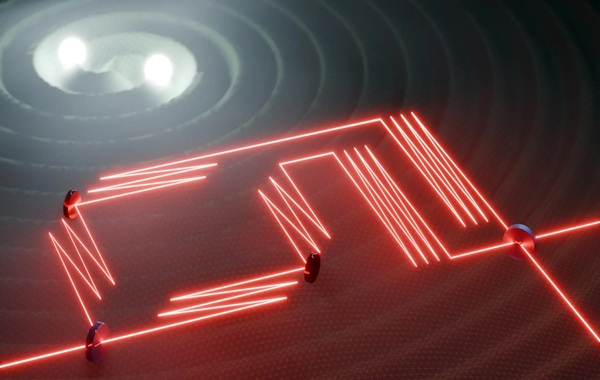
Using advanced interferometry—similar to the technology used by LIGO—scientists believe they can stimulate the absorption and emission of gravitational energy. This would allow us to study gravity not just as a background force, but as a dynamic medium we can interact with.
The Quest for the “Theory of Everything”
Why is this a game-changer? The biggest “holy grail” in modern physics is finding a way to make General Relativity (the law of the very large) talk to Quantum Mechanics (the law of the very small).
Quantum Gravity Discovered: By manipulating these waves, we may finally see “quantum signatures” in gravity, proving that it follows quantum laws.
New Communication Frontiers: If we can control gravitational waves, we could theoretically develop communication systems that pass through any matter—including entire planets—without losing a single bit of data.
Deep Space Exploration: This technology could lead to sensors so sensitive they can “see” through the opaque moments of the early universe, just seconds after the Big Bang.
A New Era of Physics
We are standing at a threshold. Just as the 20th century was defined by our mastery of electromagnetism, the 21st century may be defined by our mastery of spacetime. We are no longer just watching the cosmic symphony; we are learning how to conduct the orchestra.
Source: science daily
Galactic Cannibalism: How the Milky Way is Shredding Cosmic Clusters Into ‘Star Rivers’
Hacking the Fabric of Reality: Scientists Propose Using Lasers to Control Gravity