Galactic Collision May Have Reset the Milky Way Eleven Billion Years Ago… But What Did We Lose in the Cosmic Chaos?
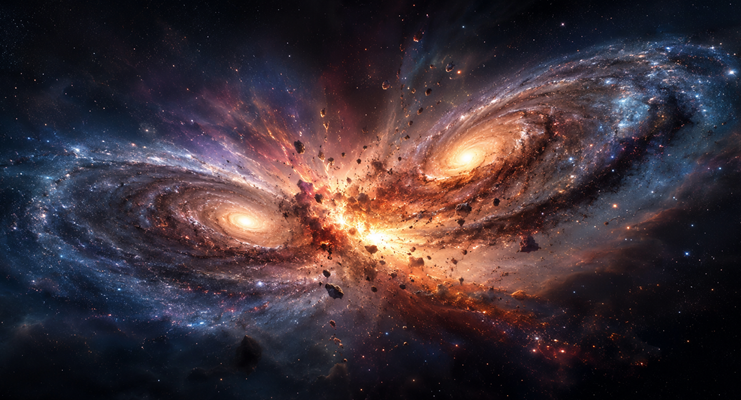
For decades, astronomers believed the Milky Way evolved in a relatively calm and gradual way. However, new research now paints a far more violent picture of our galaxy’s past. According to a study led by researchers from the Institute of Cosmos Sciences of the University of Barcelona and the Institute of Space Studies of Catalonia, the Milky Way may have suffered a catastrophic galactic collision nearly eleven billion years ago.
But here is the unsettling question that continues to echo through the scientific community: if our galaxy was nearly destroyed once before, what exactly vanished during that ancient cosmic disaster?
The findings, published in the journal Monthly Notices of the Royal Astronomical Society, suggest that the Milky Way’s original stellar disk may have been partially — or even completely — erased during a massive collision with another galaxy. If true, humanity may currently live inside a rebuilt version of the Milky Way rather than its original structure.
Could the galaxy we call home actually be the result of a cosmic rebirth?
Milky Way Galactic Collision May Have Reset the Entire Structure of Our Galaxy
The Milky Way’s disk is enormous. It stretches across hundreds of thousands of light-years and contains most of the galaxy’s stars, including our own Sun. Seen from afar, the disk resembles a rotating cosmic pancake filled with glowing spiral arms. Every second, this colossal structure spins through space at speeds exceeding two hundred twenty kilometers per second.
For years, scientists attempted to determine when this rotating disk first formed. To answer that question, astronomers studied the ages and motions of stars scattered across the galaxy. Eventually, researchers realized something extraordinary: at a certain point in the distant past, stars began moving together in a coherent rotational pattern.
This moment became known as the Milky Way’s “spin-up” phase.
At first, many researchers assumed this marked the birth of the galaxy’s disk itself. Yet the new simulations suggest something much more dramatic happened.
The Milky Way may have formed an early rotating disk long before the currently accepted timeline. Then, after a devastating collision with another galaxy, much of that ancient structure could have been destroyed.
In other words, the Milky Way may have started over.
That possibility changes the entire narrative surrounding our galaxy’s evolution. Instead of a smooth history of gradual growth, the Milky Way may have endured repeated phases of destruction and recovery — cosmic cycles resembling galactic extinction events.
Gaia-Sausage-Enceladus Merger Changed Everything Scientists Believed
The breakthrough traces back to observations made by Gaia mission in two thousand eighteen. Astronomers discovered a strange population of stars moving through the Milky Way with unusual trajectories. These stars behaved differently from the rest of the galaxy.
Their motions suggested they originated from another galaxy entirely.
Scientists eventually concluded that the Milky Way collided with a smaller galaxy billions of years ago. That ancient intruder became known as the Gaia-Sausage-Enceladus merger, often shortened to GSE.
Although researchers already suspected the collision happened roughly ten billion years ago, the new study pushes the timeline even further back. Using advanced Auriga simulations of Milky Way–like galaxies, researchers now estimate the collision likely occurred around eleven billion years ago.
That difference may seem small on human timescales. Yet in galactic evolution, it changes everything.
If the collision occurred earlier than expected, then the Milky Way’s present disk may represent a second-generation structure that formed after the galaxy recovered from near destruction.
Could traces of the original Milky Way still exist somewhere deep within the galactic halo? Or were entire stellar populations permanently erased during the impact?
Those questions continue to haunt astronomers.
Ancient Galactic Collision Triggered a Firestorm of Star Formation
The study also uncovered another fascinating clue. Around the same time as the proposed collision, astronomers observed a dramatic increase in the formation of globular star clusters throughout the Milky Way.
This timing may not be a coincidence.
When galaxies collide, massive clouds of gas become compressed under extreme gravitational forces. As a result, enormous waves of star formation erupt across the galaxy. Scientists often compare these events to cosmic fireworks because entire regions suddenly ignite with newborn stars.
According to co-author Chervin F. P. Laporte, the Gaia-Sausage-Enceladus merger likely triggered exactly this kind of galactic firestorm.
For the first time, researchers connected the formation of ancient globular clusters directly to the aftermath of the collision. That connection strengthens the argument that the merger fundamentally reshaped the Milky Way’s structure.
Yet another unsettling question emerges from this discovery.
If the collision created waves of new stars, how many older stars vanished beforehand?
Could entire ancient star systems have been swallowed, scattered, or gravitationally torn apart during the chaos?
Scientists still do not know.
Did the Milky Way Lose Entire Stellar Civilizations During the Cosmic Chaos?
Although the study focuses on galactic structure rather than extraterrestrial life, the implications inevitably spark larger philosophical questions.
If planets and star systems existed in the Milky Way before the collision, what happened to them?
Galactic mergers unleash unimaginable gravitational violence. Stars are displaced. Planetary systems become unstable. Interstellar gas clouds collapse violently. Entire regions of space can transform forever.
If intelligent civilizations existed somewhere inside those ancient structures, could the collision have erased them long before humanity appeared on Earth?
No evidence currently supports that idea. Nevertheless, the sheer scale of the event invites speculation.
After all, humanity tends to view the Milky Way as stable and eternal. Yet this research suggests our galaxy may have survived repeated catastrophic transformations over billions of years.
Perhaps the night sky we see today represents only the latest chapter of a much older and more turbulent cosmic story.
James Webb Space Telescope and ALMA Are Revealing Galactic Evolution in Real Time
Because scientists cannot directly travel back in time to observe the Milky Way’s early years, astronomers rely on distant galaxies as cosmic time machines. The farther researchers look into space, the further back in time they see.
New observations from the James Webb Space Telescope and Atacama Large Millimeter/submillimeter Array are now allowing scientists to study young galaxies undergoing violent mergers across the universe.
These observations provide crucial real-world comparisons for the simulations used in the study.
Interestingly, many distant galaxies observed by JWST already appear surprisingly mature despite existing shortly after the Big Bang. Some researchers now wonder whether galactic collisions played a major role in accelerating their growth.
Could violent mergers actually be responsible for shaping most large galaxies in the universe?
And if galactic destruction is part of normal cosmic evolution, could the Milky Way experience another major collision in the distant future?
Scientists already know the answer to that final question.
Several billion years from now, the Milky Way is expected to collide with the Andromeda Galaxy. When that happens, both galaxies will transform forever.
The universe, it seems, never stops rebuilding itself through chaos.
Milky Way Galactic Collision Research Is Rewriting Humanity’s Place in Cosmic History
Lead author Matthew D. A. Orkney emphasized that understanding galactic structure and ancient collisions together is essential for reconstructing the true history of the Milky Way.
That statement carries enormous significance.
For generations, humanity imagined galaxies as stable islands floating quietly through space. However, modern astronomy increasingly reveals a universe shaped by violence, collisions, destruction, and rebirth.
The Milky Way itself may be living proof.
Eleven billion years ago, a galactic collision may have shattered the original structure of our galaxy. The stars above Earth today could therefore belong to a reconstructed cosmic survivor — a galaxy reborn from catastrophe.
Yet perhaps the most haunting mystery remains unanswered.
If something existed in the Milky Way before that collision, would any trace of it still remain today? Or did the cosmic chaos erase an entire forgotten chapter of galactic history forever?
Source: Galactic Collision May Have Reset the Milky Way Eleven Billion Years Ago… But What Did We Lose in the Cosmic Chaos?