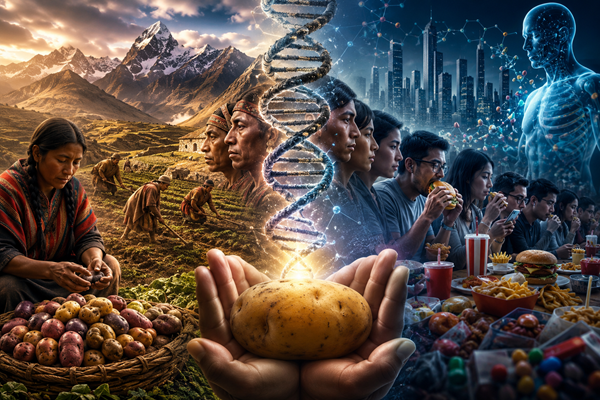
Could a food we ate thousands of years ago still be shaping our genes today… Is human evolution continuing on our dinner tables?
For thousands of years, humanity has climbed mountains, crossed deserts, and survived climates that seemed impossible to endure. Yet evolution never truly stopped walking beside us. Even now, hidden deep within our DNA, the human body continues to adapt in ways that often go unnoticed.
A new scientific study has revealed something astonishing in the high Andes Mountains of South America. Indigenous Andean populations, especially the Quechua people of Peru, may have evolved an extraordinary digestive advantage linked directly to one humble food: the potato.
But how could a simple crop alter the biology of an entire population? And if food can reshape our genes, what other silent changes might still be unfolding inside humanity today?
Andes Evolution and Potato Digestion: Could Food Quietly Rewrite Human DNA?
For decades, scientists studying human evolution focused heavily on dramatic environmental pressures. Thin oxygen levels, deadly cold, and harsh ultraviolet radiation dominated the discussion. The Andes Mountains became one of the world’s greatest natural laboratories for understanding these adaptations.
Researchers already knew that Indigenous Andean populations evolved unique biological traits that help them survive at extreme altitudes where oxygen levels remain dangerously low. However, scientists now believe another evolutionary pressure was working quietly in the background for thousands of years: diet.
Anthropologist Abigail Bigham explained that the Andes are not only important for studying adaptation to low oxygen but also for understanding how food itself can influence human evolution.
This idea transforms an everyday act into something profound. Every meal humans consume may leave a biological fingerprint across generations.
The AMY1 Gene and Human Starch Digestion: Why Do Some People Digest Potatoes Better?
At the center of this discovery lies a remarkable gene known as AMY1.
This gene controls the production of salivary amylase, an enzyme that begins breaking down starch the moment food enters the mouth. Before food even reaches the stomach, the body has already started extracting energy.
Most humans carry between two and twenty copies of the AMY1 gene in each diploid cell. Globally, the average person carries around seven copies. Yet the new study found something extraordinary among Indigenous Quechua populations in Peru.
After examining the genomes of three thousand seven hundred twenty-three individuals from eighty-five populations worldwide, researchers discovered that Quechua individuals carry a median of ten copies of the AMY1 gene.
That difference may sound small. Evolution, however, rarely moves through dramatic leaps. Instead, it advances through tiny advantages repeated over thousands of years.
Evolutionary anthropologist Omer Gokcumen described the evidence as unusually powerful. Scientists have long suspected that human groups adapt genetically to their diets, yet few examples appear this clear.
Could this mean that potatoes helped shape survival itself in the Andes?
Potato Domestication in the Andes: Did Ancient Farming Trigger Genetic Selection?
The timeline makes the discovery even more fascinating.
Researchers used advanced genetic dating techniques to trace when the increase in AMY1 gene copies began. Their findings suggest the expansion started roughly ten thousand years ago.
That timing aligns almost perfectly with the rise of potato domestication in the Andes.
Long before potatoes spread across Europe or the rest of the world, Indigenous Andean communities cultivated them high in the mountains. Potatoes became more than food. They became civilization fuel. Entire societies depended on them for survival.
As generations passed, individuals whose bodies processed starch more efficiently may have possessed subtle advantages. They may have absorbed nutrients faster, stored energy more effectively, or survived periods of scarcity with greater resilience.
Over centuries, those advantages accumulated.
Scientists estimate that higher AMY1 copy numbers provided roughly a one-point-twenty-four percent reproductive or survival advantage per generation. That tiny edge, repeated over millennia, may have reshaped the population’s biology.
Evolutionary geneticist Luane Landau explained that the comparison with other Indigenous populations strengthens the argument dramatically. Populations descended from the Maya, who lacked the same long history of potato agriculture, did not develop similar AMY1 expansions.
The parallel feels almost impossible to ignore.
Human Evolution Through Diet: Is the Modern World Still Changing Our Bodies?
This discovery forces scientists to confront a deeper question.
If potatoes influenced human genetics within a relatively short evolutionary timeframe, what might modern diets be doing to humanity right now?
For years, debates surrounding the so-called “paleo diet” argued that humans remain genetically trapped in ancient nutritional patterns. Yet this new evidence suggests the opposite may also be true. Human biology may adapt faster than previously believed.
The modern world continuously exposes humanity to new foods, artificial additives, processed sugars, and radically altered lifestyles. Unlike ancient agricultural transitions, however, today’s dietary revolution unfolds at breathtaking speed.
Could future humans evolve different digestive systems because of industrial food production? Could urban lifestyles silently reshape metabolism, immunity, or even cognition?
The Andes study does not answer these questions directly. Nevertheless, it opens the door to possibilities that feel both exciting and unsettling.
The Strange Relationship Between Technology and Human Evolution
The research also touches a larger philosophical debate emerging in modern science.
Some scientists argue that technology has become the dominant force guiding human evolution. Medicine, agriculture, genetic engineering, and artificial intelligence increasingly shape survival in ways nature once controlled alone.
In this context, the potato becomes more than food. It becomes technology.
Agriculture transformed human civilization. Farming altered migration patterns, population growth, disease exposure, and nutritional systems. Over thousands of years, those changes began sculpting human DNA itself.
Human evolution may no longer depend solely on mountains, predators, or climate. Instead, it may increasingly depend on the tools and systems humanity creates.
The question becomes hauntingly beautiful:
Are humans still adapting to nature… or are we now adapting to ourselves?
Andes Genetic Adaptation and Human Survival: What Does This Discovery Really Mean?
The story unfolding in the Andes reveals evolution not as a distant prehistoric force, but as a living process unfolding quietly inside every generation.
Evolution does not build suddenly like a skyscraper. Instead, as researchers described, it chisels patiently like a sculptor shaping stone across immense stretches of time.
A single crop. A mountain civilization. Thousands of years of survival.
Together, they may have rewritten part of the human genome.
And perhaps the most unsettling realization is this: if humanity can evolve around something as ordinary as a potato, then countless invisible evolutionary changes may already be happening around us now.
What future abilities are emerging silently inside the human species today?
What traits will survive the next thousand years?
And what parts of ourselves are already disappearing without us noticing?
Source: Could a food we ate thousands of years ago still be shaping our genes today… Is human evolution continuing on our dinner tables?
Did an Unknown Civilization Shape Mount Roraima… or Did Nature Create Something Impossible?
Did an Unknown Civilization Shape Mount Roraima… or Did Nature Create Something Impossible?
Could a food we ate thousands of years ago still be shaping our genes today… Is human evolution continuing on our dinner tables?
Sources
ScienceAlert
University at Buffalo
University of California, Los Angeles (UCLA)
Nature